Best Fish Finder for Kansas Reservoirs
It's incredibly frustrating, isn't it? You head out to one of Kansas's sprawling reservoirs like Milford, Cheney, or Wilson, full of optimism, only to spend hours seemingly fishing an empty bathtub. These vast bodies of water can feel overwhelmingly huge, making it nearly impossible to pinpoint where the fish are hiding. This guide is here to cut through that frustration, helping you understand how the right fish finder can transform your Kansas fishing trips from a guessing game into a strategic hunt, putting you on more fish, more often.
Why a Fish Finder is a Game Changer for Kansas Reservoirs
Fishing in Kansas often means tackling massive reservoirs, many of which were built for flood control and municipal water, not necessarily with angler convenience in mind. They can be incredibly deep, cover thousands of acres, and feature complex, submerged topography that's impossible to see from the surface. This is precisely where a good fish finder stops being a luxury and becomes an absolute necessity.
Understanding the Vastness of Kansas Waters
Think about a lake like Milford Lake, the largest in Kansas, or even Cheney Reservoir with its expansive, open water. From the deck of your boat, it can feel like you're floating over an endless, featureless abyss. You might know there are fish there – you've seen the reports, heard the stories – but actually finding them is another matter entirely. Are they suspended in the middle of the lake? Are they hugging a subtle channel swing twenty feet down? Without some form of electronic eyes, it's like trying to find a needle in a haystac k while blindfolded. A fish finder provides those crucial "eyes," giving you a window into the underwater world.
The sheer size and often-murky conditions of many Kansas reservoirs mean that visual cues are rarely enough. You can't just spot a weed line or a rock pile in clear, shallow water. Instead, you're dealing with submerged creek beds, old roadbeds, brush piles placed by wildlife and parks, and vast areas of open water where fish might be chasing bait. A fish finder helps you dissect these immense aquatic landscapes, reducing the "fishing blind" feeling significantly. It allows you to systematically search areas that would otherwise be passed over, giving you confidence in your location and the structure beneath.
Beyond Just "Seeing" Fish – The Information Advantage
Many anglers think of a fish finder simply as a device that shows little fish icons on a screen. While it certainly does that, its true power lies in the wealth of information it provides beyond just the presence of fish. A modern fish finder is a sophisticated mapping and sonar unit that tells you critical details like water depth, bottom composition (is it hard rock, soft mud, or gravel?), water temperature at different depths, and the presence of submerged structure like trees, brush piles, or ledges.
This comprehensive data is what truly helps you "pattern" fish. For example, if you're targeting walleye, you might learn they are consistently holding on rocky points in 20 feet of water where the temperature is 60 degrees. With this information, you can quickly move to other similar spots on the lake, rather than blindly drifting. It allows you to understand why fish are where they are, rather than just that they are there. This analytical approach, powered by your fish finder, leads to more consistent success and a deeper understanding of the fishery you're tackling. You'll stop just fishing for fish and start fishing to specific fish habitats.
Key Features to Look for in a Kansas Reservoir Fish Finder
When you're trying to navigate the sometimes overwhelming options available in fish finders, it's easy to get lost in the jargon. But for Kansas reservoirs, certain features stand out as absolutely essential for maximizing your success. Focusing on these will help you choose a unit that truly performs.
Transducer Technology and Beam Angles
The transducer is the heart of your fish finder, sending and receiving the sonar signals. The technology packed into it and the beam angles it projects are paramount, especially when covering large expanses of water. Traditional 2D sonar uses conical beams, but modern units offer so much more. Down Imaging and Side Imaging, for instance, use very thin, fan-shaped beams that provide incredibly detailed, almost photographic views of what's directly below or to the sides of your boat. For those massive, featureless-looking reservoir bottoms, Side Imaging can be a true game-changer, allowing you to scan vast areas quickly for submerged creek channels, brush piles, or rock formations.
Moreover, understanding CHIRP sonar is crucial. Instead of sending a single frequency, CHIRP sends a range of frequencies, resulting in much clearer target separation and less clutter on your screen. This means you can distinguish individual fish from bait balls, or even a fish from a submerged branch. When you're trying to locate crappie suspended in a brush pile, that distinction is everything. Different beam angles are designed for different purposes: wider beams for searching large areas, narrower beams for more precise detail directly underneath. Consider what kind of fishing you do most often on Kansas waters and choose a transducer that matches.
Display Size and Resolution
Imagine trying to read a blurry, postage-stamp-sized screen on a bright Kansas summer day, with the sun glaring down. Not fun, right? This is why display size and resolution are non-negotiable features for a good reservoir fish finder. A larger screen (think 7 inches or more) provides ample space to view multiple sonar feeds or a combination of sonar and mapping, without having to squint. When you're trying to discern a faint fish arch from bottom clutter, every pixel matters.
High resolution (the number of pixels on the screen) ensures that the images are crisp and clear. This is particularly important for interpreting Down Imaging and Side Imaging, where you're looking for fine details in submerged structure. A high-resolution screen will make it much easier to identify specific types of structure, distinguish game fish from baitfish, and even tell if a fish is hugging the bottom or suspended slightly above it. Don't underestimate the impact of a clear, readable display on your overall fishing experience and effectiveness. You can often find a great selection of high-resolution models at a Bass Pro Shops or on Amazon.
GPS, Mapping, and Waypointing
For the expansive, often featureless waters of Kansas reservoirs, a fish finder without robust GPS and mapping capabilities is like driving an unfamiliar highway without a roadmap. GPS allows you to pinpoint your exact location on the lake, which is vital for navigation and safety. But beyond that, integrated mapping is absolutely critical. Many units come pre-loaded with detailed lake maps that show contour lines, creek channels, and even navigation markers. If not, look for compatibility with map cards like Navionics or LakeMaster, which offer incredible detail for many Kansas lakes.
The ability to create and save waypoints is perhaps one of the most powerful features. When you find a productive brush pile, a submerged rock ledge where walleye are biting, or a thermocline holding crappie, you can mark that exact spot. This allows you to return to it again and again, ensuring repeat success. You can also mark hazards, ideal trolling paths, or successful drift lines. When you're exploring Best Fishing Lakes in Kansas, the ability to mark a hotspot and return to it precisely makes all the difference. This feature takes the guesswork out of finding those elusive honey holes and building a database of your own personal fishing spots over time.
Understanding Sonar Types for Different Fishing Styles
The world of fish finders has exploded with different sonar technologies, each offering a unique perspective of the underwater environment. Knowing the strengths of each type can help you tailor your choice to your specific Kansas fishing style, whether you're chasing suspended crappie or bottom-hugging catfish.
2D Sonar: The Tried and True Workhorse
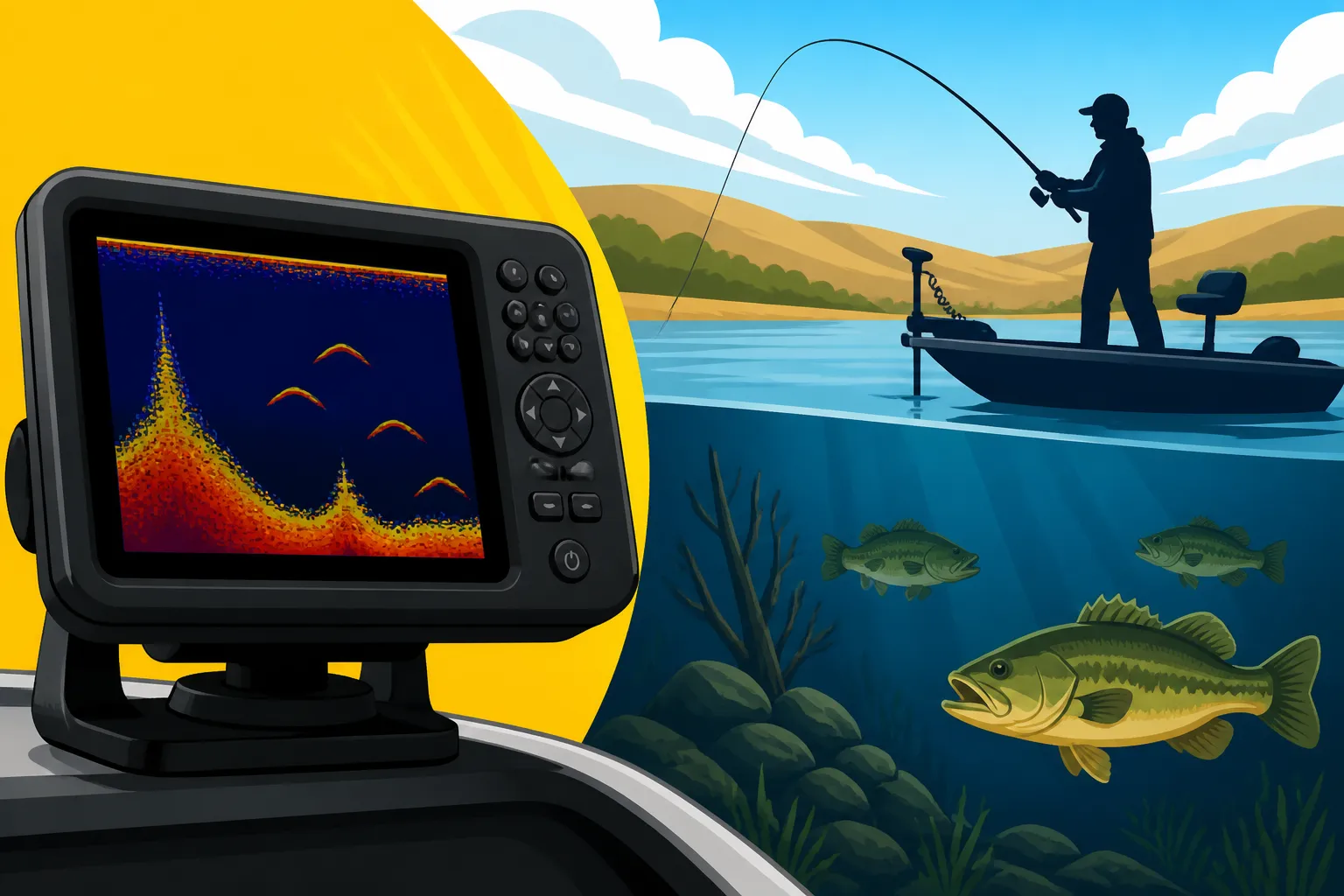
Traditional 2D sonar is what most anglers envision when they think of a fish finder. It's been around for decades, and for good reason: it's incredibly effective at providing a general overview of depth, bottom contour, and fish presence directly beneath your boat. This technology uses sound waves that travel downwards in a conical beam. When these waves hit objects like fish, the bottom, or submerged structure, they bounce back to the transducer, which then translates them into images on your screen. You'll typically see fish as "arches" or "boomerangs," with the size and completeness of the arch indicating the size of the fish.
Even with the advent of more advanced technologies, 2D sonar remains the backbone of most fish finders. It's excellent for marking schools of baitfish, identifying suspended fish, and understanding the general depth profile as you move across the lake. For many Kansas anglers, especially those just starting out or working with a tighter budget, a good 2D sonar unit is more than sufficient to improve their fishing dramatically. It’s reliable, relatively easy to interpret, and provides the fundamental information needed for successful outings.
Down Imaging and Side Imaging: Seeing the World Below and Around You
This is where fish finders truly start to shine on vast, complex reservoirs. Down Imaging (sometimes called DownVü or DownScan) provides a picture-like view of what's directly underneath your boat. Instead of arches, you'll see submerged trees, brush piles, rock formations, and even individual fish with incredible clarity, almost like a photograph. This makes it far easier to distinguish between different types of structure and to see fish relating directly to them, such as crappie buried deep in a cedar tree.
Side Imaging (or SideVü or SideScan) takes this a step further, projecting beams out to the sides of your boat. This is revolutionary for covering large areas quickly and efficiently, a huge advantage on big Kansas lakes. Imagine cruising along, and your screen shows a detailed image of a submerged roadbed 50 feet to your left, complete with fish holding on its edge. You can then mark that spot with a waypoint and turn the boat to go fish it. Side Imaging is invaluable for searching for hidden structure, locating schools of fish, and understanding the broader underwater landscape of a reservoir. It effectively widens your underwater view from a narrow cone to a broad swath, allowing you to literally "see" what's on either side of your boat without having to drive directly over it.
Live Sonar and Forward-Facing Sonar (FFS)
For those looking for the absolute cutting edge in fish finding technology, live sonar systems like Garmin's LiveScope, Lowrance's ActiveTarget, or Humminbird's Mega Live are the latest advancements. These systems provide real-time, video-game-like views of fish and structure around your boat. Instead of seeing a historical record of what you just passed over, you're watching fish swim, react to your bait, and even chase your lure.
This technology is a game-changer for sight fishing in deeper water, identifying active fish, and understanding exactly how fish are positioned relative to structure. You can cast to individual fish or small schools, watch your bait descend, and observe the fish's reaction before you even feel a bite. While these systems represent a significant investment, the tactical advantage they offer is undeniable. They are particularly popular for targeting suspended crappie or walleye in open water, allowing anglers to stay on schools that are constantly moving. For the dedicated Kansas angler looking to gain a significant edge, How to Use a Fish Finder on a Kansas Lake effectively often involves mastering these advanced systems.
Power, Installation, and Budget Considerations
Choosing a fish finder isn't just about the fancy screen or the cool sonar images; it's also about the practical aspects of power, how it's mounted on your boat, and of course, what your budget allows. These often overlooked details can make a big difference in performance and user experience.
Power Output (RMS) and Frequency Choices
The power output of your fish finder, measured in RMS (Root Mean Square) wattage, directly impacts its ability to penetrate deeper water and provide clearer returns. Generally, the higher the RMS power, the better the unit will perform in deep water and the more detail it will show, especially on the return echo. For deep Kansas reservoirs like Milford or Wilson, having ample power ensures you get accurate readings even when fishing depths of 40-plus feet. A weak signal will struggle to differentiate targets, leading to a cluttered and less useful display.
Frequency choices are also critical. Lower frequencies (like 50 kHz) penetrate deeper but offer less detail, while higher frequencies (like 200 kHz or even Mega Imaging frequencies in the MHz range) provide incredible detail but have less depth penetration. Many modern transducers are dual-frequency, offering the best of both worlds. For example, using 200 kHz for detailed views in shallower water and switching to 83 kHz or 50 kHz for better depth capability when exploring deep breaks for walleye or catfish. Matching the right frequency to the depth you're fishing and the detail you need is key.
Installation Options: Transom Mount, Trolling Motor, In-Hull
How you install your transducer significantly affects its performance. The most common is a transom mount, which is easy to install and works well for most boat types. However, at higher speeds, transom-mounted transducers can experience cavitation, leading to lost readings. For serious anglers who want clear readings while moving, a shoot-through-hull (in-hull) transducer is often preferred, as it's protected inside the boat and won't get damaged by debris or lose signal at speed. It generally works best on fiberglass hulls.
For precision fishing, especially when using your trolling motor to hold position or slowly sneak up on fish, a transducer mounted directly on the trolling motor is invaluable. This provides an unobstructed view of what's directly in front of and below your trolling motor, which is crucial for systems like Live Sonar. Best Boats for Kansas Reservoirs will influence your installation choices. Bass boats often utilize multiple transducers for different purposes, while a pontoon might just have a simple transom mount. Think about your boat type and primary fishing methods before deciding on the best installation method.
Balancing Features and Your Wallet
Let's be real, fish finders can range from a couple of hundred dollars to several thousands. It's important to set a realistic budget and then prioritize the features that matter most to your fishing style on Kansas reservoirs. You don't always need the absolute top-of-the-line model to significantly improve your fishing. An entry-level unit with solid 2D sonar, basic GPS, and a decent screen might be perfect for casual anglers hitting community lakes or smaller bodies of water.
Mid-range units typically add Down Imaging, Side Imaging, and better mapping capabilities, offering an excellent balance of features and cost for those who spend a lot of time on larger reservoirs chasing various species. High-end units, with their large, high-resolution screens, live sonar, and advanced networking capabilities, are for the dedicated tournament angler or anyone who demands the ultimate in underwater intelligence. Browse options at retailers like Bass Pro Shops or online marketplaces such as Amazon to compare different models and read reviews. Remember, the best fish finder for you is one that fits your needs and budget, and you'll find plenty of good choices across the price spectrum.
Top Brands and Their Offerings for Kansas Anglers
The fish finder market is dominated by a few key players, each with their own strengths and unique technologies. Understanding what each brand excels at can help you narrow down your choices and find a unit that best suits your fishing preferences on Kansas waters.
Humminbird: Side Imaging and LakeMaster Mapping
Humminbird has built a formidable reputation, particularly for its industry-leading Side Imaging technology. Their Mega Imaging capabilities offer unparalleled detail, allowing anglers to literally "see" individual branches on submerged trees or distinguish different types of bottom composition with incredible clarity. This is a massive advantage on Kansas reservoirs where structure fishing is key for species like crappie, walleye, and bass. Being able to scan wide areas and identify subtle changes in the bottom is a game-changer for finding those elusive hotspots.
Beyond sonar, Humminbird's LakeMaster mapping is another significant draw for Kansas anglers. LakeMaster maps often provide highly detailed contours, depth highlights, and even exclusive features like "Follow the Contour" for their compatible Minn Kota trolling motors, making precise boat control effortless. Their user interface is generally intuitive, allowing anglers to quickly switch between different sonar views and mapping screens. For anyone serious about dissecting the structure of a lake and precisely targeting fish relating to it, a Humminbird unit, especially one with Mega Side Imaging, is a strong contender.
Lowrance: ActiveTarget and C-MAP
Lowrance has been a pioneer in marine electronics for decades, and they continue to innovate with features like their ActiveTarget Live Sonar. This forward-facing live sonar system provides real-time views of fish and structure, allowing anglers to observe fish movements and reactions to lures in astonishing detail. This means you can cast to individual fish, watch them approach your bait, and even see if they reject it, providing immediate feedback that can drastically improve your technique.
For mapping, Lowrance units are often compatible with C-MAP Genesis, which allows users to create their own custom, high-definition contour maps of their favorite fishing spots. This is invaluable for finding hidden structure and subtle depth changes that might not appear on standard maps. Lowrance units are generally known for their user-friendly interfaces, often featuring touchscreen controls that make navigation and customization simple. Their HDS and Elite FS series offer a range of options suitable for various budgets, providing powerful sonar and mapping tools for any Kansas angler.
Garmin: LiveScope and ClearVü/SideVü
Garmin entered the fishing electronics market with a splash, largely due to their groundbreaking LiveScope technology. LiveScope is arguably the most talked-about live sonar system, offering incredibly crisp, real-time views of fish and structure in front of, below, and around the boat. For many, it has revolutionized how they approach fishing, turning it into a visual hunt where you can actively chase and interact with fish. This is particularly effective for suspended fish or when trying to pick out individual targets.
In addition to LiveScope, Garmin's traditional sonar, ClearVü (Down Imaging equivalent), and SideVü (Side Imaging equivalent) technologies are highly regarded for their clarity and detail. Their GPS and mapping features are also top-notch, leveraging Garmin's extensive background in navigation. Garmin's Echomap and GPSMAP series offer powerful all-in-one solutions that integrate live sonar, traditional sonar, and detailed mapping. If you're looking to embrace the future of fishing and gain an unparalleled real-time advantage on the water, a Garmin unit with LiveScope is hard to beat, though it does represent a significant investment.
Maximizing Your Fish Finder's Potential on Kansas Waters
Simply owning a fish finder is only half the battle; knowing how to properly use it and interpret its readings is what truly puts more fish in the boat. With a little practice, your fish finder can become your most valuable tool for dissecting Kansas reservoirs.
Interpreting Sonar Readings
Understanding what you're seeing on your screen can be intimidating at first. With 2D sonar, fish often appear as arches, but debris, air bubbles, or even thermoclines can create similar marks. The key is to look for distinct, strong arches, especially those that show a "tail" indicating movement. Pay attention to the thickness and completeness of the arch, as this often relates to the size of the fish. When you see bait balls – often dense, cloud-like blobs – look for larger arches or lines on the edges or within the bait, as game fish will often ambush them from these positions.
For Down and Side Imaging, you're looking for structure. Submerged trees, rock piles, ledges, and creek channels will appear with photographic clarity. Practice distinguishing different bottom types: a hard bottom (rock, gravel) will show a thicker, brighter return, while a soft bottom (mud, silt) will appear thinner and fainter. Over time, you'll learn to identify specific fish species by their behavior on the screen, such as crappie tightly packed in a brush pile or walleye hugging a deep break. This skill comes with time and experience, so don't be afraid to spend some non-fishing time simply idling around and observing what your unit displays.
Using Waypoints and Mapping for Repeat Success
Your fish finder's GPS and mapping capabilities are not just for getting around; they are powerful tools for pattern recognition and repeat success. Whenever you find a productive spot – whether it's a brush pile that produced a limit of crappie or a rocky point where you hooked into a nice walleye – mark it with a waypoint. Give it a descriptive name like "Crappie Bush 1" or "Walleye Rock 20ft." Over time, you'll build a personal map of honey holes across your favorite Kansas reservoirs.
Furthermore, use the mapping features to identify similar structure in other parts of the lake. If you find fish on a certain depth break with a particular type of timber, scan the map for other areas with similar characteristics. This allows you to expand your search without blindly idling. When you are visiting Milford Lake Fishing Guide or the Cheney Reservoir Fishing Guide, you can use your waypoints to navigate directly back to productive areas, saving valuable fishing time. Don't be shy about marking everything from hazards to successful troll paths; every piece of data contributes to a more informed and ultimately more successful fishing strategy.
Regular Updates and Maintenance
Just like your smartphone or computer, your fish finder's software needs to be updated periodically. Manufacturers regularly release software updates that can improve performance, fix bugs, add new features, and enhance mapping compatibility. Check your unit's manufacturer website for the latest firmware and follow their instructions for updating. It's often a simple process involving an SD card and a computer, and it can dramatically improve your unit's functionality.
Beyond software, physical maintenance is important. Keep your screen clean with a microfiber cloth and avoid harsh chemicals that can damage the display coating. Protect your transducer from impact, especially when launching or trailering your boat. Make sure all electrical connections are secure and free of corrosion. If you store your boat outside during the harsh Kansas winters, consider removing the head unit and storing it indoors to protect it from extreme temperatures. A little bit of care goes a long way in ensuring your investment lasts for years and continues to provide reliable information on every fishing trip.
| Sonar Type | What it Shows | Best Use for Kansas Reservoirs |
|---|---|---|
| 2D Sonar | Depth, bottom contour, fish arches, bait balls. | General scanning, identifying suspended fish, checking depths. |
| Down Imaging | Photo-like views of structure directly below boat, fish relating to it. | Precisely identifying brush piles, timber, rock ledges, channel swings. |
| Side Imaging | Photo-like views of structure and fish to the sides of the boat. | Quickly scanning large areas for hidden structure, covering water for active fish. |
| Live Sonar (FFS) | Real-time, video-like view of fish and structure around the boat. | Sight fishing, observing fish reaction to bait, tracking suspended fish. |
Disclaimer
This article is for general informational purposes only and does not constitute professional advice. Laws, prices and regulations vary by location and change over time. Consult a qualified professional for guidance on your specific situation.