Best Hook Size for Channel Catfish
One of the most common frustrations for any Kansas angler, especially when targeting those beloved channel catfish, is getting that perfect bite only to have the fish spit the hook or come unbuttoned midway through the fight. Often, the culprit isn't your bait, your technique, or even the fish's mood—it's simply using the wrong hook size. This comprehensive guide is here to demystify hook selection for channel catfish, ensuring your next outing on a Kansas lake or river is much more successful and far less frustrating.
Why Hook Size Matters for Channel Catfish
You might think a hook is just a hook, but when it comes to channel catfish, size truly makes a difference. These adaptable fish, found in nearly every body of water across Kansas, have a unique way of feeding, and matching your hook to their mouth and habits is key to consistent hook-ups.
Understanding the Channel Catfish Mouth
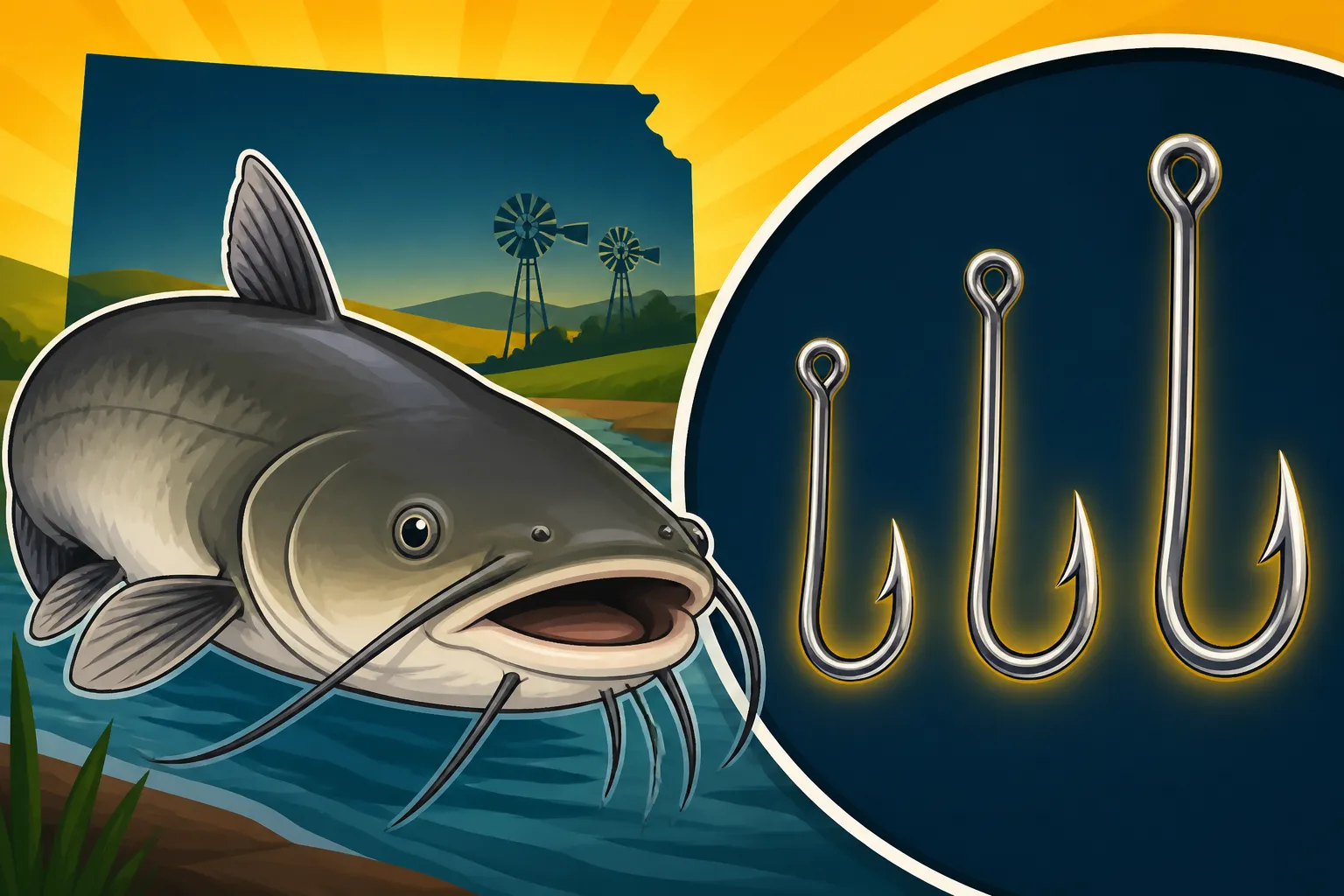
Channel catfish aren't known for their massive, toothy grins like a pike or muskie. Instead, they have a relatively small, subterminal mouth—meaning it's located slightly under their snout. They're primarily bottom feeders, using their barbels to "taste" and locate food in murky waters or along the bottom. When they take a bait, they often inhale it rather than biting down hard.
If your hook is too large, the fish might struggle to get it fully into its mouth, resulting in missed bites or "nipping" at the bait without getting hooked. Think of trying to eat a pea with a shovel; it’s just not efficient. Conversely, if your hook is too small for a sizable piece of cut bait or a large gob of worms, it can get lost in the bait, or the fish might swallow it too deeply, leading to gut-hooking which is detrimental to catch-and-release efforts. Understanding their mouth structure is foundational to choosing the right tool for the job.
Impact on Bait Presentation and Hook-Up Rates
The size of your hook directly affects how naturally your bait is presented and, consequently, your hook-up rate. A properly sized hook allows the bait to move more freely and look more appealing to a hungry catfish. For instance, if you're using a small piece of shrimp or a worm, a massive hook will overwhelm it, making it look unnatural and potentially signaling to a wary fish that something is amiss.
On the other hand, a hook that's too small might not have enough gap to expose the point when a channel cat takes the bait. The hook point needs to be clear of the bait to penetrate the fish's mouth effectively. This balance is crucial. When you have the right hook size, your bait appears natural, and when a channel catfish inhales it, the hook is positioned perfectly to catch the corner of its mouth, leading to a solid, clean hook-set almost every time. This means fewer frustrated retrieves with no fish and more successful landings, which is what we're all after when we head out for Kansas Catfish Fishing Techniques.
Deciphering Hook Sizing Conventions
Navigating the world of fishing hook sizes can feel a bit like learning a secret code. There are two main systems at play, and they work in opposite directions, which can be super confusing at first glance. But once you understand them, selecting the right hook becomes much simpler.
The Numbered Scale Smallest to Largest
This is often where the confusion begins for new anglers. For smaller hooks, the sizing works counter-intuitively: the larger the number, the smaller the hook. So, a #10 hook is smaller than a #8, and a #6 hook is larger than a #8. This scale is generally used for hooks that are smaller than what would be considered a "1" hook.
You’ll typically see this scale for panfish, trout, and sometimes for very small channel catfish bait presentations, or when targeting smaller catfish species. For instance, if you're out trying to catch bluegill or smaller channel cats with a simple worm on a bobber, you might reach for a #6 or #4 hook. These hooks are designed for delicate presentations and smaller mouths, ensuring the hook doesn't overpower the bait or the fish.
The "Aught" Scale Largest to Smallest
Now, flip that thinking on its head! Once you get past the "1" hook size, the "aught" scale kicks in, and here, the larger the number before the "/0" (pronounced "aught"), the larger the hook. So, a 1/0 hook is smaller than a 2/0 hook, which is smaller than a 3/0, and so on. This system is what you’ll be primarily dealing with when selecting hooks for channel catfish.
For most adult channel catfish in Kansas, you'll find yourself reaching for hooks in the 2/0, 3/0, 4/0, and sometimes even 5/0 or 6/0 range. This scale accounts for the larger baits and the more robust mouths of bigger fish. It’s important to remember this distinction: #10 is tiny, 10/0 is massive. Keeping these two systems separate in your mind will save you a lot of guesswork and ensure you pick up the right hooks, whether you're browsing the aisles at Bass Pro Shops or scrolling through options on Amazon.
To help visualize, here's a general guide for how hook sizes relate to each other and common catfish baits:
| Hook Scale | Common Sizes | Relative Size | Typical Use for Channel Catfish |
|---|---|---|---|
| Numbered | #8, #6, #4 | Small | Small worms, small prepared baits for panfish or small catfish |
| Aught | 1/0, 2/0 | Medium-Small | Small cut bait, nightcrawlers, small shrimp |
| Aught | 3/0, 4/0 | Medium-Large | Standard cut bait, larger chunks of chicken liver, larger prepared baits |
| Aught | 5/0, 6/0 | Large | Whole shad, large chunks of cut bait for trophy channel cats |
Recommended Hook Sizes for Kansas Channel Catfish
So, what are the go-to hook sizes that Kansas anglers swear by for channel catfish? While there's no single "magic bullet" size, understanding the typical ranges for different scenarios will set you up for success.
General Purpose Fishing Bank and Boat
For most channel catfish anglers hitting the banks of a community lake or drifting from a boat on a larger reservoir, a versatile range of hook sizes will serve you well. I generally recommend starting with hooks in the 2/0 to 4/0 range. This covers a vast majority of common scenarios and bait choices you'll encounter in Kansas.
If you're using classic baits like nightcrawlers, cut bait from shad or carp, or even chicken liver, a 3/0 hook is often a fantastic starting point. It's robust enough to handle a good-sized chunk of bait without being swallowed whole by smaller fish, yet small enough for an average channel cat to inhale effectively. For slightly larger cut bait pieces or when you suspect bigger fish might be lurking, bumping up to a 4/0 gives you that extra confidence. You can find a wide selection of these versatile hooks at sporting goods stores, including Bass Pro Shops, where you can compare different brands and styles.
Remember, the goal is to have the hook point and barb exposed enough to catch the fish's mouth. When rigging, always do a quick check to make sure the bait isn't completely engulfing the hook. This is especially true for those delicious, stinky prepared baits that channel cats can’t resist! When you master this, you'll be well on your way to a great day fishing, potentially even landing a Kansas State Record Catfish.
Targeting Smaller Channel Cats Panfish Rigs
Sometimes, you're not specifically targeting trophy catfish, but rather enjoying a day out with the family or looking for some frying-pan sized fish. Or perhaps you're just starting out and want to feel that tug on the line. In these situations, scaling down your hook size makes perfect sense.
For smaller channel catfish, often found in smaller ponds or community fishing lakes, a hook in the #2, #1, or 1/0 range can be highly effective. These smaller hooks are ideal for baits like small pieces of hot dog, corn, or a single red worm. They allow for a more delicate presentation and are less likely to spook smaller, more wary fish. Plus, if you're accidentally catching a lot of sunfish or crappie alongside your catfish, these smaller hooks are perfectly suited for them too. Just be mindful that while these hooks are great for pan-sized channel cats, they might struggle with a true behemoth, as the lighter wire can straighten out or break under extreme pressure. It's a trade-off worth considering based on your fishing goals for the day.
Targeting Larger Channel Cats Trophy Potential
Now, if you're heading out with dreams of landing a true "hawg" of a channel cat—a fish that'll really test your Best Rod and Reel Combo for Catfish—then you need to scale up accordingly. Larger channel catfish demand larger baits, and larger baits require larger hooks to ensure proper presentation and a solid hook-set.
For trophy-class channel cats, I often reach for hooks in the 5/0 or 6/0 size. These bigger hooks are perfect for presenting substantial chunks of cut bait, like a whole half of a large shad, or a big, juicy piece of carp belly. The wider gap on these hooks ensures that even with a bulky bait, the hook point remains exposed and ready to bite into that leathery mouth. Remember, big baits catch big fish, and big baits need big hooks. When ordering gear online, Amazon can be a great resource for finding larger hook sizes, especially if you're looking to buy in bulk for those serious catfishing expeditions. Just make sure your entire setup, from your line to your rod, can handle the power of a genuinely big fish.
Hook Styles and Considerations Beyond Size
While hook size is paramount, it's not the only factor. The style of hook, its material, and even subtle design elements like shank length and gap play a significant role in your catfishing success. Ignoring these can be just as detrimental as using the wrong size.
Circle Hooks vs. J-Hooks
This is perhaps the biggest debate among catfish anglers, and for good reason. Each style has distinct advantages and disadvantages.
- J-Hooks: These are the traditional, classic hooks with a "J" shape and a straight point. They require the angler to set the hook manually when a fish bites. The advantage of J-hooks is that they can provide a very direct hook-set and are highly effective when you're actively holding your rod and feel every nibble. However, they also have a higher tendency to gut-hook fish if you're not attentive or if the fish swallows the bait deeply, which can be fatal for catch-and-release. For this reason, many conservation-minded anglers are moving away from them for general catfishing.
- Circle Hooks: Circle hooks are designed to be self-setting. Their unique inward-curving point is meant to slide into the corner of the fish's mouth as the line tightens, rather than piercing other areas. This dramatically reduces the chance of gut-hooking, making them a fantastic choice for catch-and-release or for fishing multiple rods where you can't always be holding one. The key to using circle hooks is not to set the hook. Instead, let the fish take the bait, let the rod load up, and then simply reel down to tighten the line. The hook will do the work for you. For channel catfish, which often "mouth" their food before swallowing, circle hooks are incredibly effective and promote healthier fish releases. Best Circle Hooks for Catfish goes into even more detail on specific models.
Given the channel cat's feeding habits, which often involve inhaling bait, circle hooks are becoming increasingly popular and are often recommended for their effectiveness and ethical benefits.
Hook Material and Strength
You'd be surprised how much variation there is in hook materials. Most modern fishing hooks are made from high-carbon steel, which offers a good balance of strength and sharpness. However, coatings and wire diameter can vary significantly.
- Wire Strength: For channel catfish, especially those larger ones, you want a hook with good wire strength. A thin-wire hook, while sharp, can straighten out under the strain of a strong fight or a heavy fish. Look for hooks that are described as "heavy-duty" or made with thicker gauge wire. This is crucial for landing those big boys from Milford or Cheney.
- Corrosion Resistance: Fishing in Kansas means dealing with various water conditions. Some hooks come with corrosion-resistant coatings (like black nickel or bronze) that help them last longer, especially if you fish frequently or if your hooks are exposed to damp environments. While stainless steel hooks exist, they're often too brittle for the kind of force a large catfish can exert. A good quality, strong hook will maintain its integrity through multiple fish and casts, providing reliability when you need it most. This kind of reliability is essential for a productive Kansas Fishing Seasons Guide.
Understanding Shank Length and Gap
Beyond size and style, two other features of a hook, the shank length and the gap, are worth considering.
- Shank Length: This refers to the length of the hook from the eye (where you tie your line) to the bend.
- Short Shank: Short shank hooks are generally stronger because the force is distributed over a shorter length. They're excellent for powerful fish like channel cats and work well with compact baits like chicken liver or chunks of cut bait.
- Long Shank: Long shank hooks are useful when you need to thread a longer bait, such as multiple nightcrawlers or a whole small fish. They also make it easier to remove the hook from a deeply hooked fish, though with proper circle hook use, this becomes less of an issue. However, a very long shank can sometimes be a leverage point for a strong fish to pry itself off the hook.
- Gap: The gap is the distance between the hook point and the shank. A wider gap generally means a better chance of hooking a fish, especially when using bulkier baits.
- For channel catfish, a generous gap is important because their mouth structure can make it challenging for the hook point to clear the bait and embed properly. This is another reason why circle hooks are so effective; their design naturally provides a wide gap for catching the lip. When you're rigging your bait, always make sure there's enough room in the hook's gap for the point to penetrate cleanly. If your bait completely fills the gap, you're going to miss fish, plain and simple.
Choosing the right hook size and style for channel catfish in Kansas is all about understanding the fish and matching your gear to the task. By paying attention to these details, you'll not only increase your catch rates but also enjoy a more ethical and satisfying fishing experience. Happy catfishing!
Disclaimer
This article is for general informational purposes only and does not constitute professional advice. Laws, prices and regulations vary by location and change over time. Consult a qualified professional for guidance on your specific situation.