Best Trolling Motor Thrust for Lakes
There's nothing quite as frustrating as being out on your favorite Kansas lake, the fish are biting, and suddenly a gust of wind or a strong current kicks up, leaving your trolling motor struggling to keep you in position. Many anglers face this exact dilemma, realizing too late that their motor simply doesn't have the muscle to handle the conditions. This guide is here to cut through the confusion and help you determine the best trolling motor thrust for your specific needs, ensuring you spend more time fishing and less time fighting your boat.
Understanding Trolling Motor Thrust: What Does It Even Mean?
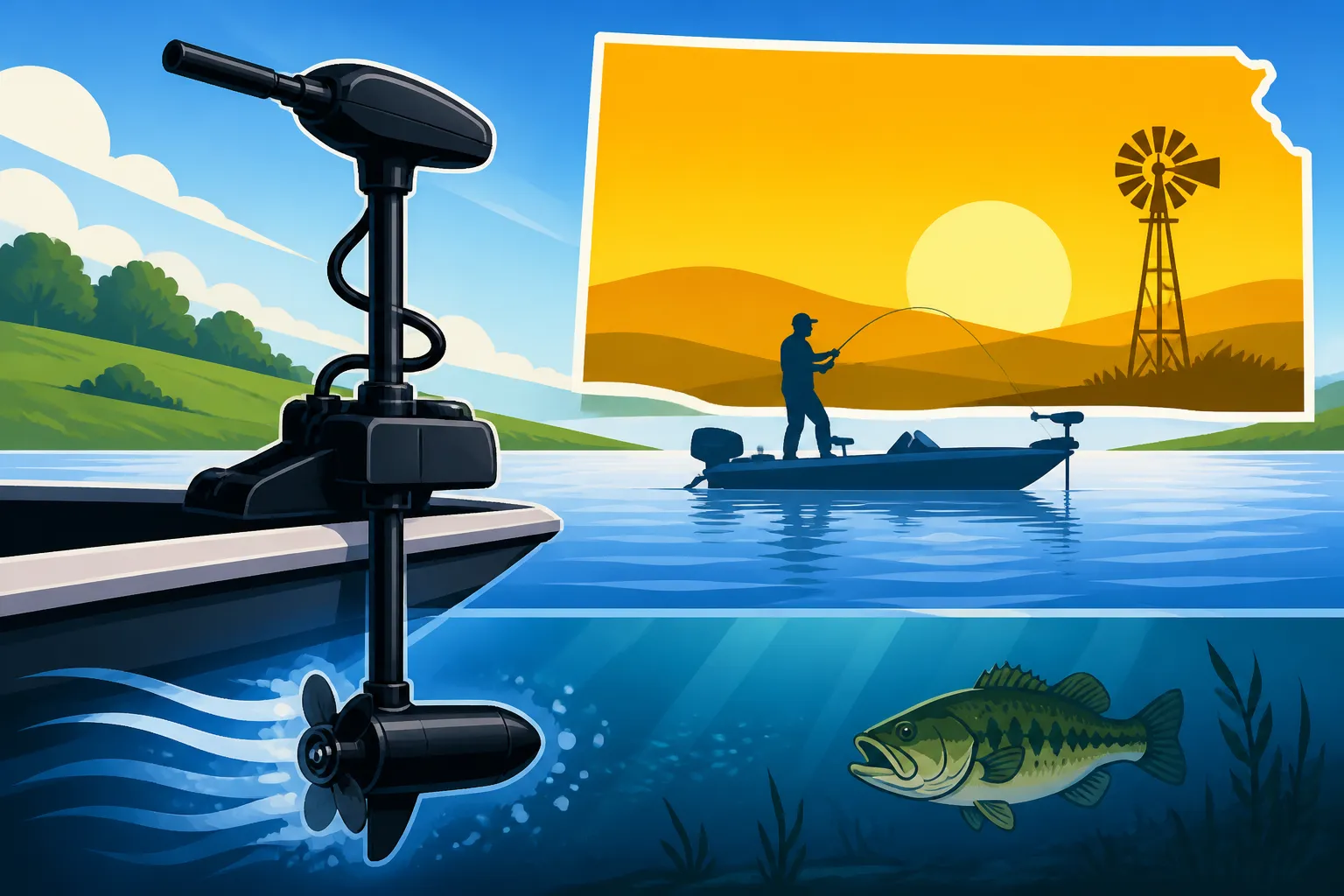
When you look at trolling motors, you'll see a number followed by "lbs" – like 55 lbs or 80 lbs. This isn't the weight of the motor itself; it's a measurement of its thrust. Think of thrust as the pushing or pulling power the motor can generate. It’s the force that moves your boat through the water, allowing you to position yourself precisely for those perfect casts.
The Basics of Thrust and Horsepower
Unlike gasoline outboard engines which are measured in horsepower, electric trolling motors are rated in pounds of thrust. Horsepower describes the rate at which work is done, typically associated with higher speeds and more powerful propulsion. Thrust, on the other hand, is a direct measure of force. For a trolling motor, more pounds of thrust means more pushing power. A 50-pound thrust motor will push your boat with 50 pounds of force. This distinction is crucial because you're not trying to plane your boat with a trolling motor; you're trying to move it slowly, quietly, and with precise control, often against environmental factors like wind or current.
It’s easy to get caught up in the numbers, but remember that a higher thrust rating translates directly to better control, especially when conditions get tough. If you’ve ever tried to hold a pontoon steady in a stiff breeze with a small trolling motor, you know exactly what I mean. The motor just can't generate enough force to counteract the wind pushing against your boat.
Why Thrust Matters for Your Fishing Experience
Having the right amount of thrust isn't just about moving your boat; it's about optimizing your entire fishing experience. Imagine you're trying to slowly work a submerged brush pile on Clinton Lake for crappie, or meticulously follow a contour line on Wilson Lake for walleye. If your trolling motor is constantly fighting the wind or current, you'll be overcompensating with the controls, making jerky movements, and likely spooking fish. Inadequate thrust means you’re working harder, burning through battery faster, and missing out on that quiet, stealthy approach that makes trolling motors so effective.
Conversely, with sufficient thrust, you can maintain a steady speed and direction with minimal effort. This translates to better bait presentation, more accurate casts, and ultimately, more fish in the boat. It gives you the confidence to tackle larger bodies of water, knowing you can get where you need to be and stay there, even when the weather decides to throw you a curveball. It’s the difference between a relaxing day on the water and a frustrating battle with the elements.
Key Factors Influencing Your Thrust Needs on Kansas Lakes
Choosing the right trolling motor isn't a one-size-fits-all situation. Several critical factors come into play, especially when you consider the unique characteristics of Kansas's diverse fishing environments, from the vast open waters of Milford Lake to the winding currents of the Kansas River.
Boat Size, Weight, and Type
This is arguably the most significant factor. A tiny 12-foot jon boat that weighs a few hundred pounds wet will require far less thrust than a fully loaded 20-foot bass boat or a large pontoon. Every extra pound of gear, every passenger, and even the type of construction material contributes to your boat's total weight, and thus, the force needed to move it.
- Small Jon Boats & Kayaks: For these lighter vessels, often used in smaller ponds or sheltered areas of larger lakes, a 30-50 lb thrust motor might be perfectly adequate. These boats don't have a lot of surface area to catch the wind, and their lighter weight makes them easier to propel. If you're using a kayak specifically for fishing, you might even consider specialized kayak trolling motors.
- Aluminum V-Hull Boats & Smaller Fiberglass Boats: If you're running a 16-18 foot aluminum boat or a smaller fiberglass bass boat, you'll likely need something in the 55-80 lb thrust range. These boats are heavier and have more hull in the water, requiring more power to move efficiently. Consider if you frequently load it with a full livewell, multiple batteries, and gear, as this adds significant weight.
- Large Bass Boats & Pontoons: For substantial vessels like 19-21 foot bass boats, large multi-species boats, or pontoons, you're almost certainly looking at an 80-120 lb thrust motor. Pontoons, with their large flat decks, act like sails in the wind and need significant power to hold their position or move against any breeze. Bass boats, though sleeker, are often heavy due to their construction, powerful main engines, and vast amounts of gear.
It’s crucial to consider the fully loaded weight of your boat. Don't just think about the empty hull; factor in fuel, passengers, all your Kansas Fishing Gear Guide, cooler, tackle, and anything else you typically bring along.
Water Conditions: Wind, Current, and Waves
Kansas is known for its wind, and anyone who has fished a large reservoir like Cheney Reservoir or El Dorado Lake on a blustery day knows how quickly a gentle breeze can turn into a serious challenge. Wind creates chop and pushes your boat around, directly counteracting your trolling motor's efforts. The stronger the wind, the more thrust you'll need to maintain control and direction.
Beyond wind, some Kansas waters have noticeable current. Rivers, spillway areas below dams, or even bottlenecks in larger reservoirs can create currents that demand more power from your motor. If you plan on fishing areas with significant current, like parts of the Kansas River Fishing Guide, you’ll definitely want to lean towards the higher end of the thrust recommendations. Waves also impact your boat’s movement, creating drag and requiring more consistent power to navigate smoothly. It's often better to have a bit of extra thrust in reserve to handle those unexpected gusts or chop, rather than being underpowered and struggling to stay on course.
Fishing Style and Application
Your preferred fishing techniques also play a role in determining optimal thrust.
- Slow Trolling & Contour Fishing: If you primarily use your trolling motor for slow, steady trolling along contour lines or submerged structures, especially for species like walleye or crappie, consistent thrust is key. You need enough power to maintain a precise speed, even with some wind resistance.
- Spot-Lock & Holding Position: Many modern trolling motors offer GPS-enabled spot-lock features, which are fantastic for holding your boat over a specific fishing spot, like a brush pile or a submerged rock pile. To effectively use spot-lock in wind or current, the motor needs sufficient thrust to constantly adjust and counteract those forces. Undersized motors will struggle, constantly overworking and draining batteries quickly.
- Navigating Heavy Cover: If you frequently fish tight spots, thick lily pads, or heavy timber for largemouth bass, you'll want ample thrust to maneuver your boat out of sticky situations. A powerful motor can help you push through weeds or pull away from snags more effectively.
- Kayak Angling: While kayaks are small, many kayak anglers appreciate more thrust for fighting wind or covering large distances. The ability to quickly adjust position with minimal paddle input can be a game-changer when targeting specific structure or sight fishing.
Consider how you fish most often. If you’re a casual angler on a small pond, your needs are different from someone who routinely fishes large, windy reservoirs in a fully equipped bass boat.
Calculating Your Ideal Trolling Motor Thrust
Now that we’ve covered the factors, let’s get down to brass tacks: how do you figure out how much thrust you actually need? There's a widely accepted rule of thumb that serves as a great starting point, but it's important to remember it's a guideline, not a hard-and-fast law.
The 2 lbs per 100 lbs Rule of Thumb
A good general rule to follow is to have at least 2 pounds of thrust for every 100 pounds of fully loaded boat weight.
Let's break that down:
-
Determine your boat's total weight: This isn't just the dry weight listed by the manufacturer. You need to estimate the weight of your boat with everything in it, including:
- The boat itself
- Main engine (if applicable)
- Fuel
- Batteries (trolling motor, cranking)
- All your fishing gear (tackle boxes, rods, net, cooler)
- Anchor
- Passengers (estimate an average weight per person)
- Livewell full of water and fish
For example, if your boat weighs 1,500 lbs dry, and you add a 300 lb outboard, 200 lbs of batteries/fuel, 100 lbs of gear, and two anglers totaling 350 lbs, your fully loaded weight is around 2,450 lbs.
-
Apply the rule: Take your fully loaded weight and divide it by 100, then multiply by 2.
- Using our example: 2,450 lbs / 100 = 24.5
- 24.5 x 2 lbs of thrust = 49 lbs of thrust.
So, for a 2,450 lb boat, you’d need at least 49 lbs of thrust. Since motors are sold in standard thrust increments (e.g., 45, 55, 70, 80, 100, 112 lbs), you would round up to the next available size, which would be a 55 lb thrust motor in this scenario.
Accounting for Additional Factors
While the 2 lbs per 100 lbs rule is a solid starting point, you absolutely need to factor in those other considerations we talked about, especially for Kansas fishing. If you frequently fish large, open reservoirs that are prone to strong winds, like Milford Lake or Tuttle Creek Lake, or if you expect to encounter currents, you should add a buffer to that calculation.
For example, if your calculated minimum is 49 lbs of thrust, but you know you’ll be on windy days often, bumping up to a 70 or 80 lb thrust motor would be a wise decision. This provides you with extra power to combat adverse conditions without overworking your motor.
Here's a quick guide to help visualize:
| Boat Type (Examples) | Estimated Loaded Weight (lbs) | Minimum Thrust (Rule of Thumb) | Recommended Thrust for Kansas Conditions (lbs) |
|---|---|---|---|
| Kayak / Small Jon Boat | 400 – 800 | 8 – 16 | 30 – 55 |
| 14-16 ft Aluminum V-Hull | 800 – 1500 | 16 – 30 | 55 – 70 |
| 16-18 ft Fiberglass / Bass | 1500 – 2000 | 30 – 40 | 70 – 80 |
| 19-21 ft Bass Boat / Pontoon | 2000 – 3000+ | 40 – 60+ | 80 – 112+ |
Remember, this table is a general guideline. Your specific boat and fishing habits will dictate the exact need. When in doubt, it’s usually better to have a bit more thrust than too little.
When More is Better (and When it's Overkill)
Having "more" thrust is almost always beneficial up to a point. Extra thrust means your motor doesn't have to work as hard, which can lead to better battery life and less wear and tear. It provides a safety net when conditions unexpectedly worsen. Imagine you're jigging for crappie on a calm morning, but an afternoon thunderstorm rolls in with heavy winds; that extra thrust will be a lifesaver for safely navigating back to the ramp.
However, there is such a thing as overkill. A 112 lb thrust motor on a tiny jon boat is not only unnecessary but can also be more expensive upfront and require a larger battery bank (more on that next) than you truly need. An oversized motor might also take up more deck space or be heavier than a smaller one, which could be a concern for smaller craft. The goal is to find the sweet spot: enough power to handle your typical and challenging conditions comfortably, without unnecessary expense or bulk. You can often find a great selection of various thrust motors at retailers like Bass Pro Shops or online at Amazon, allowing you to compare options and reviews.
Powering Your Trolling Motor: Battery Considerations
Once you've zeroed in on the ideal thrust for your Kansas fishing adventures, the next crucial step is to ensure you have the right power source. A powerful trolling motor is only as good as the batteries that feed it. Without adequate battery capacity, even the strongest motor will leave you stranded.
Matching Battery Capacity to Thrust
Trolling motors come in different voltage configurations, and this directly relates to the thrust they can provide.
- 12-Volt Systems: Most motors up to around 55-60 lbs of thrust typically run on a single 12-volt battery. These are common for smaller to medium-sized boats and provide enough power for many applications.
- 24-Volt Systems: Motors in the 70-80 lbs thrust range generally require a 24-volt system, which means two 12-volt batteries wired in series. This provides more consistent power for larger boats or more challenging conditions.
- 36-Volt Systems: For the highest thrust motors, often 100-112 lbs or more, a 36-volt system using three 12-volt batteries in series is needed. These are common on large bass boats and pontoons that demand maximum power and endurance.
It's critical that your battery system matches the voltage requirement of your chosen motor. An 80 lb thrust motor hooked up to a single 12-volt battery simply won't work, or it will severely underperform and potentially damage the motor or battery. The higher the thrust and voltage, the more batteries you'll need, which means more weight and space in your boat. When you're considering a new motor, remember to budget for the appropriate number of quality deep cycle batteries and a charger. Kansas Boat Registration for Anglers also covers the safety aspects of having properly secured batteries.
The Importance of Deep Cycle Batteries
This point cannot be stressed enough: do not use standard car cranking batteries for your trolling motor. Car batteries are designed to deliver a high burst of power for a short time (to start an engine) and then be immediately recharged by the alternator. Trolling motors, however, require a steady, sustained draw of power over many hours, often discharging the battery significantly before being recharged.
This is where deep cycle marine batteries come in. They are specifically engineered to handle repeated deep discharges and recharges without significantly degrading their capacity. While they might be heavier and more expensive upfront than a car battery, their longevity and performance for trolling motor applications are unmatched. Investing in good quality deep cycle batteries means more hours on the water and less worry about running out of juice. Some anglers opt for newer lithium-ion deep cycle batteries, which are lighter and offer even more cycles, though they come with a higher price tag. No matter your choice, ensure you have sufficient amp-hour (Ah) ratings to support your motor's run time.
Trolling Motor Features Beyond Thrust
While thrust is undoubtedly critical, modern trolling motors come packed with a suite of features that can enhance your fishing experience on Kansas lakes. Overlooking these can mean missing out on significant advantages.
Shaft Length: A Crucial but Overlooked Detail
This is a big one that many anglers don't give enough thought to until they're out on the water. The shaft length of your trolling motor needs to be appropriate for your boat's hull and how high it sits in the water. If the shaft is too short, your prop will come out of the water in waves or chop, causing it to "cavitate" (spin freely without pushing water) and lose thrust. This can be incredibly annoying and inefficient, especially when trying to maintain position on a windy day at Kanopolis Lake. If the shaft is too long, the motor will sit unnecessarily deep, potentially hitting submerged objects in shallower areas or making it harder to deploy and retrieve.
A good rule of thumb is that the top of the motor housing (where the prop connects to the shaft) should be at least 12 inches below the waterline. You'll need to measure the distance from the deck where your motor will be mounted to the waterline. Account for choppy conditions and how your boat might sit with a full load. Many manufacturers provide guidelines for shaft length based on boat length, and it's always wise to check their recommendations.
GPS Integration and Spot-Lock Technology
Modern trolling motors have revolutionized boat control with GPS integration. Features like "Spot-Lock" (Minn Kota's term) or "Anchor Mode" (Garmin and Lowrance's term) use GPS to precisely hold your boat's position over a specific spot, even in wind or current. This is an absolute game-changer for targeting structure, working a specific brush pile, or holding over a school of fish without dropping an anchor.
These systems also offer features like "Autopilot" or "Route Tracking" which allow the motor to follow a predetermined course or a compass heading. Imagine marking a productive contour line on your fish finder, and then having your trolling motor automatically follow it while you focus entirely on fishing. This technology can make a huge difference on large bodies of water, saving you effort and helping you stay on the fish. While they come at a higher cost, many anglers find the investment well worth it for the added convenience and fishing success. Brands like Minn Kota and Motorguide are popular choices for their robust GPS-enabled motors, which you can often find at retailers like Bass Pro Shops.
Foot Pedal vs. Hand Control
The choice between a foot pedal and hand control largely comes down to personal preference and fishing style.
- Foot Pedal Control: This is the preferred choice for many serious bass and walleye anglers, particularly those who stand and cast. A foot pedal allows you to control the boat's direction and speed with your foot, leaving both hands free for casting, retrieving, and fighting fish. The learning curve can be a little steep for some, but once mastered, it offers incredibly intuitive and responsive control. If you're constantly casting and reeling, a foot pedal allows for uninterrupted action.
- Hand Control: Hand control motors, where you manually steer and control speed with a tiller handle, are often found on smaller boats, kayaks, or as transom-mount motors. They are typically less expensive and simpler to operate. They work well if you're seated, doing more passive fishing like still fishing or drift fishing, or if deck space is at a premium. However, they do tie up one of your hands, which can be a drawback for active casting or complex lure presentations.
Consider how you fish, the type of boat you have, and your budget when making this choice. There are also hybrid options and remote controls available that offer flexibility. Knowing the Best Rod and Reel Combo for Catfish will help you match your control style with your fishing technique.
Disclaimer
This article is for general informational purposes only and does not constitute professional advice. Laws, prices and regulations vary by location and change over time. Consult a qualified professional for guidance on your specific situation.