Best Rod Holder Setup for Trolling
Trolling for fish across Kansas’s beautiful reservoirs and rivers is one of the most effective ways to cover water and find active fish, especially species like walleye and wipers. However, anyone who's tried to manage multiple lines while simultaneously steering the boat, watching the electronics, and avoiding tangles knows the frustration. Without a well-thought-out rod holder setup, you’re just asking for a chaotic day on the water. This guide will help you understand the best rod holder configurations for efficient and enjoyable trolling, making your Kansas fishing adventures far more productive.
Why a Dedicated Rod Holder Setup is Crucial for Trolling
Imagine trying to hold two, three, or even four fishing rods in your hands for hours on end, all while maintaining a specific speed and direction, and keeping an eye on your sonar. It sounds exhausting, right? That’s precisely why a dedicated rod holder setup isn't just a luxury for serious anglers; it's a fundamental necessity for effective trolling. It frees your hands, ensures consistent lure presentation, and dramatically reduces the headache of tangled lines.
The Frustration of Juggling Rods and Tangled Lines
We’ve all been there. You're out on Milford Lake, the wind is just right, and you’re trying to run two planer boards and a couple of flat lines off the back. Suddenly, one rod gets a bite, and as you grab it, another rod slips, or worse, lines cross and you’ve got a bird’s nest of monofilament. It's enough to make you want to throw your hat in the water! The simple truth is, without a secure and strategically placed rod holder, every troll becomes a balancing act, and potential chaos is always lurking just around the corner. Not only does this lead to lost fish, but it can also damage your expensive gear. A proper setup eliminates the need for constant vigilance over unsecured rods, allowing you to focus on the fish, the boat, and the experience.
Achieving Optimal Lure Presentation and Consistent Depth
Trolling isn't just about dragging a lure behind a boat; it's about presenting that lure in a very specific way, at a very specific depth and speed, for an extended period. This consistency is incredibly hard to achieve when you're manually holding a rod. A good rod holder locks your rod into position, maintaining the angle of your line relative to the water and the boat. This means your crankbait is running at its intended depth, your spinner rig is tracking perfectly, and your bait is consistently in the strike zone. Think about targeting deep-holding walleye on Cheney Reservoir – even a slight change in rod angle can pull your bait out of their preferred feeding lane. Rod holders ensure that once you find that sweet spot, you can replicate it pass after pass. This consistency is key to figuring out what the fish are responding to on any given day.
Types of Rod Holders and Their Best Applications
When it comes to rod holders, it’s not a one-size-fits-all situation. Different styles offer unique advantages, and understanding these differences is crucial for choosing the right setup for your specific trolling needs and boat type. Each type serves a distinct purpose, from permanent fixtures to highly adjustable systems that adapt to various fishing scenarios.
Flush Mount, Clamp-On, and Track Systems
These are the three primary categories you'll encounter, and each has its own benefits and drawbacks:
-
Flush Mount Rod Holders: These are often found on larger boats and are permanently installed into the gunwale (the upper edge of the boat's side). They offer a very clean, low-profile look, as only the opening and a small collar are visible when a rod isn't in place.
- Pros: Extremely sturdy and robust, ideal for heavy-duty trolling for large fish like striped bass or wipers. They become an integrated part of your boat's structure, minimizing snags or interference. Once installed, they require very little maintenance beyond occasional cleaning.
- Cons: Installation is permanent and requires drilling significant holes into your boat, which can be daunting for some and potentially impact resale value if not done well. Their angle is fixed, offering no adjustability once installed, which means careful planning is essential. If you want to change your setup or fish a different style, you might be out of luck.
- Best Application: Ideal for dedicated trolling boats or those targeting very large, powerful fish where maximum strength and a clean aesthetic are paramount. If you're consistently deep trolling for monster catfish on Tuttle Creek Lake, a robust flush mount might be exactly what you need.
-
Clamp-On Rod Holders: These are popular for their versatility and ease of installation. They attach to various parts of your boat, such as rails, gunwales, or transoms, using a clamping mechanism.
- Pros: No drilling required, making them perfect for smaller boats, rental boats, or anglers who want to easily reconfigure their setup. They are portable and can be removed for storage or transferred between boats. Many clamp-on models offer adjustability in angle and rotation.
- Cons: While generally sturdy, they might not be as rock-solid as a flush mount for extreme applications, especially if clamped to a flimsy rail. Clamping mechanisms can sometimes scratch finishes if not padded correctly. Some models can be bulky and create trip hazards.
- Best Application: Excellent for kayaks, jon boats, or smaller craft where drilling isn't an option or flexibility is desired. Great for anglers who frequently change their trolling spread or fish different types of waters. You can find a wide variety of these on Amazon or at your local Bass Pro Shops, making it easy to compare options. For a beginner trying out trolling on a Kansas Community Fishing Lake Rules, these are a fantastic starting point.
-
Track Systems: These represent perhaps the most versatile and customizable option for trolling setups. A metal track is permanently mounted to the gunwale or transom, and various rod holders (along with other accessories like cup holders or electronics mounts) can be slid into and locked onto the track.
- Pros: Unparalleled adjustability. You can slide holders fore and aft, remove them completely, or add more as needed. This allows you to fine-tune your trolling spread on the fly, spacing out lines to avoid tangles or concentrating them for specific patterns. Most track systems are incredibly robust and can handle multiple heavy rods.
- Cons: The initial installation of the track itself involves drilling, similar to flush mounts, though usually less extensive for each individual holder point. They can be a more significant upfront investment.
- Best Application: Anglers who require maximum flexibility and want to run diverse trolling spreads for species like walleye, crappie, or white bass. This system is particularly beneficial on larger boats fishing big reservoirs like Wilson Lake or El Dorado Lake where conditions and target species can change frequently. You can set up for Kansas Walleye Fishing Techniques one day and then easily reconfigure for Kansas Crappie Fishing Techniques the next.
Adjustable vs. Fixed Angle Holders
Beyond the mounting style, the adjustability of the rod holder itself is a critical factor:
-
Fixed Angle Holders: As the name suggests, these holders offer a set angle once the rod is inserted. Many flush mount holders fall into this category, but some clamp-on and track-mounted holders can also be fixed.
- Pros: Simplicity and strength. With fewer moving parts, they are often more robust and less prone to failure under heavy strain. They excel when you know exactly what angle you need for a specific technique and want that angle to remain absolutely consistent.
- Cons: Lack of versatility. If you need to change your line angle to account for wind, current, or different lure depths, you can't adjust it. This means you might need multiple fixed holders at different angles to cover various scenarios.
- Best Application: Best for very specific trolling patterns where a consistent, unchanging rod angle is desired. For instance, running a deep diver directly off the stern, or using planer boards where the rod angle contributes to board spread.
-
Adjustable Angle Holders: These holders feature a mechanism (often a gear-lock or cam-lock) that allows you to change the angle of the rod relative to the boat. Some also allow for rotational adjustment.
- Pros: Incredible versatility. You can fine-tune the angle to present lures at different depths, account for boat speed, or adapt to changing conditions. This is essential for experimenting with different trolling depths or presenting multiple lures at varying distances from the boat. They also allow you to quickly change the rod's position for fighting a fish or clearing lines.
- Cons: Can sometimes be less robust than fixed holders due to more moving parts, though high-quality adjustable holders are extremely strong. Cheaper models might slip under heavy strain. They can also be a bit more expensive.
- Best Application: Ideal for almost all trolling scenarios where adaptability is valued. Whether you're chasing Kansas White Bass Guide on a river run or seeking Kansas Walleye Fishing Guide in a reservoir, the ability to quickly modify your rod angle is a huge advantage. They are a great choice for any angler running multiple lines or fishing varied terrain.
Here's a quick comparison of the main rod holder types:
| Feature | Flush Mount | Clamp-On | Track System |
|---|---|---|---|
| Installation | Permanent drilling required | Tool-free/clamp | Permanent track drilling required |
| Adjustability | Minimal (fixed angle) | High (angle & rotation) | High (position, angle & rotation) |
| Strength | Very high | Moderate to High | Very high |
| Versatility | Low (fixed) | High (portable, adaptable) | Very high (modular, customizable) |
| Aesthetics | Very clean, low profile | Can be bulky, visible clamps | Clean once track is installed |
| Cost | Mid-range (holder + installation) | Low to Mid-range | High (track + multiple holders) |
| Best Use Case | Dedicated heavy-duty trolling | Small boats, rental, flexible | Multi-species, diverse techniques |
Designing Your Ideal Trolling Setup for Kansas Waters
Now that you understand the different types of rod holders, let’s talk about how to actually put together a "best" setup for your Kansas fishing adventures. This involves considering your boat, your target species, and the overall strategy of your trolling.
Considering Your Boat Type and Trolling Style
The first step in designing your ideal rod holder setup is to be brutally honest about your vessel and your preferred way to fish.
- Small Jon Boats or Kayaks: If you're running a smaller boat, perhaps a 12-foot jon boat on a local Kansas State Fishing Lakes Guide or a fishing kayak on the Kansas River, space is at a premium. Flush mounts might be too permanent or impractical. Clamp-on holders are likely your best bet, offering flexibility and easy removal. You might only run one or two rods for simpler spreads, so a couple of robust, adjustable clamp-ons placed on the transom or gunwales could be perfect. Look for models that can swivel, allowing you to quickly turn the rod to fight a fish without obstruction. Many anglers find high-quality clamp-on holders for their kayaks on Amazon.
- Larger Bass Boats or Multi-Species Rigs: If you have a larger boat, like a fiberglass bass boat or a deep-V multi-species boat often seen on Milford Lake, you have more options. A track system running along the gunwales can be incredibly effective. This allows you to run multiple rods, perhaps two off the stern for flat lines, and two mid-ship with planer boards for a wide spread. The track system lets you adjust the spacing of your rod holders to prevent tangles and optimize your spread based on whether you're chasing a Kansas Walleye Minimum Length Limit of 21 Inches or focusing on crappie. You can also integrate other accessories into the track, like tool holders or extra cup holders, truly customizing your space.
- Walleye, Crappie, or Catfish: Your target species will also dictate your needs. For heavy-hitting fish like big Kansas blue or flathead catfish, you'll want ultra-strong, perhaps fixed-angle holders that can withstand significant force. For walleye, who often hit lures with a softer bite, sensitive adjustable holders that allow for quick rod removal are often preferred. For crappie, especially when spider rigging or drift fishing, you might want more holders (four to six) with lighter action, pointing out at various angles. Kansas Catfish Daily Limits can be generous, so being able to manage multiple rods effectively means more fish in the cooler.
Strategic Placement and Spacing
Once you’ve chosen your holder types, where you put them is just as important as what they are. Proper placement is key to preventing tangles, maximizing your spread, and ensuring ease of access.
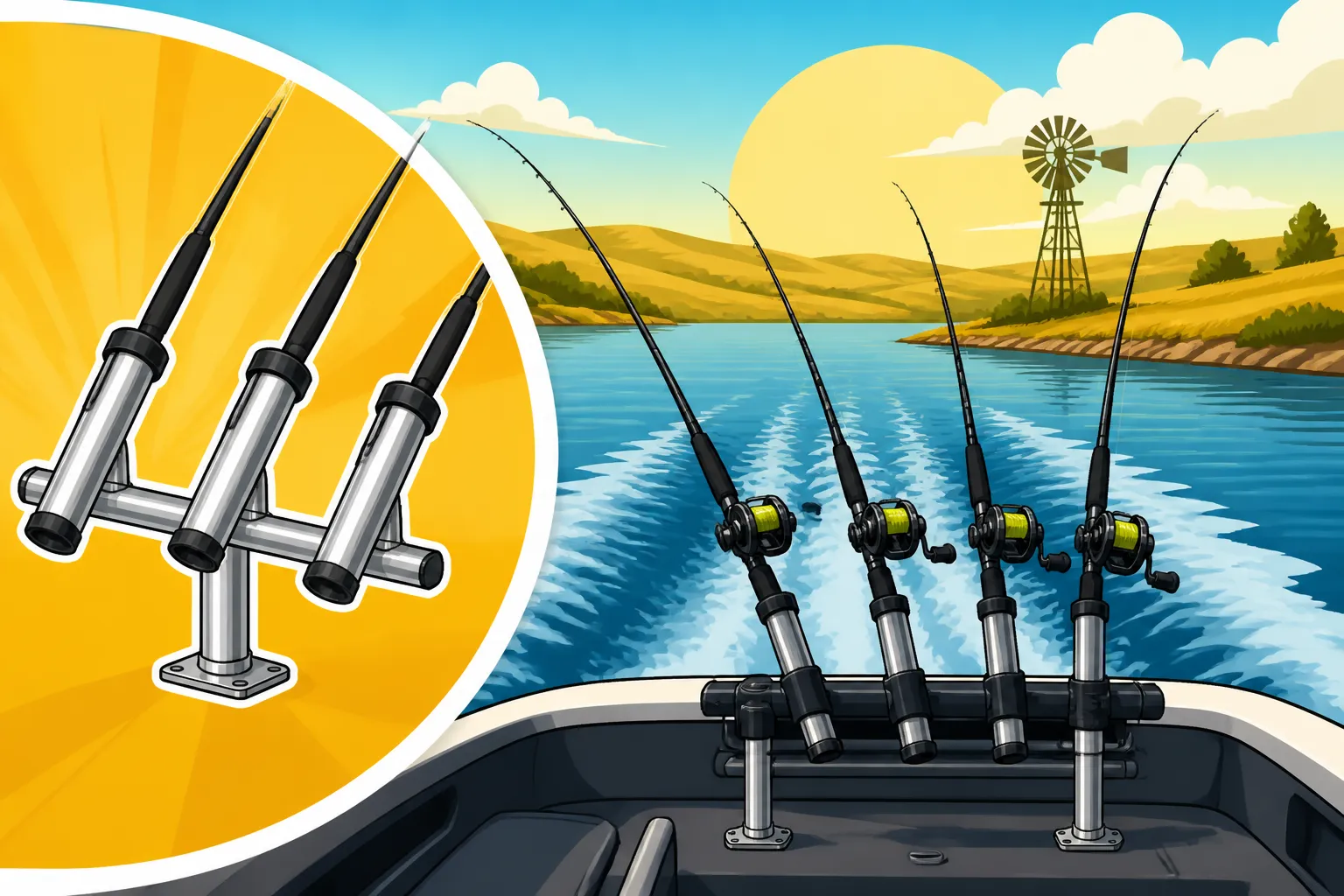
- The "V" or "Fan" Spread: A popular and effective trolling setup involves creating a "V" or fan shape with your lines. This often means placing two rods directly off the stern, angled slightly outward. Then, two more rods (often with planer boards) are placed mid-ship, angled further out to cover a wider swath of water. This is especially effective when targeting walleye or wipers that might be spread out.
- Staggering Depths: Combine rod holder placement with different lure choices and line lengths to stagger your depths. For example, a crankbait running shallow on a short line off a stern holder, followed by a deeper diving lure on a longer line from a mid-ship holder. This allows you to probe different depths simultaneously.
- Accessibility: Ensure that each rod in a holder is easily reachable. When a fish hits, you need to grab that rod quickly without fumbling over other equipment or reaching across someone else. This is where adjustable holders shine, allowing you to quickly pivot the rod towards you as you retrieve it.
- Clearance and Obstructions: Before drilling or clamping, visualize your entire setup. Will the rod tips clear your boat's canopy? Will they interfere with the trolling motor control? Is there enough space to walk around safely? Consider your Kansas Kayak Fishing Gear Guide if you're out on a smaller vessel; every inch matters. For larger boats, think about how the rods will interact with your Best Trolling Motor for Kansas Lakes or your fish finder.
Essential Accessories and Maintenance
Your rod holder setup isn't just the holders themselves; it's a system. A few accessories can make a huge difference in safety and efficiency.
- Safety Lanyards/Leashes: Even the most secure rod holder can fail, or a monster fish can try to rip your rod out. A simple rod leash or lanyard, attaching your rod to the boat, can save you from losing expensive gear. You can find these inexpensive but crucial items at Bass Pro Shops or online.
- Rod Butt Holders: Some holders are designed with an open top and a bottom cup for the rod butt. Others fully enclose the rod handle. Consider what works best for your style. An open-top might be quicker for rod removal, but a fully enclosed one offers maximum security.
- Maintenance: Rod holders, especially those exposed to the elements, need care. Periodically clean them to remove dirt, grime, and saltwater (if you've ventured to coastal waters, though less of a concern for pure Kansas fishing). Check all moving parts on adjustable holders for proper function and lubrication. Ensure all mounting hardware is tight and free of corrosion. This simple routine will extend the life of your investment and ensure they're ready for every trip. If you're using a Kansas Boat Registration Guide, remember that proper boat maintenance, including accessories, contributes to overall safety on the water.
Having the right rod holder setup is truly transformative for trolling. It takes the stress out of managing multiple lines, allows for precision lure presentation, and ultimately leads to more successful and enjoyable fishing trips on Kansas's abundant waters. Invest wisely, plan strategically, and you'll be well on your way to mastering the art of trolling.
Disclaimer
This article is for general informational purposes only and does not constitute professional advice. Laws, prices and regulations vary by location and change over time. Consult a qualified professional for guidance on your specific situation.