Kansas Redear Sunfish Identification
It's an age-old challenge for anglers in Kansas: you pull up a beautiful panfish, but is it a bluegill, a green sunfish, or that often-elusive, highly-prized redear? Many of us have been there, staring intently at our catch, trying to remember the subtle distinctions. This guide is here to cut through the confusion and equip you with the knowledge to confidently identify a Kansas Redear Sunfish, ensuring you know exactly what you've landed and how to appreciate its unique characteristics.
The Basics of Redear Sunfish: A Kansas Gem
The Redear Sunfish, often affectionately nicknamed "shellcracker," is a truly special fish found throughout many of Kansas's waters. While perhaps not as ubiquitous as their bluegill cousins, finding and identifying a redear is a real treat, signaling a healthy and often more mature panfish population. They're not just pretty to look at; they offer a fantastic fight on light tackle and are absolutely delicious on the dinner plate.
Why Redear Sunfish Stand Out
For many panfish enthusiasts, the Redear Sunfish holds a special place. They’re known for their strong pull, often surprising anglers with their feisty nature, especially when hooked on ultralight gear. Unlike some other sunfish that might be content nibbling, a redear often strikes with confidence. This spirited fight makes them a favorite target once you learn where to find them and how to identify them. Beyond the sport, their firm, white, flaky meat makes for excellent table fare, often considered superior by some to other sunfish. There’s something incredibly satisfying about reeling in a fish that's not only a joy to catch but also a delight to eat. When you think about it, finding a fish that offers both sport and sustenance in equal measure is a true gift, and the redear certainly delivers on both fronts. They're the kind of fish that anglers seek out for a reason, promising a rewarding experience on the water.
General Appearance and Size
A typical Kansas Redear Sunfish will have a deep, compressed body shape, very similar to a bluegill, but often appearing a bit more robust or chunky for its length. Their overall profile is very much that of a classic sunfish, or "bream," as they are often called in other parts of the country. They generally sport an olive-green back that fades into silvery-green or golden flanks, with a lighter, almost white or yellowish belly. The fins are typically dusky or clear. While some bluegill can grow quite large, redears have a reputation for reaching impressive sizes more consistently, often exceeding a pound or even two in prime conditions. Catching a true slab redear can be a memorable experience, feeling much like pulling up a small dinner plate from the depths. They might not reach the massive sizes of some larger game fish, but for a panfish, a big redear is a truly respectable catch. This consistent potential for larger size is one of the reasons they are so highly regarded among panfish anglers.
Key Identification Features of Redear Sunfish
When you've got a fish in your hand, it's all about looking for those distinct markers. With redear sunfish, there are a few tell-tale signs that, once you know them, will make identification much easier. It's not just about a quick glance; it's about observing specific anatomical details that set them apart from other species splashing around in Kansas lakes and ponds.
The Signature "Red Ear" Flap
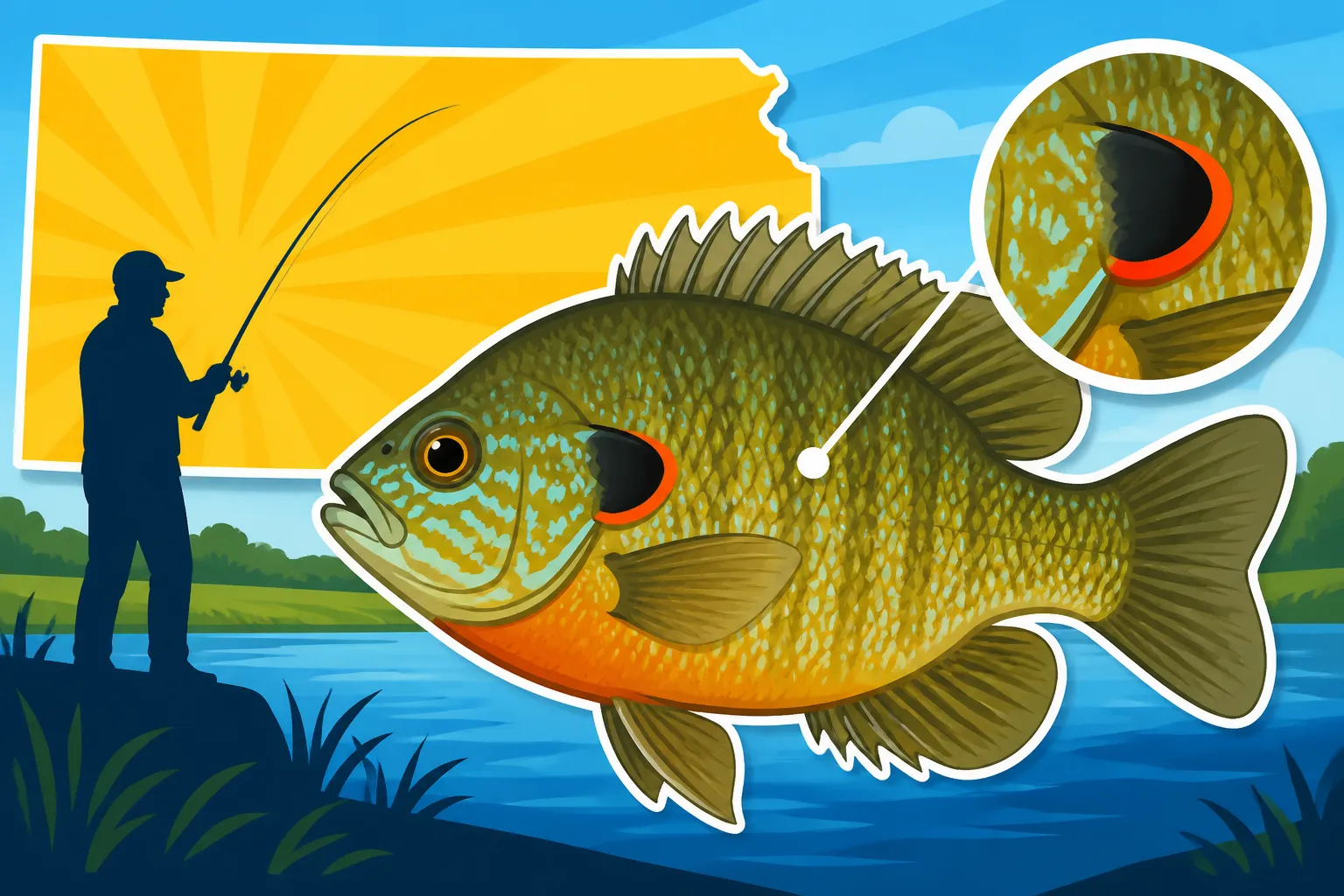
This is, by far, the most defining characteristic and the origin of their common name. A Redear Sunfish will have a distinctive red or orange margin around the posterior edge of its opercular flap – that's the stiff, bony plate covering the gills, often referred to as the "ear" or "gill cover." This margin can vary in intensity. On a vibrant male during spawning season, it might be a brilliant, fiery red. On a younger fish or one from less clear water, it might appear more as a dull orange or even a reddish-brown crescent.
The crucial point here is that it's a colored margin, not just a solid black spot like you'd find on a bluegill. You'll see this color clearly outlined, sometimes a thin line, sometimes a thicker band, along the very edge of the flap. This feature is present on both sexes, though usually more pronounced and vivid in males, particularly when they're guarding nests. Even if the fish is a bit pale from being caught, or if the water is murky, that reddish hue is usually still discernible, making it your primary go-to for identification. Keep an eye out for this splash of color; it’s the ultimate clue.
Body Coloration and Markings
Beyond the "ear," the body of a Redear Sunfish provides additional clues. Their overall coloration is generally a rich olive-green on the back, fading into a brassy or golden-green on the sides. You'll often notice a pattern of scattered dark spots or speckles along their flanks, giving them a somewhat speckled appearance, particularly above the lateral line. These spots are usually irregular, not forming distinct vertical bars as you might see on some bluegill or largemouth bass.
The belly is typically pale, ranging from white to yellowish, sometimes with a slight orange tint, especially in larger, mature specimens. It’s important to remember that fish coloration can be highly variable depending on water clarity, diet, and even the fish's mood. A redear pulled from stained, tannin-rich water might appear darker and more subdued than one caught from clear, sandy-bottomed lakes. However, the consistent theme is that blend of olive and brassy tones with those distinct speckles, lacking the strong vertical barring often seen in other sunfish.
Mouth and Fin Characteristics
Take a closer look at the mouth of the fish. Redear Sunfish have a relatively small, somewhat pointed mouth, especially when compared to a Green Sunfish. Their upper jaw typically doesn't extend past the front edge of the eye, which is a subtle but helpful distinction. This smaller mouth is indicative of their diet, which largely consists of small invertebrates, particularly snails, which they "crack" with specialized pharyngeal teeth in their throats – hence the "shellcracker" nickname.
Now, let's examine the fins. The pectoral fins (the pair of fins behind the gill covers, on the sides of the body) are usually longer and more pointed than those of a bluegill. If you fold the pectoral fin forward, it will often extend past the front edge of the eye. This is a good subtle indicator. Their dorsal fin (the fin on the top of the back) and anal fin (the fin on the underside, towards the tail) are generally spiny in the front and soft-rayed in the back, typical of sunfish, but lack the pronounced dark blotches often found on the soft dorsal fin of bluegill. The overall fin structure is proportionate to their robust body, contributing to their strong fighting ability. Sometimes, to really examine those subtle differences, a small magnifying glass – check out options on Amazon – can be a game-changer for new anglers.
Differentiating Redear Sunfish from Look-alikes in Kansas
Kansas waters are home to a variety of panfish, and many of them can look quite similar at first glance. It's easy to confuse a redear with a bluegill or even a green sunfish, especially if you're new to fishing or just not paying close attention. Knowing the subtle differences is key to accurate identification. This is where a careful eye and a bit of practice come into play.
Redear vs. Bluegill
This is probably the most common identification challenge. Both redear and bluegill are deep-bodied, panfish, often found in similar habitats. However, there are crucial differences. The most significant is the "ear" flap. A bluegill will have a solid black or dark blue-black opercular flap, often with no distinct colored margin. It might look iridescent in certain lights, but it won't have that clear red or orange rim that is the hallmark of the redear.
Furthermore, bluegill often exhibit distinct dark vertical bars along their sides, especially when stressed or during spawning, which redear typically lack. Bluegill also tend to have a smaller, more puckered mouth, but the redear's mouth is even more distinctly pointed and less "puckered." While both are phenomenal fish to catch, their distinct characteristics make it possible to tell them apart once you know what to look for. Think of the bluegill's "ear" as a solid, dark earring, while the redear has a fancy, colorful trim. You can learn more about Kansas Bluegill Identification to sharpen your skills.
Redear vs. Green Sunfish
Green Sunfish are another common panfish in Kansas, and they can sometimes be confused with redears, especially smaller ones. The key distinguishing features lie in their mouth, body shape, and gill flap. Green Sunfish have a noticeably larger mouth that extends back to at least the middle of the eye, sometimes even beyond it. This gives them a more predatory appearance, and indeed, they are often more aggressive feeders. Their body tends to be more elongated and less deep-bodied than a redear, with a robust, almost bass-like head.
While Green Sunfish do have an opercular flap with a black spot, it rarely, if ever, has a red or orange margin. Instead, it might have a yellowish or greenish-white edge, but never the vibrant red of a true redear. Green Sunfish often have bright yellow or orange margins on their dorsal, anal, and caudal (tail) fins, which is another characteristic generally absent in redears. They also tend to have a blotchy pattern on their sides rather than the more uniform speckles of a redear. Understanding these differences can really help you correctly identify your catch.
Redear vs. Other Panfish and Hybrids
Kansas waters host several other sunfish species, including various types of sunfish and crappie. While crappie (both white and black) are generally much easier to distinguish due to their distinct body shape and fin structure, other sunfish can sometimes present a challenge. For instance, sometimes you might encounter a hybrid sunfish – a cross between two different species, often bluegill and green sunfish. These hybrids can be particularly tricky because they might exhibit a mix of characteristics from both parent species. They might have a faint hint of red, or a gill flap that isn't quite solid black but also not a clear red margin.
In these cases, if the red or orange margin on the opercular flap isn't clearly defined and vibrant, it's likely not a pure Redear Sunfish. Always look for that unmistakable reddish trim as your primary identifier. If you're really unsure, especially with a hybrid, it's often best to default to the more common species or observe if it shows a strong dominant characteristic. When it comes to fishing regulations, if you can't confidently identify it, it's usually safest to assume it falls under a general panfish category. For a broader overview of species, check out the Kansas Fish Species Guide or the Kansas Panfish Guide.
Here's a quick comparison table to help you keep these sunfish straight:
| Feature | Redear Sunfish | Bluegill | Green Sunfish |
|---|---|---|---|
| Opercular Flap | Black spot with distinct red/orange margin | Solid black or dark blue-black spot, no red | Black spot with yellowish/greenish-white margin |
| Mouth Size | Small, pointed; upper jaw typically not past eye | Small, puckered; upper jaw not past eye | Large; upper jaw extends to middle or past eye |
| Body Shape | Deep-bodied, robust, somewhat compressed | Very deep-bodied, rounder, compressed | More elongated, less deep, robust head |
| Body Color | Olive-green back, golden/brassy flanks, speckles | Olive-green to dark blue back, silvery sides, often vertical bars | Olive-green, blue-green mottling, yellow belly |
| Pectoral Fin | Longer, pointed; often extends past eye | Shorter, rounder; typically doesn't reach eye | Shorter, rounded |
| Fin Margins | Usually dusky or clear | Usually dusky or clear, sometimes yellowish | Often bright yellow or orange margins on fins |
Habitat and Behavior Clues for Identification
Beyond just looking at the fish once it's on the hook, understanding where and how Redear Sunfish live can significantly boost your identification skills. Certain behaviors and preferred environments are strong indicators that you're in the right place to find these particular panfish, even before you see that tell-tale red ear.
Preferred Habitats in Kansas
Redear Sunfish in Kansas have a strong preference for clear, vegetated waters. They thrive in lakes, ponds, and slow-moving river backwaters where there's an abundance of aquatic vegetation, such as lily pads, submerged grass beds, and brush piles. This vegetation provides both cover from predators and a rich feeding ground. Unlike some other sunfish that might be found higher in the water column, redears are often bottom-oriented. They spend a good deal of their time rooting around in the substrate, searching for their favorite meals.
Look for them around structural elements like brush piles, submerged logs, rock beds, or even rip-rap along dam faces, especially in areas with moderate depth. They don't typically do as well in extremely muddy or turbulent waters. If you're fishing a clear Kansas lake with plenty of natural cover and a healthy invertebrate population, your chances of encountering a redear are much higher. Many Kansas Community Lake Fishing Rules are designed to support healthy panfish populations like the redear.
Feeding Habits and Nicknames
The Redear Sunfish earned its famous nickname, "shellcracker," for a very good reason: their diet primarily consists of snails and other shelled invertebrates. Unlike bluegill, which are more generalist feeders, picking off insects from the surface or water column, redears have specialized crushing plates in their throats (pharyngeal teeth) that allow them to effectively crunch through snail shells.
This specialized diet means they spend a lot of time on or near the bottom, often rooting around in the vegetation or soft sediment to dislodge their prey. Knowing this helps not only with identification but also with fishing strategy. If you're targeting redears, you'll want to present your bait or lure close to the bottom, perhaps using small jigs tipped with bait or tiny worms, mimicking the food sources they naturally seek out. Their preference for mollusks also means that they tend to thrive in water bodies with abundant snail populations, which correlates with their preference for clear, vegetated environments.
Spawning Behaviors
Like most sunfish, Redear Sunfish are nest builders and colonial spawners. They typically spawn in late spring to early summer when water temperatures consistently reach the upper 60s to low 70s Fahrenheit. Males will fan out shallow depressions in sandy or gravelly bottoms, often in clusters near aquatic vegetation or other cover, similar to how bluegill spawn. During this time, the males become much more vibrant in coloration, with the red margin on their opercular flap becoming incredibly vivid.
Observing these nesting colonies can be a strong indicator of redear presence. While they often nest alongside other sunfish species, the presence of multiple males with clearly defined red ear flaps strongly points to a redear population. They're very protective of their nests, making them susceptible to being caught during this period. Knowing Kansas Fishing Seasons Guide and general spawning times can help you understand when to look for these behaviors.
Why Accurate Identification Matters
Beyond the simple satisfaction of knowing what you've caught, being able to accurately identify a Redear Sunfish and distinguish it from other species carries practical importance for both the individual angler and the broader fishing ecosystem. It impacts your experience, your compliance with regulations, and contributes to the health of our fisheries.
Angling Success and Regulations
For the angler, accurate identification is crucial for several reasons. Firstly, it allows you to refine your fishing techniques and tackle. If you know you're targeting redears, you might choose specific baits (like small pieces of worm or grubs) and presentations (bottom fishing) that differ from those you'd use for bluegill or crappie. Knowing your quarry means you can become a more effective and successful angler.
Secondly, and perhaps most importantly, different fish species often have different regulations, including daily creel limits and sometimes length limits. Misidentifying a fish could inadvertently lead to you exceeding a limit for one species while thinking you were catching another. For example, while panfish limits are often generous, it's critical to understand the rules. Always check the current Kansas Daily Creel Limits by Species to ensure you're compliant. A good fishing guide, easily found on Amazon, can often help with quick identification in the field. Ignoring these rules, even accidentally, can lead to penalties for Fishing Without a License Penalties in Kansas or for violating catch limits.
Conservation and Ecology
From a broader perspective, accurate species identification is vital for fisheries management and conservation efforts in Kansas. State wildlife agencies rely on angler catch reports and surveys to monitor fish populations, track trends, and make informed decisions about stocking programs, habitat improvements, and regulation adjustments. If anglers are consistently misidentifying species, this data can become skewed, leading to less effective management strategies.
Healthy fish populations, including the beloved Redear Sunfish, contribute to the overall ecological balance of Kansas waterways. By understanding and correctly identifying the fish we catch, we become active participants in the conservation process. This helps ensure that future generations of anglers will continue to enjoy the thrill of catching these unique and delicious "shellcrackers" in the beautiful lakes and ponds across our state. Every angler plays a role in keeping our waters vibrant and thriving.
Disclaimer
This article is for general informational purposes only and does not constitute professional advice. Laws, prices and regulations vary by location and change over time. Consult a qualified professional for guidance on your specific situation.