Kansas Fish Species Guide
It can be incredibly frustrating to hit the water in Kansas, feel a tug on your line, and then pull in a fish you can’t quite identify. Is it a walleye or a saugeye? A white crappie or a black crappie? Knowing your fish species isn't just about satisfying curiosity; it's crucial for understanding regulations, tailoring your techniques, and even knowing what you're bringing home for dinner. This comprehensive guide will walk you through the diverse and exciting world of Kansas fish species, helping you confidently identify your catch and appreciate the incredible biodiversity our state's waters offer.
Understanding Kansas's Diverse Aquatic Ecosystems
Kansas might be known for its vast prairies and golden wheat fields, but beneath the surface of our lakes, rivers, and ponds lies a surprisingly rich and varied aquatic world. Our state boasts a remarkable array of fish species, each adapted to different environments, from the muddy bottoms of the Kansas River to the clear, rocky depths of Wilson Lake. This diversity is what makes fishing in Kansas so endlessly fascinating – you never quite know what you might reel in next!
The Importance of Habitat Diversity
Our state's waterways offer a mosaic of habitats, and this habitat diversity is directly responsible for the wide range of fish species you'll encounter. Large reservoirs like Milford Lake and Cheney Reservoir provide expansive open water, deep channels, and rocky points perfect for species like walleye, wipers, and striped bass. Meanwhile, the slower, often muddier flows of rivers such as the Kansas River or the Marais des Cygnes are prime territory for various catfish species and gar. Even smaller farm ponds and community lakes, with their shallower, often weedier conditions, are bustling with panfish and largemouth bass.
The type of water body, its depth, current, bottom composition, and vegetation all play a critical role in determining which fish species thrive there. For instance, cold, clear, flowing water is ideal for trout (when stocked), while warm, turbid, slow-moving water is perfect for channel catfish. Understanding these basic habitat preferences can significantly improve your chances of targeting specific species and truly appreciating the intricate web of life beneath the surface.
Native vs. Introduced Species
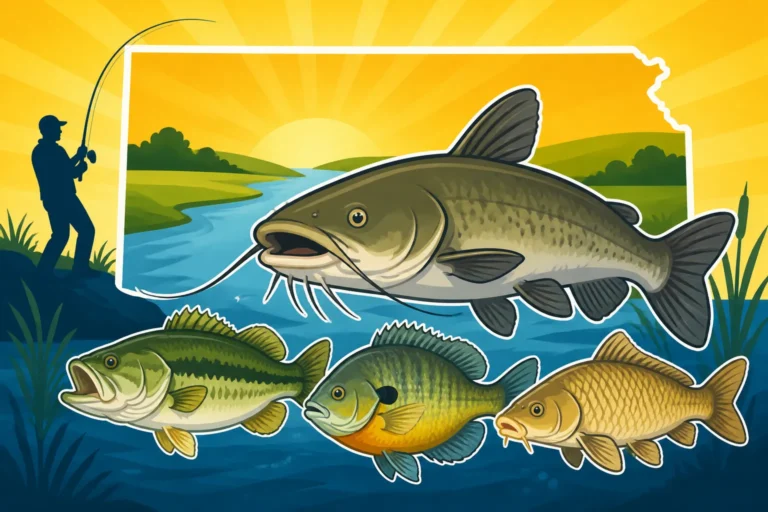
When you're out fishing in Kansas, you're interacting with a mix of fish that have called these waters home for centuries and others that have been introduced, sometimes intentionally, to enhance fishing opportunities. Our native species, such as channel catfish, flathead catfish, largemouth bass, and many panfish, are perfectly adapted to the natural conditions of Kansas. They form the backbone of our aquatic ecosystems and provide countless hours of angling enjoyment.
However, many of our most popular game fish, like walleye, saugeye, and wipers, are either introduced or are hybrids developed for their sporting qualities and excellent table fare. These introductions have greatly expanded the diversity of fishing experiences available to anglers. For example, the saugeye, a cross between a walleye and a sauger, was specifically created to thrive in the sometimes turbid waters of Kansas reservoirs where pure walleye might struggle. It's a fascinating blend of nature and fishery management, all aimed at giving us more fish to catch!
The Mighty Catfish Family: Kings of Kansas Waters
When you think of fishing in Kansas, chances are the image of a whiskered warrior comes to mind. Catfish are deeply ingrained in the state's angling culture, offering everything from easy bank fishing for dinner to epic battles with true monsters of the deep. They are resilient, abundant, and delicious, making them a favorite for many anglers.
Channel Catfish: The Widespread Favorite
The channel catfish is, without a doubt, the most ubiquitous and beloved catfish species in Kansas. You can find them in virtually every lake, pond, and river across the state, from urban community lakes to the largest reservoirs. They are easily identifiable by their deeply forked tail, smooth, scaleless skin, and dark spots that become less pronounced as they age. Channel catfish are opportunistic feeders, eating just about anything from insects and crawdads to smaller fish and decaying matter. This makes them relatively easy to catch using a wide variety of baits.
Anglers often target channel cats with cut bait, stink baits, worms, or even hot dogs. They put up a respectable fight, especially on lighter tackle, and their white, flaky meat is excellent on the dinner table. It’s a species that truly offers something for everyone, whether you’re a beginner angler or a seasoned pro. Knowing Kansas Channel Catfish Facts and Limits is essential before heading out. For gear, many anglers find a basic spinning rod and reel combo, along with a tackle box stocked with circle hooks and slip sinkers, to be perfect. You can find excellent starter kits for catfish on Amazon, which often include a variety of essential terminal tackle.
Blue Catfish: Giants of the Reservoirs
If you're looking for a serious battle, the blue catfish is your target. These true titans of the catfish world are primarily found in our larger reservoirs like Milford Lake, Tuttle Creek Lake, and the Kansas River. Blue cats can grow to immense sizes, with state records pushing well over 100 pounds. They are distinguishable from channel cats by their less-forked tail (though still noticeably forked), typically unspotted, bluish-gray coloration, and a distinct hump behind their head in larger specimens.
Blue catfish are primarily piscivorous, meaning they prefer to eat other fish. Cut bait, especially fresh shad or carp, is often the most effective for these monsters. Targeting blue cats requires heavier tackle – stout rods, large baitcasting reels, and strong braided line are a must. The fight of a big blue cat is legendary, often involving long, powerful runs that will test your gear and your endurance. They are a highly sought-after trophy fish, and the feeling of landing a true giant is an experience few anglers ever forget.
Flathead Catfish: Ambush Predators of Rivers
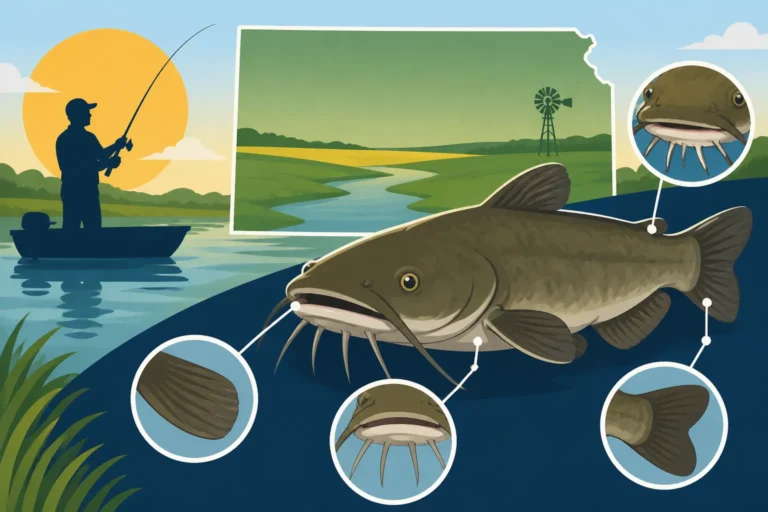
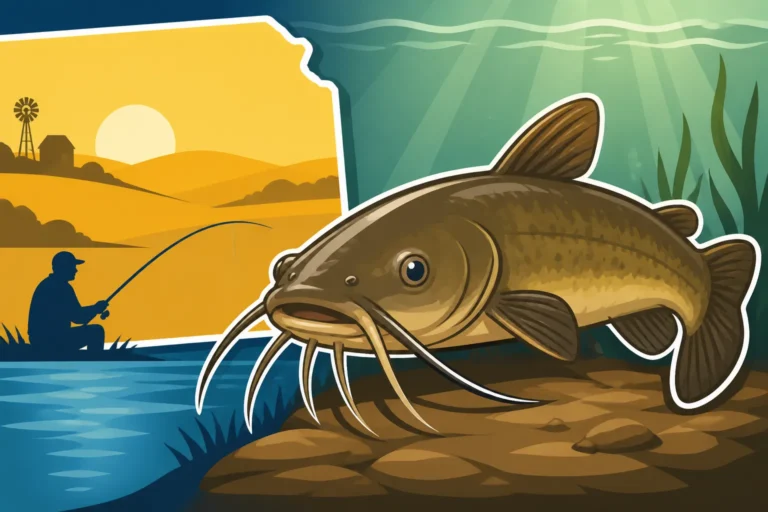
The flathead catfish is another heavyweight contender, but with a distinctly different personality and preferred habitat. Flatheads are solitary, ambush predators that prefer structure-laden rivers and large creek systems, though you can find them in some reservoirs too. Their name comes from their distinctive broad, flattened head, and they have a unique lower jaw that protrudes beyond the upper jaw. Their coloration is mottled, often yellowish-brown with dark blotches, providing excellent camouflage in their preferred rocky or woody cover. Their tail is square or only slightly notched, not deeply forked like a channel or blue cat.
Unlike the omnivorous channel cat or the fish-eating blue cat, flatheads are almost exclusively piscivorous, and they prefer live bait. Sunfish, shad, and small carp are prime offerings for these elusive hunters. Fishing for flatheads often involves setting up near submerged logs, rock piles, or undercut banks, and waiting patiently for a powerful strike. They are incredibly strong fish and demand heavy-duty gear. Catching a flathead is often considered a true angling achievement, a testament to patience and a deep understanding of their secretive habits.
| Catfish Species | Typical Size Range (Kansas) | Key Identification | Preferred Habitat | Primary Diet |
|---|---|---|---|---|
| Channel Catfish | 1-10 lbs (can exceed 30 lbs) | Forked tail, spots (young), smooth skin | Ponds, lakes, rivers | Omnivorous (worms, bugs, cut bait, fish) |
| Blue Catfish | 5-50 lbs (can exceed 100 lbs) | Less forked tail, bluish-gray, unspotted | Large reservoirs, big rivers | Piscivorous (shad, other fish) |
| Flathead Catfish | 10-40 lbs (can exceed 70 lbs) | Flat head, protruding lower jaw, mottled color, square tail | Rivers, woody/rocky structure | Piscivorous (live fish) |
Walleye and Saugeye: Prized Catches for Table Fare
Kansas reservoirs are home to two highly sought-after predatory game fish known for their challenging nature and delectable white meat: the walleye and its hybrid cousin, the saugeye. These species provide thrilling action, especially during specific times of the year, and are a top target for many dedicated anglers.
Walleye: The Elusive Golden Eye
The walleye is a true freshwater gem, instantly recognizable by its large, glassy, light-sensitive eyes – hence the name "walleye." They have a long, slender body, golden-brown coloration with dark vertical bars, and a prominent dorsal fin with sharp spines. In Kansas, walleye thrive in our larger, clearer reservoirs like Wilson Lake, Milford Lake, and Cheney Reservoir, often preferring rocky structures, points, and humps. They are primarily nocturnal or crepuscular feeders, meaning they are most active during low light conditions at dawn, dusk, or night.
Walleye are cunning predators, and catching them often requires finesse and a good understanding of their movements. They primarily feed on baitfish like shad and crappie. Popular techniques include trolling with crankbaits or spinner rigs, jigging with live bait (minnows or nightcrawlers), and casting jerkbaits. They are legendary for their light bite, often described as a subtle "thump" or just added weight, making setting the hook a precise art. Successfully landing a walleye is incredibly rewarding, and their firm, flaky, white meat is considered among the finest freshwater table fare. Checking Kansas Walleye Size and Limits is crucial, as they often have specific regulations to protect the fishery.
Saugeye: A Kansas Hybrid Success Story
For anglers who love walleye but fish waters that might be a bit murkier or warmer, the saugeye is a fantastic alternative. The saugeye is a fertile hybrid cross between a female walleye and a male sauger, specifically developed to thrive in a broader range of water conditions, including the often-turbid waters of many Kansas reservoirs like Perry Lake and Tuttle Creek Lake. They grow faster and are often more aggressive than pure walleye, making them a great target for anglers.
Visually, saugeye are a blend of their parents. They have the large, glassy eyes of a walleye but often exhibit distinct dark spots on their dorsal fin, a characteristic inherited from the sauger. Their overall coloration can be more mottled or blotchy than a pure walleye. They share many of the same predatory instincts as walleye, feeding on baitfish, but are often more willing to bite during daylight hours. Techniques for catching saugeye are similar to walleye, with trolling crankbaits and jigging proving very effective. They are excellent fighters and, like walleye, provide superb table quality. Understanding the nuances of Saugeye Identification can really help you distinguish them from pure walleye on the water.
Crappie: Panfish for Every Angler
Crappie, both white and black, are arguably the most popular panfish in Kansas, beloved by anglers of all ages for their aggressive bites, schooling behavior, and delicious fillets. They are a staple of Kansas fishing, providing excellent opportunities year-round, but especially during their spring spawning season.
White Crappie: The Schooling Aggressors
White crappie are widespread across Kansas, inhabiting most reservoirs, state fishing lakes, and larger ponds. They are easily identified by their silvery bodies, often with 5-10 dark vertical bars on their sides, and a dorsal fin with 5 or 6 spines. White crappie are typically found in open water near submerged brush piles, standing timber, or other forms of cover, often suspending in schools. They are aggressive feeders, particularly during their spring spawn when they move into shallower water to build nests.
Anglers pursue white crappie with a variety of methods. Small jigs (often tipped with a minnow or a plastic grub) are incredibly effective, as are live minnows suspended under a bobber. When you find a school of white crappie, the action can be fast and furious, leading to quick limits. Their propensity to school makes them an excellent target for Kansas Spring Crappie Fishing Tips, as you can often catch many fish from a single spot. They are also fantastic table fare, with sweet, white meat that's perfect for frying. Knowing Kansas White Crappie Identification will help you quickly distinguish them from their black crappie cousins.
Black Crappie: Structure Lovers
While often found alongside white crappie, black crappie tend to prefer slightly clearer water and more dense vegetation or woody cover. They are distinguishable by their darker, often mottled coloration, and typically have 7 or 8 spines in their dorsal fin – a key difference from the white crappie. The dark mottling on their sides, which sometimes forms irregular blotches rather than distinct vertical bars, also sets them apart.
Black crappie are often more tightly associated with structure than white crappie, making them a fun challenge to target. You'll find them holding tight to submerged logs, fallen trees, brush piles, and weed beds. Like white crappie, they readily strike small jigs and live minnows. They also school, but their schools can be tighter to cover. Many anglers choose ultra-light spinning gear for crappie, enjoying the spirited fight these relatively small fish put up. Both species are excellent eating, making a successful crappie outing a treat for the palate as well as the spirit.
Bass Species: The Thrill of the Fight
For many anglers, the aggressive strike and acrobatic fight of a bass represent the pinnacle of freshwater sportfishing. Kansas is home to three main species of black bass, each offering a unique challenge and thrill.
Largemouth Bass: The Classic Ambush Predator
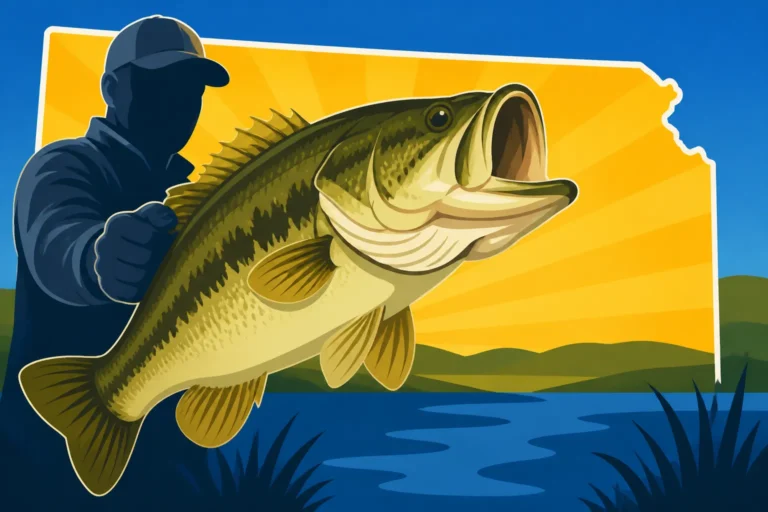
The largemouth bass is arguably the most iconic freshwater game fish in North America, and it thrives in many Kansas waters. They are easily identified by their large mouth (the jaw extends beyond the eye when closed), a dark lateral stripe running down their side, and their deep olive-green to blackish back, fading to white on the belly. Largemouth bass prefer warmer, shallower, often vegetated waters – think farm ponds, community lakes, and the protected coves of larger reservoirs. They are classic ambush predators, lying in wait among weeds, lily pads, or submerged timber for an unsuspecting baitfish or frog.
Anglers pursue largemouth bass with an incredible array of lures and techniques. Spinnerbaits, crankbaits, plastic worms, jigs, and topwater lures are all highly effective, depending on the season and conditions. The explosive strike of a largemouth, especially on a topwater lure, is heart-stopping. They are powerful fighters, often jumping and thrashing to throw the hook. Catching a trophy largemouth is a celebrated achievement, and while many are caught for sport and released, their white, flaky meat is also delicious. Kansas Largemouth Bass Facts provide more details on their behavior and habitat. Finding a good selection of bass lures on Amazon can help you be prepared for any situation.
Smallmouth Bass: River and Reservoir Fighters
While not as widespread as their largemouth cousins, smallmouth bass offer an equally thrilling, if not more powerful, fight. True to their name, their mouth does not extend beyond the eye. They also typically have vertical bars or splotches on their sides rather than a distinct lateral stripe, and their coloration is often more bronze or brownish-gold. Smallmouth bass prefer cooler, clearer, rocky waters, making them a prime target in certain Kansas reservoirs like Wilson Lake and sections of our clearer rivers. They are less associated with dense vegetation and more with hard bottom, rocks, and current.
Smallmouth bass are fierce fighters pound-for-pound, known for their incredible stamina and acrobatic jumps. They feed on crayfish, minnows, and aquatic insects. Anglers targeting smallmouth often use techniques like fishing tube jigs, Ned rigs, grubs, and small crankbaits around rocky points, drop-offs, and current seams. Their habitat preferences mean you might need to cover more water or focus on specific types of structure to find them. The "bronze back" is a prized catch for its fighting spirit and beautiful appearance.
Spotted Bass: An Often Overlooked Challenger
The spotted bass, sometimes called a "spot," is often confused with both largemouth and smallmouth bass in Kansas, but it has distinct characteristics. Its mouth is smaller than a largemouth's but larger than a smallmouth's, extending to or slightly beyond the back of the eye. A key identifying feature is a patch of small teeth on its tongue, which neither largemouth nor smallmouth possess. They also have rows of dark spots on their lower sides, giving them their name. Spotted bass often occupy a habitat somewhere between largemouth and smallmouth, comfortable in moderately clear waters with some current and rocky or woody structure.
Spotted bass are aggressive feeders and excellent fighters, often performing multiple jumps and strong runs. They tend to school more readily than largemouth, and once you find them, you can often catch several from the same area. They respond well to many of the same lures used for largemouth and smallmouth, including jigs, crankbaits, and soft plastics. Don't underestimate the spotted bass; they offer a fantastic angling experience and are an important part of Kansas's diverse bass fishery.
White Bass, Stripers, and Wipers: Hard-Fighting Schooling Fish
If you're looking for fast action and powerful fights, the white bass, striped bass, and their hybrid, the wiper, are species you'll want to get acquainted with. These schooling predators offer some of the most exciting fishing opportunities in Kansas.
White Bass: The Energetic Schoolers
White bass are a fantastic and abundant sport fish found in most of Kansas's larger reservoirs and rivers. They are characterized by their silvery bodies with distinct dark lateral stripes (usually 4-7, often broken), and a deep body profile. What makes white bass so much fun to catch is their schooling behavior and aggressive feeding frenzies, often called "white bass runs" or "boils." During these events, large schools of white bass herd baitfish to the surface, creating a visible commotion that anglers can spot from a distance.
These frenzies often occur in spring during their spawning runs up rivers and creeks, and then throughout summer and fall on the open water of reservoirs. When a school is active, just about any small, shiny lure will get hit – Kastmasters, Rooster Tails, small crankbaits, or even just bare hooks. The action can be non-stop, making them an excellent species for beginners and seasoned anglers alike. White bass are also good eating, though they have a more pronounced "fishy" flavor than crappie or walleye. They are a true schooling species, providing some of the most exhilarating fishing experiences Kansas has to offer. For more on their characteristics, read up on Kansas White Bass Identification.
Striped Bass and Wipers: Hybrid Powerhouses
For sheer power and size among the "striped" family, the striped bass and its hybrid, the wiper, are the top contenders in Kansas.
Striped Bass are native to saltwater but have been successfully stocked in a few large, deep Kansas reservoirs, most notably Wilson Lake and Cedar Bluff Reservoir, where they are able to survive and grow to impressive sizes. They have long, silvery bodies with prominent, unbroken dark lateral stripes. Stripers are powerful, open-water predators that feed almost exclusively on large baitfish. Catching a pure striped bass in Kansas is a trophy achievement, often requiring heavy tackle and specialized trolling techniques with large plugs or live bait.
The wiper (also known as a "hybrid striped bass") is a cross between a female striped bass and a male white bass. This hybrid was specifically developed for its incredible growth rate, aggressive nature, and ability to thrive in waters that might not support pure striped bass. Wipers are found in many major Kansas reservoirs, including Cheney, Milford, and El Dorado lakes. They look like a blend of their parents, with a deep body like a white bass but more distinct, often broken or irregular, lateral stripes. A key identifier is that their stripes are usually broken and uneven, unlike the mostly unbroken stripes of a pure striper. Check out Kansas Hybrid Striped Bass Identification for visual cues.
Wipers are renowned for their brutal strength and relentless fights. They are open-water predators, often schooling and chasing baitfish. Anglers target them by trolling large crankbaits, casting heavy spoons, or using live bait like shad. When a wiper hits, be prepared for a fight that will test your tackle and muscles. They are excellent eating, especially when fresh, and are considered one of Kansas's premier sport fish.
Panfish and Sunfish: Fun for the Whole Family
While trophy fish grab headlines, the humble panfish and sunfish provide countless hours of enjoyment, especially for families and those seeking consistent action. These smaller, often brightly colored fish are abundant, easy to catch, and delicious, making them a perfect target for a relaxing day on the water.
Bluegill: The Backyard Pond Favorite
The bluegill is perhaps the most recognizable and widespread panfish in Kansas, found in nearly every pond, lake, and slow-moving river. They are characterized by their distinctive dark "ear flap" (a black spot on the operculum), a small mouth, and often vibrant blue and orange coloration, especially in males during the spawning season. Their name comes from the iridescent blue around their gill plates. Bluegill are typically found in shallower water, often around vegetation, docks, or submerged brush, where they feed on insects, small crustaceans, and plant matter.
Bluegill are incredibly easy to catch, making them an ideal target for introducing children to fishing. A small hook, a bit of worm, and a bobber are often all you need. They provide a spirited fight for their size, and their sheer abundance means you can often catch many in a short amount of time. Kansas Bluegill Identification details their appearance and habitat. Their small, flaky fillets are sweet and delicious, though it takes a few to make a meal! Many anglers enjoy using ultra-light rods and reels for bluegill, savoring every wiggle and pull.
Redear Sunfish: Shellcrackers of Kansas
The redear sunfish, often affectionately called a "shellcracker," is another popular panfish in Kansas, though perhaps not as widespread as the bluegill. They get their "shellcracker" nickname from their diet, which largely consists of snails and other mollusks, which they crush with specialized teeth. Redear are identified by a prominent red or orange margin on their opercular flap (the "ear flap"), which is typically bright red in males. They also tend to have a slightly more pointed snout than a bluegill and a more subdued, olive-green coloration.
Redear prefer clear, vegetated waters in ponds and lakes, often congregating near the bottom where their mollusk prey resides. While they can be caught with worms like bluegill, targeting them specifically often involves fishing baits closer to the bottom. They grow larger than bluegill on average and offer a robust fight, making them a fun challenge on light tackle. Their meat is firm and delicious, making them a highly desirable catch for the frying pan.
Other Notable Sunfish Species
Kansas waters are home to several other sunfish species that add to the panfish bounty. These include:
- Green Sunfish: A hardy and aggressive sunfish, identifiable by its larger mouth (similar to a bass), blue-green iridescent spots, and a prominent black spot at the base of the dorsal and anal fins. They are extremely common in smaller ponds and creeks, often outcompeting bluegill in less-than-ideal conditions. While smaller, they are feisty.
- Warmouth: A lesser-known sunfish that resembles a rock bass or a stockier green sunfish. They have a more bass-like body shape, dark irregular blotches, and red eyes. They prefer slow-moving water with plenty of vegetation or woody cover.
- Orangespotted Sunfish: A smaller, often overlooked sunfish with striking orange spots on its sides. More common in slow rivers and marshy areas, they are less of a targeted game fish but add to the diversity.
All these panfish species are excellent for introducing new anglers to the sport and providing a consistent, enjoyable fishing experience, often requiring only simple gear that can be easily picked up at local sporting goods stores or through online retailers like Amazon.
Unique and Lesser-Known Kansas Fish Species
Beyond the popular game fish, Kansas waters hold some truly unique and often overlooked species, some with ancient lineages and others providing niche fishing opportunities or important ecological roles.
Paddlefish: Prehistoric Giants
The paddlefish is one of the most remarkable and ancient fish species found in Kansas. This truly prehistoric fish is easily identified by its extremely long, paddle-shaped snout, which can be up to one-third of its total body length. They are smooth-skinned, dark gray to black, and can grow to enormous sizes, often exceeding 50-60 pounds, with state records pushing much higher. Paddlefish are filter feeders, using their paddle to detect plankton in the water, which they then filter through their gill rakers.
In Kansas, paddlefish populations are primarily found in specific rivers, particularly the Neosho and Marais des Cygnes, and in areas of their impounded reservoirs. They do not bite hooks in the traditional sense due to their filter-feeding nature. Instead, they are caught through a technique called "snagging" during a specific, highly regulated season, typically in the spring when they migrate upstream to spawn. Snagging involves using large, barbless treble hooks to literally snag the fish as they swim by. It's a highly physical and unique fishing experience that offers the chance to catch a truly enormous, ancient creature. Understanding Kansas Paddlefish Snagging Season is essential before attempting to catch these magnificent fish.
Gar Species: Ancient Predators
Kansas waters are home to several species of gar, fish that look like they swam straight out of the dinosaur age. Longnose gar, shortnose gar, and spotted gar are the most common. All gar species are characterized by their long, slender bodies, diamond-shaped ganoid scales (which are hard and bony, like armor), and a mouth full of sharp teeth. They are ambush predators, often lurking near the surface in shallow, weedy areas, waiting to strike at unsuspecting baitfish.
Gar are often viewed as "trash fish" by some anglers, but they are powerful fighters and a unique challenge. Their hard, bony mouths make them difficult to hook with conventional methods. Some anglers specifically target them using rope lures (frayed nylon rope that their teeth get tangled in) or by carefully planning their hook sets when using live bait. They put up a strong, often acrobatic fight, and landing a large gar is an accomplishment. While their flesh is edible (though difficult to clean due to their scales), many anglers practice catch and release for these fascinating living fossils.
Freshwater Drum and Common Carp: Abundant and Overlooked
Many Kansas anglers might dismiss the freshwater drum and common carp, but these abundant species play important ecological roles and can provide excellent fishing action, especially for those looking for something different.
The freshwater drum, sometimes called a "sheepshead" or "gaspergou," is found in many large rivers and reservoirs. They have a humped back, a silvery-gray body, and a distinctive lateral line that curves sharply upwards. Drum are bottom feeders, using their sensitive barbels and a powerful pharyngeal jaw to crush mollusks, crayfish, and insects. They are strong fighters, often pulling hard and deep. While sometimes overlooked, their firm, white meat is quite good, particularly when fresh.
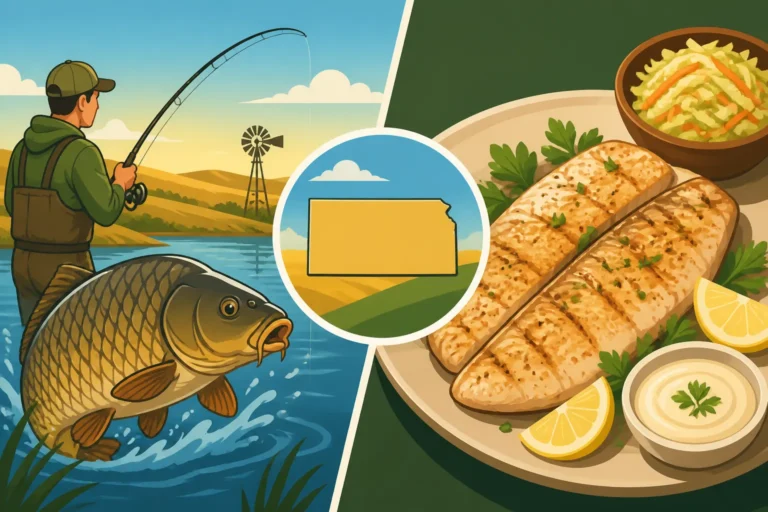
The common carp is an introduced species that has proliferated across Kansas waters. Carp are large, deep-bodied fish with prominent barbels around their mouth, and golden-brown or olive coloration. They are bottom feeders, rooting around in the mud for insects, worms, and plant matter. Despite their reputation, carp are incredibly powerful fighters, especially on light tackle, and are highly sought after by a dedicated segment of anglers. "Euro-style" carp fishing, using specialized rigs and baits like corn or dough balls, is a popular technique. While often released, smaller carp can be prepared for eating. These species, while not always the first choice, certainly offer unique angling experiences.
Stocked Trout: A Winter Delicacy
Kansas isn't known for its natural trout streams, but thanks to the Kansas Department of Wildlife, Parks and Tourism (KDWP), rainbow trout are stocked in various community lakes and streams across the state during the cooler months, typically from fall through spring. These stockings provide a fantastic cold-weather fishing opportunity, especially for families.
Rainbow trout are identifiable by their iridescent silver bodies with a pink or red stripe along their sides and numerous small black spots. They are cold-water fish, which is why their season is limited to when water temperatures are low enough for them to survive and thrive. Anglers targeting stocked trout use light tackle, small hooks, and baits like power bait, corn, worms, or small spinners and flies. The thrill of catching a colorful rainbow trout on a chilly winter day is a unique pleasure in Kansas. Be sure to check Kansas Trout Permit Guide as a special trout permit is required in addition to a standard fishing license to fish for and possess trout.
Key Considerations for Kansas Anglers
Understanding the fish species in Kansas is just the beginning. To be a successful and responsible angler, there are a few more critical aspects to keep in mind.
Regulations, Limits, and Seasons
Every fish species in Kansas has specific regulations regarding size limits, daily creel limits (how many you can keep), and sometimes even seasonal restrictions. These regulations are put in place by the KDWP to ensure sustainable fish populations for future generations. Forgetting to check these rules can lead to fines and a poor experience. For example, walleye often have minimum length limits to allow fish to reach reproductive maturity, and crappie might have very generous limits due to their fast reproduction rates.
It's your responsibility as an angler to know and follow these rules. Always consult the current KDWP Fishing Regulations Summary or their website before heading out. This is not just about avoiding trouble; it's about being a good steward of our natural resources. Understanding Kansas Fishing Seasons and Limits is foundational to any successful trip.
Where to Find Specific Species
Knowing what fish live in Kansas is one thing; knowing where to find them is another. Different species prefer different habitats, and even within a single lake, their locations can change with the season, time of day, and weather conditions.
- Catfish: You'll find channel cats almost anywhere, but big blue cats are in large reservoirs and rivers, while flatheads prefer rivers with lots of structure.
- Walleye & Saugeye: Focus on rocky points, humps, and submerged structure in large reservoirs.
- Crappie: Look for brush piles, standing timber, and submerged cover in most lakes and ponds.
- Bass: Largemouth love weeds and shallow cover in ponds and coves; smallmouth prefer rocky, clear water in specific reservoirs and rivers.
- White Bass, Stripers & Wipers: Open water chasing baitfish, or river runs in spring.
- Panfish: Shallow, vegetated areas in nearly all water bodies.
- Trout: Stocked waters during the winter months.
A great resource for finding specific spots is the KDWP's website, which often provides fishing reports and stocking schedules. Local bait shops are also invaluable sources of current information. Sometimes, a general search for Best Fishing Lakes in Kansas can help you narrow down your options based on target species.
Conservation and Responsible Angling
As anglers, we have a vital role to play in the conservation of Kansas's fish species and aquatic environments. This means practicing responsible angling habits:
- Catch and Release: For certain species, or when you've reached your limit, proper catch-and-release techniques ensure fish survive to fight another day. Use appropriate hooks, handle fish gently, and release them quickly.
- Respecting Limits: Adhering to daily creel and size limits is critical for maintaining healthy fish populations. Taking more than your share can quickly deplete a fishery.
- Preventing Invasive Species: Always clean, drain, and dry your boat and gear between water bodies to prevent the spread of aquatic nuisance species like zebra mussels or invasive plants.
- Litter Control: Pack out everything you pack in. Our waterways are not trash cans.
By understanding the species, respecting the rules, and practicing conservation, we can ensure that Kansas fishing remains a fantastic pastime for generations to come. Your passion for fishing directly contributes to the health and future of these amazing aquatic inhabitants.
Disclaimer
This article is for general informational purposes only and does not constitute professional advice. Laws, prices and regulations vary by location and change over time. Consult a qualified professional for guidance on your specific situation.