Best Tackle for Kansas Trout Fishing
Getting ready to chase trout in Kansas can be incredibly exciting, but also a little daunting if you're not sure which tackle will give you the best chance of success. It’s easy to feel overwhelmed by the sheer number of rods, reels, lines, and lures out there. This comprehensive guide will break down the essential gear you need for Kansas trout fishing, helping you make informed choices so you can hit the water with confidence.
Choosing the Right Rod and Reel Combination
When it comes to trout fishing in Kansas, your rod and reel setup is foundational. You're often dealing with smaller, sometimes skittish fish, and you need gear that allows for delicate presentations while still having enough backbone to fight a feisty rainbow. The key is balance and sensitivity.
Rod Types and Actions for Trout
For Kansas trout, most anglers gravitate towards lighter setups. An ultralight or light action spinning rod is almost universally recommended, and for good reason. These rods are designed to handle lighter lines and smaller lures, giving you the sensitivity to feel subtle bites and the flexibility to prevent small hooks from tearing out of a trout's mouth.
Think about the environment you’ll be fishing. Are you casting into small community ponds or larger, more open reservoirs? For tight quarters around stream banks or smaller ponds like those often stocked in urban areas, a shorter rod, perhaps 5 to 6 feet, offers better maneuverability. If you’re casting across a wider expanse of water at a larger lake, a rod in the 6.5 to 7-foot range can give you that extra casting distance you might need to reach where the trout are holding. The light action is crucial because it allows the rod to bend deeply into the blank, absorbing the shock of a trout’s head shakes and protecting your light line. A fast action tip on a light rod can still offer excellent sensitivity for detecting those soft takes, while the progressive bend handles the fight.
Ideal Reel Sizes for Trout Fishing
Matching your rod with the right reel is just as important. For ultralight or light action rods, you’ll want a spinning reel in the 1000 to 2500 size range. These are compact, lightweight reels that perfectly balance with a lighter rod. A 1000 size reel is often considered an ultralight setup, ideal for the absolute lightest lines and tiny baits. It’s fantastic for those days when the trout are particularly finicky and you need the most delicate presentation possible.
Moving up to a 2000 or 2500 size reel gives you a bit more line capacity and often a slightly smoother drag system, which can be beneficial if you hook into a surprisingly large trout or are fishing in an area with a lot of snags where you might need to apply a bit more pressure. The key characteristic to look for in any trout reel is a smooth, reliable drag system. Trout, especially freshly stocked ones, can make quick, powerful runs, and a sticky or jerky drag will almost certainly lead to a broken line or a pulled hook. A good quality reel with a consistent drag will let the fish take line when it needs to, wearing it out without putting undue stress on your light tackle.
Line Choices and Leader Setups
The line you choose, and how you rig your leader, can make or break your trout fishing success. Trout have excellent eyesight, especially in clear Kansas waters, so stealth is paramount.
Main Line Options for Trout
For your main line, you have a few primary choices, each with its own advantages. Monofilament line is a classic for a reason. Its inherent stretch acts as a shock absorber, which is great when a trout strikes hard or makes a sudden run, reducing the chance of breaking light lines. It's also relatively inexpensive and user-friendly. For most Kansas trout fishing, a 4 to 6-pound test monofilament is a solid choice. It's strong enough for the average trout while remaining thin enough for good casting distance and presentation.
Fluorocarbon line can also be used as a main line, particularly if you're in very clear water or fishing an area with abrasive structure. Its low visibility underwater is a huge plus, as it refracts light similar to water, making it nearly invisible to fish. However, fluorocarbon is generally more expensive and has less stretch than mono, so you need to be mindful of its shock absorption. Braided line, while incredibly strong and sensitive, is often too visible for trout as a main line. Its lack of stretch can also lead to pulled hooks. However, it excels when used with a fluorocarbon leader, offering extreme sensitivity and casting distance. If you go this route, a 6 to 8-pound test braid is usually sufficient, combined with a much lighter leader.
The Importance of a Fluorocarbon Leader
Regardless of your main line choice, a fluorocarbon leader is highly recommended for trout fishing. This is where you get the advantage of invisibility right at the business end of your setup. Even if you're using monofilament as your main line, adding a 2 to 4-foot section of fluorocarbon leader dramatically increases your chances of getting bites. The line test for your leader should typically be lighter than your main line. If you're running 6-pound mono, a 4-pound fluorocarbon leader is perfect. If you're using braided line, dropping down to a 4 or even 2-pound fluorocarbon leader will make a significant difference.
Trout are notorious for being line-shy, especially in heavily fished areas or crystal-clear waters, which you'll encounter in many of the community lakes and trout ponds stocked by the state. The low visibility of fluorocarbon means the fish are less likely to spot your line and shy away from your bait or lure. When tying your leader, ensure you use a strong, reliable knot like a double uni knot or an Albright knot to connect your main line to your leader. Practice these knots at home; a faulty knot is a common point of failure when fighting a good fish. Kansas Trout Permit Guide has more information on specific regulations you might encounter.
Baits and Lures for Hungry Trout
Once you have your rod, reel, and line sorted, it's time to think about what you're going to present to those trout. Kansas trout, especially newly stocked ones, can be quite aggressive, but they can also become picky, so having a variety of options is key.
Popular Baits for Kansas Trout
Live bait often reigns supreme for trout, offering natural scent and action that can be irresistible. Small worms like red wigglers or nightcrawler pieces are always a solid bet. They’re natural, readily available, and trout simply can’t seem to resist them. Thread a small piece onto a light wire hook, like a size 8 or 10, and fish it under a bobber or on a light Carolina rig.
For stocked rainbow trout, especially in those designated winter trout waters, prepared baits are often incredibly effective. Brands like PowerBait (in various colors like chartreuse, rainbow, or even glitter) are practically legendary. You can mold PowerBait into a small ball around your hook, letting it float off the bottom, or fish it under a bobber. Salmon eggs, particularly the scented varieties, are another fantastic option that trout find highly appealing. A small cluster of salmon eggs on a tiny hook can be deadly. When the fish are sluggish during colder months, presenting these baits slowly and subtly can be the trick. You can find many of these specific bait options at your local sporting goods store or even at larger retailers like Bass Pro Shops. For tips on when and where trout are stocked, check out Kansas Winter Trout Fishing Guide.
Effective Lures for Active Trout
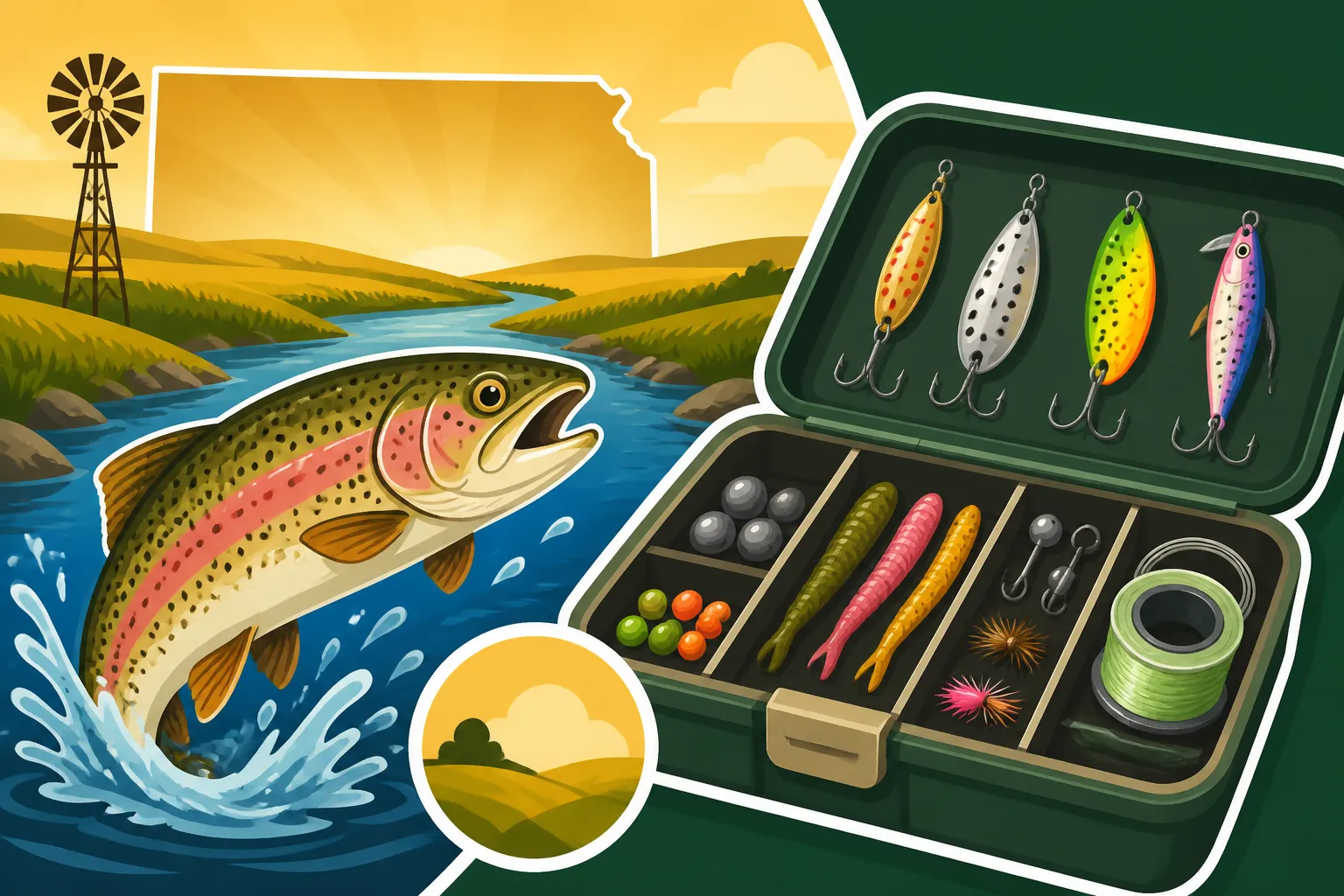
When trout are more active, or you want to cover more water, lures become incredibly effective. Inline spinners, like those from Mepps or Rooster Tail, are perennial favorites. The flashing blade and vibrating action mimic baitfish, drawing aggressive strikes. Sizes from 0 to 2 are usually perfect for Kansas trout. Cast them out and retrieve steadily, varying your speed until you find what the fish prefer. Bright colors like silver, gold, chartreuse, or even a firetiger pattern can be very productive.
Small spoons are another excellent choice. Brands like Kastmaster or Little Cleo in weights from 1/16 to 1/8 ounce have a wobbling action on the retrieve that trout can't ignore. They cast a mile and sink quickly, allowing you to target different depths. Jigs, especially small marabou jigs or tiny plastic grub tails on 1/32 to 1/16 ounce jig heads, can also be highly effective. Fish them with a slow retrieve, subtle twitches, or under a small bobber for a finesse presentation. Sometimes, a simple black, white, or olive marabou jig can outfish everything else. For a more detailed look at lure choices, consider reading Best Lures for Kansas Trout Fishing.
Essential Accessories for Trout Anglers
Beyond the core rod, reel, line, and bait, a few key accessories can significantly improve your trout fishing experience in Kansas. These items help with convenience, fish care, and overall efficiency on the water.
Crucial Terminal Tackle
Having the right terminal tackle is non-negotiable. First up are hooks. You'll want a variety of small, sharp, light-wire hooks in sizes ranging from 12 down to 8. Aberdeen or bait holder hooks are good for natural baits, while treble hooks might be found on some smaller lures. Bring a good pair of needle-nose pliers or hemostats for de-hooking fish. Trout have delicate mouths, and careful removal minimizes harm, especially if you plan to release them.
Split shot weights are essential for getting your bait down to the desired depth. Have an assortment of very small sizes, from BB to 3/0, so you can fine-tune your presentation. For fishing PowerBait off the bottom, a small swivel and an egg sinker or sliding weight (a simple Carolina rig setup) is incredibly effective. And, of course, a selection of small bobbers—clip-on or slip bobbers—will allow you to suspend your bait at precise depths, which is often crucial for finicky trout. It's wise to organize these small items in a compact tackle box or a small, clear utility box so they're easy to access. Many anglers find convenient options for these smaller items on sites like Amazon.
Landing Nets and Fish Care
A small, fine-mesh landing net is an absolute must for trout fishing. Trout have very soft fins and scales, and handling them incorrectly can cause significant damage. A net allows you to safely land the fish, keeping it in the water if you intend to release it, or providing a secure way to bring it to shore if you’re keeping it. Look for nets with a rubberized or knotless mesh, as this is gentler on the fish's slime coat and helps prevent hooks from getting tangled.
If you plan to keep your catch, a small cooler with ice is important to keep the fish fresh. For catch-and-release, minimizing air exposure and handling is critical. Wet your hands before touching the fish, support its belly, and try to remove the hook quickly while the fish is still in the water. These practices increase the trout's chances of survival. Knowing Kansas Daily Creel Limits by Species is also essential before you head out.
Fly Fishing for Kansas Trout
While spinning tackle is popular, fly fishing offers a different, often highly rewarding, approach to Kansas trout, especially in stream environments or for more challenging presentations.
Fly Rod and Reel Considerations
For fly fishing for trout in Kansas, a lightweight fly rod in the 3 to 5-weight range is ideal. A 4-weight rod is a fantastic all-around choice, offering enough finesse for delicate dry fly presentations yet enough power to handle nymphing rigs or small streamers. Rod lengths typically range from 7.5 to 9 feet. A longer rod (8.5 or 9 feet) can provide better line control and easier roll casts, especially useful in tighter stream conditions or when mending line on a drift.
Pair your fly rod with a matching fly reel. For trout, the reel's primary purpose is to hold your fly line and provide a smooth drag for fighting fish. A simple, well-made click-and-pawl or disc drag reel will suffice. It doesn’t need to be overly elaborate or expensive, as the casting is primarily done with the line, not the reel. The balance between your rod and reel is more important than the reel's raw power.
Fly Lines, Leaders, and Tippets
Your fly line is crucial as it provides the weight for casting your nearly weightless flies. For a 4-weight rod, you'll use a 4-weight fly line. A weight-forward (WF) floating line is the most versatile choice for general trout fishing, allowing for dry fly, nymph, and light streamer presentations. If you plan to fish deeper or with heavier nymphs frequently, a sink-tip line or even a full sinking line might be considered, but a floating line is the best starting point.
Connected to your fly line is a tapered leader, usually 7.5 to 9 feet long, which gradually decreases in diameter from the thick butt section (which connects to your fly line) down to a very fine tip. This taper helps turn over your fly gently. To the end of your leader, you’ll attach a section of tippet, which is a fine, uniform diameter line. Tippet sizes are designated by X-ratings (e.g., 5X, 6X, 7X). For Kansas trout, 5X or 6X tippet is commonly used, providing a good balance of strength and stealth. You might need to go down to 7X for extremely finicky fish or tiny dry flies. Always carry extra spools of tippet in various sizes, as you'll be replacing it frequently.
Essential Fly Patterns for Kansas Trout
The world of trout flies is vast, but you don't need hundreds to get started in Kansas. Focus on a few reliable categories. For dry flies, patterns like Elk Hair Caddis (size 14-18), Parachute Adams (size 14-18), and Griffith's Gnat (size 18-22) will cover most situations when trout are rising to insects on the surface. For nymphs, which are usually fished subsurface and imitate aquatic insect larvae, classics like the Pheasant Tail Nymph (size 14-18), Hare's Ear Nymph (size 14-18), and Prince Nymph (size 12-16) are deadly. Don’t forget a few small midge patterns (size 20-24), as midges are a year-round food source.
For streamers, which imitate small baitfish, Woolly Buggers (black, olive, brown, size 8-12) are incredibly versatile. You can retrieve them slowly, strip them aggressively, or even swing them through currents. Having a small box with a selection of these key patterns, along with a few attractor patterns like San Juan Worms, will give you a great foundation for Fly Fishing Techniques for Kansas Trout.
Maintaining Your Trout Fishing Gear
Good tackle is an investment, and proper care will ensure it lasts for many seasons of Kansas fishing. Taking a few minutes after each trip can prevent costly replacements and frustrating equipment failures.
Rod and Reel Maintenance Tips
After each outing, especially if you've been fishing in muddy or sandy conditions, take a moment to wipe down your rod and reel. Use a damp cloth to remove any dirt or debris from the rod blank, guides, and reel exterior. Pay special attention to the reel's spool and line roller, where grit can accumulate and cause friction.
Periodically, and especially if your reel has been submerged or exposed to heavy rain, you'll want to do a more thorough cleaning and lubrication. Consult your reel's manufacturer instructions, but generally, this involves removing the spool, cleaning around the main shaft, and applying a light coating of reel oil to moving parts and grease to gears. Avoid over-lubricating, as this can attract more dirt. Store your rod in a rod sock or tube to protect the guides and blank from damage. Keep your reel covered or in its original box to prevent dust and scratches.
Line and Lure Care
Your fishing line is arguably the most critical component, and it's also the most susceptible to wear and tear. After each trip, inspect your line, especially the first few feet near your hook or lure, for nicks, abrasions, or twists. If you find any damage, cut off the compromised section. If you fish frequently, consider re-spooling your main line once or twice a season, or more often if you notice a significant decrease in casting performance or increased memory.
For your lures, wipe them down to remove water and prevent rust on hooks. Store them in a tackle box compartment where they can dry out, and consider using desiccant packets in your tackle box, especially during humid Kansas summers, to absorb moisture. Check the hooks on your lures regularly; they should be razor-sharp. Use a hook sharpener to touch them up, as a dull hook will miss more fish than you'd believe. Replacing rusty or bent hooks is a small cost compared to losing a trophy trout.
Considerations for Different Kansas Trout Waters
Kansas boasts a variety of trout fishing opportunities, from small, often seasonal, community lakes to designated year-round trout streams. Your tackle might need slight adjustments depending on where you're casting a line.
| Water Body Type | Typical Tackle Recommendation | Key Considerations |
|---|---|---|
| Community Trout Ponds | Ultralight spinning combo (5-6 ft rod), 4-6 lb mono, PowerBait, worms, small inline spinners. | Heavily stocked, often clear water. Trout can be active but also line-shy. Focus on scent and subtle presentation. |
| Designated Trout Streams | Light action spinning or fly combo (7-8.5 ft rod), 4 lb fluorocarbon leader. Small jigs, nymphs, dry flies, tiny spinners. | Smaller, wilder fish. More technical fishing. Fly fishing shines here. Stealth, accurate casting, and precise drifts are key. |
| Larger Reservoirs (Winter Stockings) | Light action spinning combo (6-7 ft rod), 6 lb mono or braid with 4 lb fluorocarbon leader. Spoons, larger spinners, jigs, PowerBait. | Fish may spread out more. Longer casts, ability to cover water. Can encounter larger, holdover trout. Wind can be a factor. |
| Private Ponds (Stocked) | Similar to community ponds. Ultralight combo, wide array of baits and lures. | Check rules with landowner. Fish behavior can vary greatly based on stocking frequency and pressure. |
This table provides a general overview, but always adapt to specific conditions. For example, some community lakes might have significant weed growth, which would influence your lure choice (perhaps weedless jigs) or require fishing higher in the water column. Kansas Fishing Regulations Explained will always be your best friend for specific rules in designated waters.
Remember, fishing is as much about observation and adaptation as it is about having the right gear. Pay attention to what's working for others, or try different presentations until you unlock the bite. Sometimes, the smallest change, like a lighter leader or a different color of PowerBait, can make all the difference. Happy trout fishing!
Disclaimer
This article is for general informational purposes only and does not constitute professional advice. Laws, prices and regulations vary by location and change over time. Consult a qualified professional for guidance on your specific situation.