How to Tell Male From Female Crappie
It's a common question that pops up when you're out on the water, especially during those magical spring days when crappie are on the move: "Is that a male or a female?" It might seem like a small detail, but understanding how to tell the difference between male and female crappie can genuinely transform your fishing strategy, giving you a better grasp of their behavior, especially during the crucial spawning season. This guide is going to walk you through the tell-tale signs, both visual and behavioral, so you can confidently identify crappie genders and use that knowledge to your advantage.
Why Gender Identification Matters for Crappie Anglers
Let's be real, most of the time we're just thrilled to have a crappie on the line, regardless of its gender. But for those of us who really want to dial in our fishing game, especially when we're trying to consistently find bigger fish or understand local population dynamics, knowing the difference can be a huge asset. It's not just about curiosity; it's about connecting with the natural world beneath the surface.
Understanding Spawning Strategies
Crappie are fascinating creatures, and their spawning ritual is a prime example of nature's intricacies. When the water temperatures start to climb into the sweet spot, roughly in the mid-50s to low-60s Fahrenheit, the males get busy. They scout out prime locations in shallow water, often near submerged brush, timber, or weed lines, and meticulously fan out circular nests. These nests, which can range from dinner-plate size to nearly three feet across, are where the females will eventually lay their eggs.
Knowing this behavior is key. If you're seeing crappie in these shallow, sheltered areas, especially a darker-colored fish guarding a depression, chances are you've found a male on his nest. Females, on the other hand, will move in, deposit their eggs, and then typically retreat to slightly deeper water to recover, often in small schools. So, if you're targeting those egg-laden females, you might need to adjust your depth and location from where you find the nesting males. This knowledge directly impacts where you cast and how you present your bait, making your time on the water much more efficient. You can learn more about Kansas Spring Crappie Fishing Tips to help you target these fish.
Targeting Bigger Fish and Conservation
It's often the case that the biggest fish caught during the spawn are the females, simply because they are carrying the weight of their eggs. While they might not be actively feeding aggressively during the actual egg-laying, finding those staging females before or after they visit the nests can lead to some impressive catches. Think about it: a female full of roe is significantly heavier than a male of the same length. So, if you're after that personal best, keeping an eye out for the signs of female crappie can be beneficial.
Beyond personal bests, understanding crappie gender plays a subtle role in conservation. While crappie are generally abundant in Kansas waters and have generous bag limits, being mindful of catching and releasing heavily egg-laden females can contribute to the long-term health of the crappie population. It's not a strict rule or regulation, but a consideration for the ethical angler. This kind of awareness helps us all be better stewards of our precious fisheries. Check out Kansas Daily Creel Limits by Species for specific regulations.
Key Visual Differences Between Male and Female Crappie
Now, let's get down to the nitty-gritty: what can you actually see to tell them apart? While it's easiest during the spawn, there are some subtle clues year-round if you know what to look for. No need for a biology degree here, just a keen eye and a little practice.
Coloration Changes During Spawn
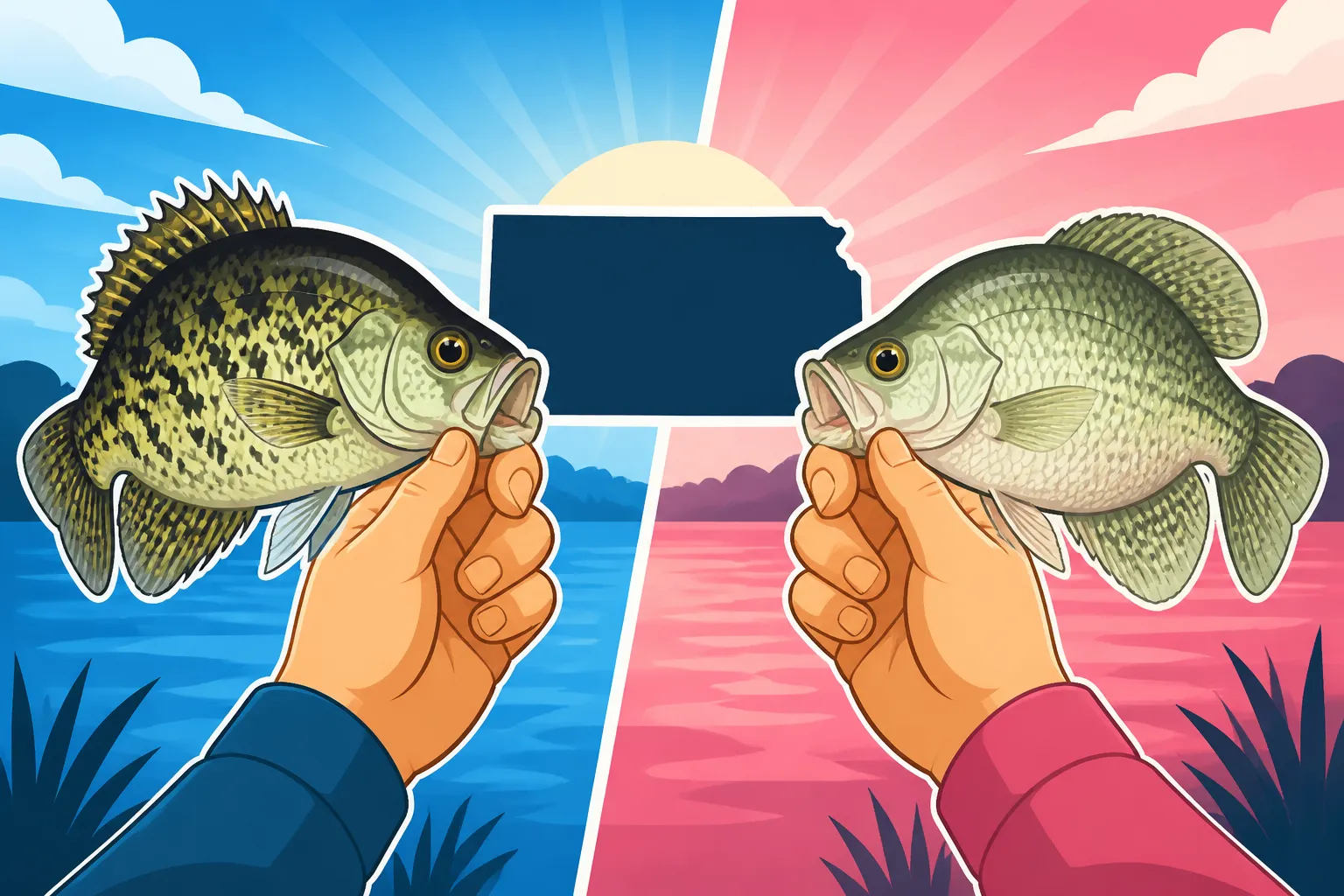
This is, hands down, the most reliable visual cue for differentiating male and female crappie during the spawning season. Male crappie undergo a dramatic transformation. Their bodies, especially around the head and lower jaw, will darken significantly, often turning almost black, or a very dark olive green. The banding and mottling patterns that are usually quite distinct on their sides become much more pronounced and intense. This striking coloration serves as a visual signal to females, indicating readiness to spawn, and also helps them blend in with the dark substrate of their nests.
Female crappie, on the other hand, tend to retain their more silvery, mottled appearance. While their colors might deepen slightly, they generally don't exhibit the dramatic darkening that males do. If you catch a crappie with a dark, almost charcoal-colored head, especially if it's spring, you can be pretty confident you've got a male. Conversely, a fish with a consistently lighter, more silvery hue is very likely a female. A good pair of polarized sunglasses from Amazon can really help you spot these color differences in clear water.
Body Shape and Size
While less definitive than coloration, body shape can offer additional hints, particularly during the spawn. Female crappie, when they are gravid (full of eggs), will often have a noticeably rounder, plumper belly. They’ll look thicker and wider, especially in the abdominal region, as they carry thousands of tiny eggs. This is particularly evident right before they move onto the nests to deposit their payload.
Male crappie, while still healthy-looking, typically maintain a more streamlined appearance. Their bodies might seem a bit flatter or more compressed side-to-side, especially once they've spent time fanning nests and actively defending them. After the spawn, as females shed their eggs, this difference becomes far less obvious, and it can be very difficult to tell them apart by body shape alone. Younger fish also show less distinct differences in body shape. You can read more about Kansas White Crappie Identification and Kansas Black Crappie Identification for general appearance cues.
Fin Characteristics
Another subtle, but sometimes useful, cue can be found in the fins, particularly the anal fin (the fin located behind the vent on the underside of the fish). During the spawn, some male crappie develop a rougher, almost sandpaper-like texture on their anal fins, and sometimes even their caudal (tail) fin and pectoral fins. These are often referred to as "breeding tubercles" or "nuptial tubercles," though they are much less pronounced than in some other fish species like carp or shiners. They help the male stimulate the female during spawning and adhere to her.
Female crappie usually have smoother fins, lacking these rough patches. Again, this is not a universal rule and can be quite subtle, requiring you to actually feel the fin. It's often best used as a corroborating sign rather than a primary identification method. Combine it with color and body shape observations for the most accurate assessment.
Here's a quick comparison table for visual cues:
| Characteristic | Male Crappie (Spawning Season) | Female Crappie (Spawning Season) |
|---|---|---|
| Overall Coloration | Head and lower jaw darken significantly, often black or very dark olive; body mottling intensified. | Maintains more silvery, mottled, or lighter appearance. |
| Body Shape | More streamlined; may appear flatter after nest-fanning. | Noticeably rounder, plumper belly when gravid (full of eggs). |
| Fin Texture | May develop a rough, sandpaper-like texture (nuptial tubercles) on anal and caudal fins. | Fins generally remain smooth. |
| Behavioral Role | Guards and fans nest; aggressive towards intruders. | Enters nest to lay eggs, then often retreats. |
Behavioral Clues: Observing Crappie Spawning Patterns
Sometimes, seeing isn't enough, or the fish just aren't showing those distinct visual cues. That's when observing their behavior becomes your best tool. Crappie have very distinct roles during the spawn, and understanding these can tell you exactly who you're looking at, even before you cast your line.
Male Aggression and Nest Building
If you've ever seen a crappie violently thrash around a specific spot in shallow water, chasing off bluegill or smaller bass, you're almost certainly witnessing a male crappie guarding his nest. These guys become incredibly territorial during the spawn. They'll diligently fan out a circular depression on the bottom, clearing away debris and exposing clean substrate. This is their kingdom, and they'll defend it with surprising ferocity for their size.
Imagine yourself out on a calm spring morning, paddling a kayak or slowly moving along a bank. You might notice a darker-colored fish darting out from a shadowy spot near a stump, nipping at anything that gets too close, then quickly returning to its station. That's a male, plain as day. They're often so focused on their duty that they can be easier to catch, sometimes even hitting lures out of pure aggression rather than hunger. Keeping an eye out for these tell-tale signs of a "crappie patrol" means you've found a male. For more on finding them, check out When Crappie Move Shallow in Kansas.
Female Egg-Laying Behavior
Female crappie have a much different role in the spawning process. Their primary job is to produce and deposit eggs. Once they are full of roe, they will approach the male's nest, often lingering nearby or in slightly deeper cover before moving onto the fanned-out area. After a successful spawning event, they typically leave the nest site and may retreat to slightly deeper water to recuperate. They often form small, loose schools at this time, recovering from the energy expenditure of egg-laying.
So, if you're targeting females, you might look for fish that are not directly on a nest, but rather schooling up in nearby cover, perhaps a few feet deeper than the nesting males. These fish might be more inclined to feed as they regain their strength. Spotting females in this context often means observing a group of lighter-colored, plumper-bellied fish moving together. Sometimes, a female might be caught with a prolapsed vent (part of her reproductive organ protruding slightly), which is a clear sign she has recently laid or is about to lay eggs. You can research Best Water Temperature for Crappie Spawn to help pinpoint when these behaviors are most active.
Factors Influencing Crappie Appearance and Behavior
While the general rules for telling male from female crappie hold true, it's important to remember that nature isn't always perfectly textbook. Several factors can influence how distinct these differences appear, making identification a bit more challenging sometimes.
Season and Water Conditions
The most pronounced differences in crappie gender occur during the breeding season, typically spring, when water temperatures are conducive to spawning. Outside of this window, differentiating males from females visually becomes much more difficult, if not impossible, without internal examination. In the cooler months of fall and winter, both sexes tend to look very similar, with no significant color or body shape variations.
Water clarity and light conditions also play a role. In clear water, using good quality fishing sunglasses (like those you can find on Amazon) can help you discern subtle color changes or body shapes from a distance. In turbid or muddy water, visual identification becomes incredibly challenging, forcing you to rely more on behavioral cues or simply assume you've caught a crappie and enjoy the fight! Heavy overcast skies or low light conditions can also make spotting those darker male colors less obvious. Kansas Fishing Seasons Guide provides a good overview of when to expect these conditions.
Diet, Age, and Size
A crappie's diet can impact its overall condition and, by extension, its appearance. A well-fed fish might appear plumper regardless of gender, potentially masking the gravid belly of a female. Conversely, a male that has spent weeks aggressively defending a nest without much feeding might appear thinner and more depleted.
Age and size can also affect how distinctly these gender characteristics present. Younger crappie, especially those not yet mature enough to spawn, will show very little to no difference in appearance between sexes. As crappie mature and grow larger, the males' spawning coloration tends to be more dramatic, and the females' egg-laden bodies become more obvious. So, if you're catching a lot of smaller crappie, don't be surprised if the gender differences are less apparent. Often, it's the more robust, mature fish that exhibit the clearest signs.
Species Variation: Black vs. White Crappie
Kansas is home to both black crappie and white crappie, and while the general principles of gender identification apply to both, there can be slight variations. Male black crappie, for example, often develop a very intense, almost solid black head and throat during the spawn. Their vertical barring can also become incredibly prominent. Male white crappie will also darken, but sometimes their coloration might lean more towards a very dark grey or olive, and their vertical barring (which is usually more distinct on white crappie anyway) will become incredibly sharp.
These are subtle differences, and ultimately, the darkening of the head and body for males, and the plumper, lighter appearance for females, remain the primary visual indicators for both species during the spawning period. Regardless of which species you're targeting, armed with this knowledge, you'll be a more observant and effective crappie angler.
Disclaimer
This article is for general informational purposes only and does not constitute professional advice. Laws, prices and regulations vary by location and change over time. Consult a qualified professional for guidance on your specific situation.