Best Rod Setup for Kansas Crappie
There's nothing quite like the subtle tap of a crappie bite, but that exhilarating moment can quickly turn into frustration if your rod setup isn't up to the task. Many anglers struggle with missing those light strikes or finding their gear isn't sensitive enough to detect timid fish hiding in Kansas brush piles. This comprehensive guide is here to walk you through everything you need to know to assemble the perfect rod setup, ensuring you're ready to tackle any crappie fishing scenario Kansas waters throw your way.
Understanding Kansas Crappie Fishing for the Right Rod
Before you even think about picking out a rod, it’s crucial to understand what crappie fishing in Kansas truly entails. It’s not a one-size-fits-all situation, and the best rod for one scenario might be completely wrong for another. Crappie are subtle biters, often found relating to specific structures, and their behavior can change dramatically with the seasons and water conditions.
The Nature of Kansas Crappie Fishing
Kansas boasts an incredible array of crappie fishing opportunities, from the vast reservoirs like Milford Lake and Cheney Reservoir to smaller community ponds and even local rivers. Both white crappie and black crappie thrive here, each with slightly different preferences, though they often overlap. White crappie tend to prefer murkier water and more open-water structures, while black crappie often seek out clearer water and dense cover like fallen trees or submerged brush. This variety means you'll encounter everything from shallow water cover to deep-water submerged timber. If you're looking to dive deeper into these fantastic panfish, check out our comprehensive Kansas Crappie Fishing Guide.
Picture this: you're out on a calm morning, slowly working a jig around a submerged brush pile at Clinton Lake. The bites are incredibly light, almost imperceptible. If your rod is too stiff or lacks sensitivity, you're going to miss those fish, thinking they simply aren't there. Conversely, trying to pull a chunky crappie out of thick cover with an ultra-light noodle rod can quickly lead to snapped lines or lost fish. Understanding these nuances—the environment, the fish's behavior, and the typical size of crappie—will directly inform your gear choices.
The challenge is balancing sensitivity with enough backbone to control a hooked fish, especially when they dive into cover. Crappie mouths are also notoriously papery, meaning an overly stiff rod or an aggressive hook set can easily tear the hook free. It's a delicate dance, and your rod plays a pivotal role.
Common Crappie Techniques in Kansas
Kansas anglers employ a variety of techniques to target crappie, and each method might benefit from a slightly different rod setup. From casting tiny jigs to slow-trolling multiple lines, your rod needs to match the tactic.
One of the most popular methods is jigging, whether vertically over structure or casting and retrieving. This technique demands a sensitive rod to feel the light "thump" or subtle slack in the line that often signals a crappie bite. You're typically using small jigs, often 1/16 oz or lighter, making rod sensitivity paramount. Many anglers also use live minnows under a bobber, a technique that still benefits from a responsive rod, especially when setting the hook on a light bite. For more specific jigging strategies, explore our guide on Jigging Techniques for Kansas Crappie.
Then there's spider rigging, a method where anglers use multiple long rods, often up to 12-16 feet, fanned out from the boat to cover a wide area. This is a slow-trolling or drifting technique, typically with minnows or jigs, designed to present baits to suspended crappie. Obviously, the rod requirements for this technique are vastly different from a single jigging rod. Another fun, specialized technique is "dock shooting" or "skipping" jigs under docks, which requires a shorter, fast-action rod for precision and quick, accurate casts.
Key Rod Characteristics for Kansas Crappie
Now that we've covered the "why," let's get into the "what." The specific characteristics of a fishing rod – its length, power, action, and material – are what truly differentiate a good crappie rod from a mediocre one.
Rod Length and Its Impact
The length of your crappie rod is probably one of the most noticeable features and directly affects how you fish. Shorter rods offer precision and ease of handling in tight spaces, while longer rods excel at casting distance, leverage, and managing multiple lines.
For general casting and jigging in most Kansas conditions, a rod between 5 to 7 feet is a fantastic all-around choice. A 5-foot rod is great for "dock shooting" or when fishing from a kayak where space is limited. It allows for quick, accurate casts into tight spots. A 6-foot rod offers a good balance of casting distance and control, making it a favorite for many bank anglers or those casting from a boat. A 7-foot rod extends your casting range, which can be crucial when crappie are holding further from the boat or bank, and provides excellent leverage for fighting fish in open water.
When you start talking about specialized techniques like spider rigging, rod lengths can jump dramatically. Many spider rig setups use rods ranging from 10 to 16 feet or even longer. These long rods are designed to spread multiple baits out and away from the boat, covering a wide swath of water. They also allow for subtle bait presentation and absorbing the shock of a fish strike without pulling the hook from a crappie's delicate mouth. While not for every angler, having one or two longer rods can really open up new crappie opportunities, especially on large Kansas reservoirs.
Rod Power and Action Considerations
These two characteristics are often confused but are critical for crappie fishing. Rod power refers to the lifting strength or backbone of the rod – how much force it takes to bend the rod. Rod action describes where the rod bends when pressure is applied, usually categorized as fast, moderate, or slow.
For crappie, you'll almost exclusively be looking at Ultra-Light (UL) to Light (L) power rods. Anything heavier, like a medium-light or medium power rod, will simply be too stiff to feel the delicate bites of crappie and too much for their paper-thin mouths. An ultra-light rod offers maximum sensitivity and fun for even small crappie, allowing you to feel every head shake. A light power rod provides a bit more backbone, which can be useful if you're targeting larger crappie or fishing in areas with denser cover where you need to exert a bit more control.
In terms of rod action, a fast to moderate-fast action is generally preferred for crappie. A fast action rod bends mostly in the tip section, which translates to superior sensitivity for detecting subtle bites and quick, efficient hook sets. This is fantastic for jigging. A moderate-fast action rod bends a little further down the blank, offering a good balance of sensitivity and a slightly more forgiving bend that can help prevent hooks from tearing out. A moderate or slow action rod (often called a "parabolic" bend) might be used for certain slow-trolling techniques, as its softer bend helps keep fish pinned, but it generally lacks the sensitivity needed for active jigging.
Material and Handle Comfort
The materials used in a rod's construction and the design of its handle also play a significant role in its overall performance and your fishing experience. These factors contribute to weight, sensitivity, and comfort.
Most quality crappie rods today are made from graphite. Graphite is renowned for its lightweight nature and exceptional sensitivity, which is exactly what you need to feel those faint crappie bites. Higher modulus graphite typically means a lighter and more sensitive rod, though it can also be more brittle. Some crappie rods might incorporate a blend of graphite and fiberglass, often referred to as a composite. These composite rods offer a bit more durability and a softer, more forgiving action, which can be beneficial for certain applications, but usually at the expense of some sensitivity.
Handle comfort might seem secondary, but after hours of casting and jigging, an uncomfortable handle can quickly fatigue your hands. Most handles are made from either cork or EVA foam. Cork is traditionally favored for its classic look, light weight, and sensitivity, transmitting vibrations well. EVA foam is durable, easy to clean, and provides a comfortable, non-slip grip, even when wet. It often comes down to personal preference, but ensuring the handle fits your hand comfortably and is long enough for two-handed casting if needed, will make your time on the water much more enjoyable. Think about ergonomics – a well-designed handle means less strain. You can find a wide selection of rods with various handle types on platforms like Amazon.
| Rod Characteristic | Ideal for Kansas Crappie | Why It Matters |
|---|---|---|
| Power | Ultra-Light (UL) to Light (L) | Allows detection of subtle bites and protects delicate crappie mouths. |
| Action | Fast to Moderate-Fast | Fast tip for sensitivity and quick hook sets; moderate-fast offers a balance of sensitivity and forgiveness. |
| Length (General) | 5-7 feet | Versatile for casting, jigging, and bank fishing; good balance of distance and control. |
| Length (Specialized) | 10-16 feet | Essential for spider rigging, spreading baits, and covering wide areas. |
| Material | Graphite | Lightweight, sensitive, and transmits subtle bites effectively. |
| Handle | Cork or EVA Foam | Ensures comfort during long fishing sessions and provides a secure grip. |
Reel and Line Pairings for Optimal Crappie Performance
Your rod is only half of the equation. To create a truly effective crappie setup, you need to pair it with the right reel and fishing line. These components work in harmony with your rod to provide balance, smooth operation, and the ability to detect and fight fish effectively.
Choosing the Right Spinning Reel
For crappie fishing, a spinning reel is almost universally the preferred choice. They excel at casting light lures, handling light lines, and are generally user-friendly. When selecting a spinning reel for crappie, size, drag system, and retrieve ratio are key factors.
You'll want a small, lightweight spinning reel, typically in the 500 to 1000 series size. A 500 series reel is exceptionally light and perfect for ultra-light rods and small jigs, often used for dock shooting or very light presentations. A 1000 series reel offers a bit more line capacity and a slightly larger retrieve, making it a versatile choice for most crappie fishing scenarios, especially with 6-7 foot light action rods. These smaller reels balance well with lightweight crappie rods, preventing your setup from feeling tip-heavy or cumbersome. For a deeper dive into reel specifics, check out our guide on the Best Reel Size for Crappie.
A smooth drag system is non-negotiable. Crappie have delicate mouths, and a sticky or jerky drag can easily lead to pulled hooks or broken lines, especially when a larger crappie makes a run. Test the drag on any reel you consider to ensure it delivers line smoothly under pressure. The retrieve ratio isn't as critical as it is for some other species, but a medium-fast retrieve (e.g., 5.0:1 to 6.0:1) is generally versatile enough for most crappie techniques, allowing you to work jigs effectively and reel in slack quickly. Brands like Shimano, Daiwa, and Penn offer excellent small spinning reels suitable for crappie, many of which are readily available on Amazon.
Selecting the Ideal Fishing Line
The fishing line is your direct connection to the fish, and its characteristics can significantly impact your sensitivity, casting distance, and ability to land crappie. You have several options, each with its own advantages.
Monofilament (mono) is a popular and cost-effective choice for crappie. It's forgiving, with inherent stretch that acts as a shock absorber, helping to prevent hooks from tearing out of delicate crappie mouths. Its low visibility can also be an advantage in clear water. For crappie, a light test is key, typically 4 to 6-pound test. Too heavy, and you'll lose casting distance with small jigs and sacrifice sensitivity. The downside is its stretch reduces sensitivity, making it harder to feel very light bites, and it has more memory, leading to coils.
Fluorocarbon offers a good balance. It's virtually invisible underwater, which is a huge plus in clear Kansas lakes, and has less stretch than monofilament, providing better sensitivity. It also sinks, which can be an advantage when you want your jig to get down faster. However, it can be stiffer and more expensive. Many anglers use a fluorocarbon leader (2-4 feet) tied to a braided main line to get the best of both worlds. For crappie, a 4 to 6-pound test fluorocarbon is usually sufficient.
Braided line has become increasingly popular for its incredible sensitivity and zero stretch. You'll feel every bump, tap, and change in current with braid. It also allows for longer casts with light lures and is very thin for its breaking strength. For crappie, 6 to 10-pound test braid is common, though it's often paired with a fluorocarbon leader because braid is highly visible. The main drawbacks are its visibility, lack of stretch (which requires careful drag setting to prevent pulled hooks), and it can sometimes dig into the spool if not wound tightly. Consider using a small swivel and a fluorocarbon leader when fishing braid for crappie, especially in clear water.
Putting Together Your Go-To Kansas Crappie Setup
Now that we've broken down all the components, let's look at how to combine them into effective crappie fishing setups for various situations you might encounter in Kansas. Having the right tools for the job makes all the difference.
The Versatile All-Around Setup
If you're looking for one setup that can handle most Kansas crappie fishing situations, a versatile all-around rod and reel combo is your best bet. This setup balances sensitivity, casting ability, and fish-fighting power.
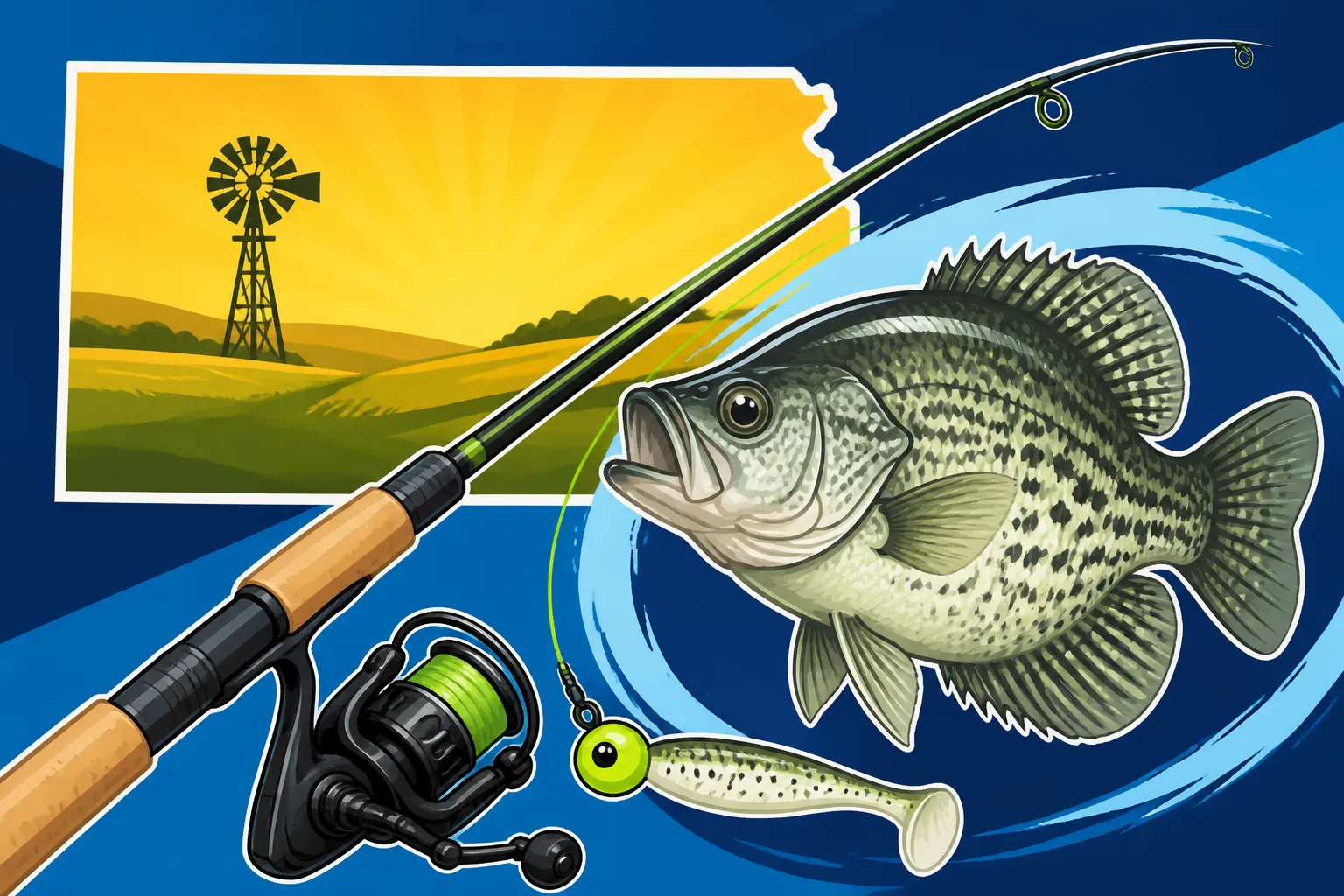
A 6-foot, light power, fast action spinning rod is arguably the most versatile choice for crappie anglers in Kansas. It provides enough length for decent casting distance from shore or boat, while the light power and fast action ensure excellent sensitivity for detecting those subtle bites, whether you're working a small jig or drifting a minnow. Pair this rod with a 1000 series spinning reel spooled with 6-pound test monofilament or a 6-pound braid with a 4-pound fluorocarbon leader. This combo offers a fantastic balance for most applications, from targeting white crappie in brush piles to casting for black crappie along rocky points. It's a reliable workhorse that will serve you well in various scenarios, including many spring fishing opportunities, as detailed in our Kansas Spring Crappie Fishing Tips guide.
This setup is forgiving enough for beginners but responsive enough for experienced anglers to appreciate. It's light enough to cast all day without fatigue and robust enough to handle the average 10-inch minimum length crappie you might encounter across Kansas waters. Many reputable brands offer excellent combos that fit this description, and you can often find great deals on Amazon for a ready-to-go setup.
Specialized Setups for Specific Techniques
While a versatile setup is great, sometimes a specialized approach is necessary to maximize your success, especially when targeting crappie with particular techniques or in specific environments.
For spider rigging or slow-trolling, you'll want dedicated long rods. These are typically 10 to 16-foot (or longer), light to moderate-light power rods with a moderate action. The softer action helps absorb the shock of a strike while maintaining a slow, steady presentation. You'll often use several of these, each paired with its own small spinning reel (500-1000 series) spooled with 6-8 pound monofilament or braid. The goal here is to present multiple baits at varying depths and distances from the boat, covering a wide swath of water while drifting or slow-trolling. This technique is often highly effective for locating suspended crappie in large reservoirs.
For dock shooting or skipping jigs under piers and overhangs, a shorter, more precise setup is ideal. Think a 4.5 to 5.5-foot, ultra-light power, fast action spinning rod. The short length allows for the unique casting motion required, and the fast tip provides the necessary snap for accuracy. A tiny 500 series spinning reel with 4-pound monofilament or a thin 6-pound braided line (with a short fluorocarbon leader) completes this highly specialized setup. It's a precise art, and having the right compact tools makes all the difference in reaching those crappie hiding in the shadows.
Essential Accessories to Complement Your Rod
Beyond the rod, reel, and line, a few key accessories will round out your crappie fishing setup and make your time on the water more efficient and enjoyable. Don't overlook these small but mighty additions.
First and foremost, a well-organized tackle box is essential. For crappie, this means a selection of jigs (1/32 oz to 1/8 oz in various colors), small bobbers, split shot weights, and an assortment of small hooks for live bait. Having your tackle neatly organized in a compact box means you're not fumbling around when the bite is hot. Consider a dedicated crappie tackle box for ease of use. If you want more tips on how to organize your gear, check out our guide on Best Tackle Box Setup for Kansas Anglers.
Next, don't forget a small pair of line clippers or scissors. Trying to bite through line with your teeth is never a good idea. A good pair of clippers makes knot tying and re-rigging quick and easy. A small landing net is also incredibly helpful, especially when targeting larger crappie. It prevents lost fish at the boat and reduces stress on the fish if you plan to release them. Finally, a fish gripper or towel can be useful for handling crappie, as their fins can be quite prickly. Some anglers also carry a small measuring device to ensure their catch meets the Crappie Minimum Length Limit of 10 Inches before retention. Having these small tools readily accessible can greatly enhance your crappie fishing experience.
Disclaimer
This article is for general informational purposes only and does not constitute professional advice. Laws, prices and regulations vary by location and change over time. Consult a qualified professional for guidance on your specific situation.