Best Line Weight for Kansas Walleye
Let's be honest, standing in the fishing aisle trying to pick the "perfect" line for Kansas walleye can feel like deciphering a secret code. So many types, so many weights, and the stakes feel high when you're targeting such a prized catch. But trust me, understanding line choice isn't just about preference; it's about making sure you're effectively presenting your bait and landing that fish. This guide will help you confidently choose the best line weight for Kansas walleye, cutting through the confusion.
Understanding Walleye Behavior and Habitat in Kansas
Before we even talk about specific lines, it's crucial to understand the fish you're targeting. Walleye are unique, and their habits directly influence the gear choices that will lead to success in Kansas waters. Think about where they live and how they feed, and suddenly those line choices start to make a lot more sense.
How Walleye Hunt and What That Means for Your Line
Walleye are primarily visual feeders, especially known for their exceptional low-light vision, which is why dawn, dusk, and even night fishing can be so productive. They tend to hang around structure – sunken timber, rocky points, ledges, and humps – often ambushing prey rather than chasing it down over long distances. Their diet consists mostly of smaller fish, crayfish, and insects. What does this mean for your fishing line? A few key things. First, because they are visual predators, stealth can be a major factor. They have excellent eyesight, and a thick, visible line might put off a wary walleye. Second, their preference for structure means your line will frequently come into contact with abrasive surfaces like rocks and wood. You need a line that can withstand some abuse, or at least one that's easily replaceable if it gets frayed. Finally, their subtle bite, especially in colder water, demands a line with good sensitivity to detect those faint taps.
When you're out on a lake like Milford Lake or Cheney Reservoir, fishing those deep ledges, you'll notice that the walleye aren't always aggressive biters. Sometimes it's just a slight tick, or the line simply feels "heavy." A sensitive line is paramount to feeling these subtle takes, ensuring you set the hook at the right moment. If your line is too thick, stretchy, or simply not designed for sensitivity, you might miss a lot of those fish.
Typical Walleye Size and Strength in Kansas Waters
Kansas walleye can vary quite a bit in size, from smaller eaters in the 1-2 pound range to true trophy fish pushing double digits. While a 5-pound walleye might not fight with the drag-screaming power of a large striper, they are solid, respectable game fish. They'll make strong runs, especially if hooked in open water, and can use their broad sides to create a lot of resistance. Landing a good-sized walleye often involves pulling it out of some snaggy cover or quickly bringing it to the boat before it can wrap around submerged structure. This isn't a job for ultra-light tackle designed for panfish.
Given the Kansas Walleye Minimum Length Limit of 21 Inches in many areas, you're often targeting fish that are strong enough to put up a decent fight. If you're specifically targeting trophy-sized walleye, like those found in the clearer waters of Wilson Lake, you'll need a line that can handle the unexpected power of a larger fish, but also one that doesn't compromise on presentation. A balance must be struck: strong enough to land the fish, but fine enough to get the bite.
The Core Factors Influencing Line Weight Choice
Choosing the right line isn't just about picking a number; it's about considering the conditions and methods you'll be using. These factors are interconnected, and a smart angler adapts their line choice to the specific scenario they face.
Water Clarity and Stealth: The Invisible Advantage
Kansas lakes and rivers offer a wide range of water clarities. Some reservoirs, especially those with rocky bottoms or those that haven't received recent heavy rains, can be remarkably clear. Think of the deep, clear waters you might encounter at Wilson Lake. In these conditions, walleye rely heavily on their eyesight, and they can easily spot thick, visible fishing lines. This is where line stealth becomes a massive advantage.
On the other hand, a lake like Tuttle Creek Lake might have more stained or turbid water, especially after a good rain or during a period of higher flow in the rivers feeding it. In these murkier conditions, line visibility becomes less of a concern, and you might be able to get away with a slightly thicker, more robust line without spooking fish. The key is to assess the water clarity on any given day. If you can see your lure clearly a few feet down, the walleye can probably see your line. Using a line that blends in or is difficult to see underwater can be the difference between a successful day and going home empty-handed.
Fishing Techniques: Trolling, Jigging, and Casting
The way you fish for walleye profoundly impacts the ideal line choice. Each technique presents different demands on your line, from sensitivity to stretch to how it handles in the water.
- Trolling: When you're Trolling for Walleye on Kansas Reservoirs with crankbaits or spinner rigs, you need a line that allows your lure to reach and maintain its desired depth. Thinner lines cut through the water with less resistance, allowing crankbaits to dive deeper and lighter weights to hold bottom better. Line stretch can also be a factor here; too much stretch can make it harder to feel subtle bites or effectively set the hook when a fish grabs a fast-moving bait far behind the boat. A low-stretch line helps transmit those subtle vibrations directly to your rod.
- Jigging: Whether you're vertical jigging over structure or casting jigs to rocky points, sensitivity is king. You need to feel every bump, every tick, every change in resistance. A line with minimal stretch is crucial for detecting those light bites and translating even the slightest movement to your rod tip. Jigging often involves working baits close to the bottom, where snags are common, so abrasion resistance is also important.
- Casting: When casting various lures like stickbaits, swimbaits, or even bottom bouncers, casting distance and lure presentation are key. A smoother, thinner line will cast further, allowing you to cover more water. How the line lies on the water and whether it causes unnatural drag on your lure can also affect presentation, especially with lighter baits.
Many anglers might even carry multiple setups, each spooled with a different line type and weight, specifically tailored for their chosen Kansas Walleye Fishing Techniques on a given day. This versatility can be a game-changer.
Structure and Cover: Battling the Snags
Kansas walleye love structure. Whether it's the submerged timber in the upper reaches of some reservoirs, the rocky outcroppings and ledges of Wilson Lake, or the riprap along the dam faces of El Dorado Lake, these areas hold fish but also pose a significant threat to your fishing line. Rocks, zebra mussels, sharp shells, and sunken wood can easily fray or cut your line, leading to lost lures and, more frustratingly, lost fish.
The challenge is to find a line that is both sensitive enough for walleye bites and robust enough to handle the abuse. This often means prioritizing abrasion resistance, especially in situations where you know you'll be fishing around heavy cover. If you're consistently breaking off on snags, it's not just annoying; it's costing you money in lost tackle and potentially injuring fish left with hooks in their mouths. Choosing a line that can stand up to these challenges means fewer headaches and more fish in the net.
Recommended Line Weights and Types for Kansas Walleye
Now that we've covered the "why," let's dive into the "what." There are three main types of fishing line that Kansas walleye anglers typically consider, each with its own strengths and ideal applications.
Monofilament: The Classic Choice
Monofilament, or mono, has been a staple in fishing for decades, and for good reason. It's relatively inexpensive, easy to tie knots with, and offers good shock absorption due to its stretch.
- Pros: Cost-effective, good knot strength, excellent stretch (which can prevent hooks from tearing out), good shock absorption, easy to cast.
- Cons: High visibility (especially in clear water), significant line memory (can coil off the reel), less sensitive than other lines, less abrasion resistant than fluorocarbon or braid, absorbs water.
- When to Use It: Mono can be a good choice for topwater presentations (though less common for walleye), or for beginners. It's also suitable for trolling shallow-running crankbaits where extreme depth isn't needed and the stretch can act as a shock absorber when a fish hits hard.
- Recommended Weights: For general walleye fishing, a 6 to 10-pound test monofilament is often a good starting point. If you're fishing in exceptionally clear water and need maximum stealth, you might drop down to 4-pound test, but this increases the risk of break-offs. If you're targeting larger fish in heavy cover, you might go up to 12-pound. For a versatile option, 8-pound test is a solid middle ground. You can find a wide selection of quality monofilament lines on sites like Amazon.
Fluorocarbon: The Stealth Assassin
Fluorocarbon has gained immense popularity among walleye anglers, and for good reason. It's often seen as a hybrid, combining some of the best qualities of mono and braid for walleye applications.
- Pros: Nearly invisible underwater (refractive index similar to water), excellent abrasion resistance, good sensitivity, sinks faster than mono, little to no stretch.
- Cons: More expensive than mono, can be stiffer and have more line memory, knot tying requires careful attention to prevent slippage and breakage, can be harder to cast in very light weights.
- When to Use It: Fluorocarbon excels as a main line when water clarity is paramount and you need sensitivity, such as when jigging or using bottom bouncers in clear water. It's also fantastic as a leader material attached to braided line (more on that below), giving you the best of both worlds. Its abrasion resistance makes it ideal when fishing rocky areas.
- Recommended Weights: For a main line, 6 to 10-pound test fluorocarbon is common. If using it as a leader with braided line, you'll often match the leader test to your target fish size, typically 8 to 12-pound test, depending on the snags and fish size. Many anglers will use a Kansas Trout Permit Guide line for trout (which are also visually keen), then scale up for walleye.
Braided Line: Power and Sensitivity
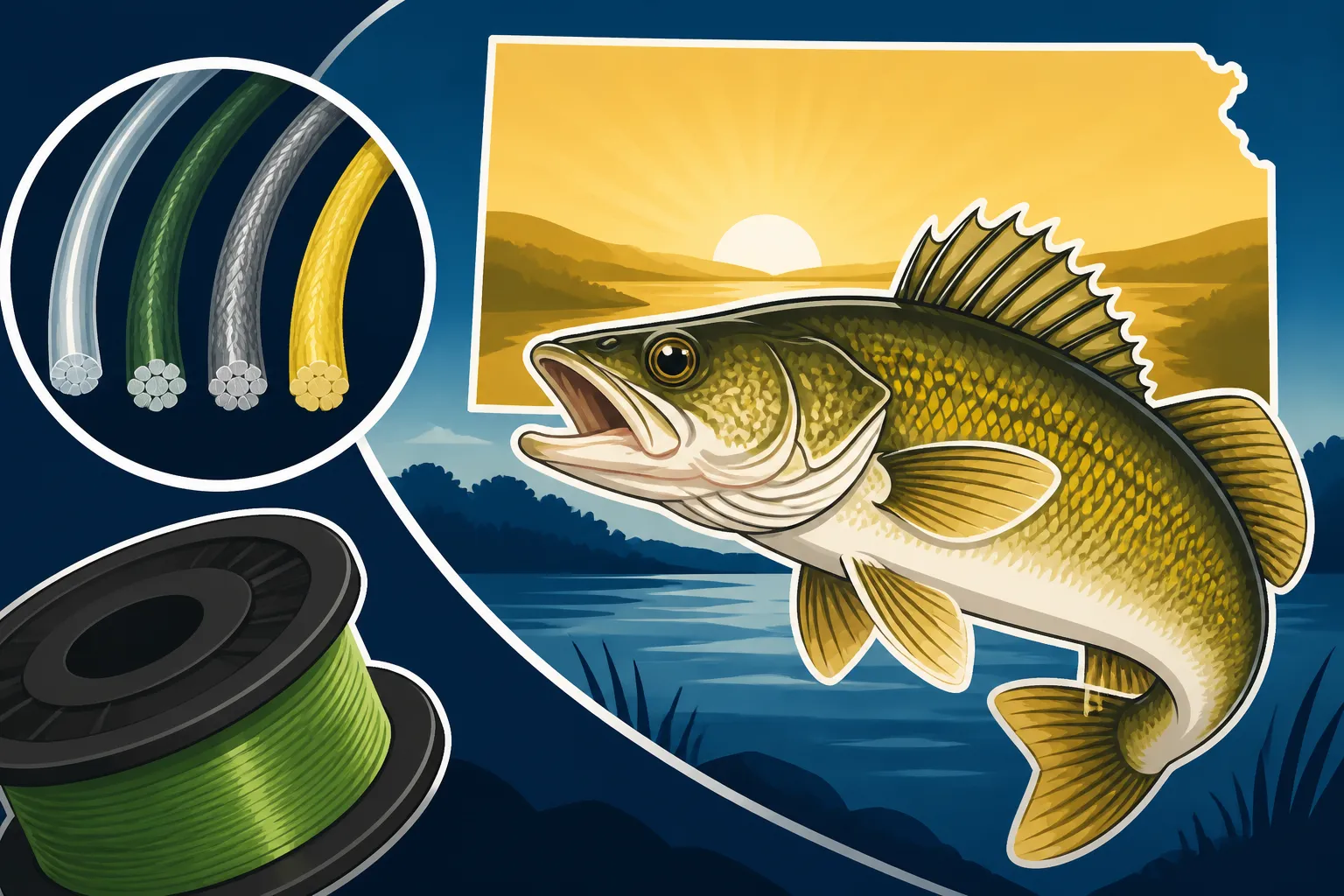
Braided line is made of multiple strands of synthetic fibers woven together, giving it incredible strength for its diameter and virtually no stretch.
- Pros: Extremely strong for its diameter, virtually no stretch (maximum sensitivity and hook-setting power), excellent casting distance, incredible abrasion resistance (though it can be cut by sharp objects more easily than some other lines).
- Cons: Very visible (unless specialty colored lines are used), can be expensive, difficult to cut without sharp scissors, can "dig in" on the spool if not spooled correctly or if a fish makes a hard run. Can be prone to wind knots with some setups.
- When to Use It: Braid is fantastic as a main line for jigging, pitching, and trolling, especially when you need maximum sensitivity to detect light bites or when fishing deep water to minimize line drag. It's often paired with a fluorocarbon leader to mitigate its high visibility. This combination is especially effective for Kansas Walleye Fishing Techniques that require a delicate presentation in clear water with the backbone to pull fish from cover.
- Recommended Weights: For walleye, 10 to 20-pound test braided line is commonly used as a main line. The higher strength for a thinner diameter means you can feel more and cast further. The choice usually comes down to personal preference and the specific technique. For example, 10-pound braid might be ideal for casting light jigs, while 15 or 20-pound might be preferred for heavier trolling setups or fishing areas with really nasty snags.
Here's a quick comparison of the three main line types for Kansas walleye:
| Line Type | Key Characteristic | Pros | Cons | Recommended Walleye Test (Main Line) | Best Use Case |
|---|---|---|---|---|---|
| Monofilament | Stretchy, good shock absorber | Inexpensive, good knot strength, forgiving | Visible, less sensitive, line memory | 6-10 lb | Trolling shallow cranks, beginners |
| Fluorocarbon | Low visibility, dense | Nearly invisible, abrasion resistant, sensitive | Stiff, expensive, knot critical | 6-10 lb | Jigging, bottom bouncing, clear water, leader material |
| Braided Line | No stretch, high strength | Super sensitive, strong, long casts | Visible, expensive, prone to wind knots | 10-20 lb | Jigging, trolling (with leader), heavy cover |
Balancing Line Weight with Rod, Reel, and Lure
Choosing the best line weight for Kansas walleye isn't a solitary decision; it needs to be part of a holistic approach to your entire fishing setup. Your rod, reel, and the lures you're using all play a critical role in how your chosen line performs. Think of it like a symphony – all the instruments need to be in tune for a beautiful performance.
Matching Your Rod and Reel to Your Line
Just like you wouldn't put truck tires on a sports car, you shouldn't mismatch your fishing line with your rod and reel. Rods are typically rated for a range of line weights and lure weights, often printed right on the blank. A "medium-light" power rod, for example, might be rated for 6-12 pound test line, while a "medium" rod might be 8-17 pound. Sticking within these recommendations is important for optimal performance and preventing damage to your gear.
- Rod Power and Action: A rod with a lighter power might feel overloaded with heavy braided line, compromising its sensitivity and casting ability. Conversely, a heavy-power rod might not load properly with ultra-light monofilament, resulting in poor casting distance and reduced feel. The rod's action (how much it bends) also matters. A "fast action" rod, which bends mostly at the tip, pairs well with low-stretch lines like braid and fluorocarbon for quick hook sets. A "moderate action" rod, which bends more through the middle, can be more forgiving with mono. If you're looking for a new setup, consider combinations like the "Best Rod and Reel Combo for Walleye" for guidance.
- Reel Size: Spinning reels and baitcasting reels are also designed for specific line capacities and diameters. Spooling a reel designed for 8-pound mono with 30-pound braid might mean you don't have enough line capacity, or the line simply doesn't lay on the spool correctly, leading to tangles and casting issues. Check your reel's specifications and select a line weight and diameter that it can handle efficiently.
A balanced system ensures that the rod loads properly on the cast, the reel handles the line smoothly, and you can feel those subtle walleye bites.
Lure Weight and Presentation
Your lure choice is intrinsically linked to your line weight. Heavier lures can cut through water more easily, but if your line is too thick, it will still create drag and inhibit the lure's natural action or prevent it from reaching its desired depth.
- Crankbaits and Trolling: When using crankbaits, especially for Trolling for Walleye on Kansas Reservoirs, line diameter directly affects the diving depth. A thinner line will allow your crankbait to dive deeper with less effort. If you're trying to hit a specific depth, say 15 feet, and your line is too thick, you might find your lure only reaching 12 feet. This is where the low diameter of braided line, often paired with a fluorocarbon leader, really shines. For precise depth control, a thin but strong line is invaluable.
- Jigs and Soft Plastics: With jigs and soft plastics, especially lighter ones, the line weight can drastically alter the presentation. A heavy, stiff line can cause a light jig to "helicopter" or fall unnaturally. A thinner, more supple line allows the jig to fall freely and present more naturally to the walleye. It also impacts how far you can cast those lighter lures, which can be crucial when trying to reach a distant seam or submerged hump.
- Bottom Bouncers: For bottom bouncers, which are popular for drift fishing or slow trolling, you want a line that allows the rig to maintain contact with the bottom without excessive drag. While some anglers might go a bit heavier here due to abrasion from the bottom, finding a balance between strength and feel is key. You need to feel those ticks and bumps as the bouncer travels over structure.
Ultimately, the best line weight facilitates the perfect presentation of your chosen lure, giving it the action and depth needed to entice those finicky walleye.
Practical Tips for Maximizing Your Walleye Line Performance
Even the "best" line weight won't perform optimally if not properly cared for. A little bit of attention to your line can go a long way in preventing frustration and ensuring you're ready when that trophy walleye decides to bite.
Knot Tying and Line Maintenance
A chain is only as strong as its weakest link, and in fishing, that weak link is often the knot. No matter how strong your line, a poorly tied knot will fail.
- Knot Selection: For monofilament and fluorocarbon, reliable knots like the Improved Clinch or Palomar knot are excellent choices for tying on lures and swivels. For braided line, because it's so slick, a Palomar knot is almost universally recommended, or a similar knot specifically designed for braid. When tying a fluorocarbon leader to braid, an FG knot or a Double Uni knot are popular, though they take practice. Always moisten your knots with saliva before cinching them down; this reduces friction heat that can weaken the line.
- Line Inspection: After every fishing trip, or even periodically throughout a long day on the water, take a few minutes to inspect the last few feet of your line. Run it between your fingers, feeling for nicks, abrasions, or rough spots. These are potential failure points. If you find any damage, don't hesitate – cut off a few feet of line and re-tie your lure. This simple habit can save you from losing that big walleye you’ve been waiting for. Especially when fishing around riprap or submerged brush, your line is constantly taking a beating.
- Preventing Line Twist: Line twist can lead to tangles, knots, and generally poor line performance. It often occurs from lures that spin, improperly setting your drag, or reeling against a pulling fish. Use quality swivels, especially with spinning lures or when trolling, to minimize twist. Regularly check your line for signs of twist and if it's severe, let out a lot of line behind the boat while moving to help it untwist, or strip it off the reel and re-spool it.
When to Change Your Line
Fishing line doesn't last forever. Environmental factors, use, and simple aging all contribute to its degradation. Knowing when to replace your line is just as important as choosing the right kind.
- Signs of Wear: Fading color, excessive line memory (when it springs off the spool in coils), fraying, or a noticeable reduction in strength are all clear indicators it's time for new line. If your line starts to feel rough or fuzzy, especially braided lines, it's losing its integrity and needs replacing.
- UV Damage: Monofilament and fluorocarbon lines are susceptible to UV degradation from sunlight. Over time, the sun's rays break down the polymers, making the line weaker and more brittle. Even if you don't fish often, line left on a reel exposed to sunlight will degrade.
- Frequency: As a general rule of thumb, if you fish regularly (e.g., several times a month during peak season), consider replacing your main line at least once a season. If you fish heavily, you might do it more often. For casual anglers, changing line every one to two years might suffice, but always inspect it thoroughly. Investing in fresh line is a small cost compared to losing a trophy fish or a favorite lure due to preventable line failure. You can often find bulk spools of your preferred line on Amazon to make respooling more economical. This proactive approach is part of successful Kansas Fishing Techniques for Beginners and seasoned pros alike.
Disclaimer
This article is for general informational purposes only and does not constitute professional advice. Laws, prices and regulations vary by location and change over time. Consult a qualified professional for guidance on your specific situation.