Deep Water Trolling for Kansas Stripers
There's nothing quite like the thrill of a Kansas striper hitting your line, but let's be honest: finding those powerful fish, especially when they retreat to the cool, dark depths of our big reservoirs, can feel like trying to find a needle in a haystack. Many anglers get frustrated, dragging lines aimlessly without a bite. This isn't about luck; it's about understanding the nuances of deep water trolling. This guide is here to unravel the mystery, providing you with detailed strategies and gear insights to consistently put those hard-fighting Kansas striped bass in your boat, even when they're hiding way down deep.
Understanding Kansas Stripers and Their Deep Water Habits
Tackling deep-water stripers in Kansas isn't just about dropping a line and hoping for the best; it's about understanding their behavior, which is heavily influenced by the unique characteristics of our reservoirs. These fish are masters of adaptation, and knowing why and where they go deep is your first step to success.
Why Stripers Go Deep in Kansas
Kansas summers can get scorching hot, and while we love the sunshine, our lakes don't always offer consistent, comfortable temperatures throughout the water column. This is where the thermocline comes into play. The thermocline is that invisible layer where the warm, oxygen-rich surface water meets the colder, denser, deeper water. Stripers, being cold-water species at heart (even the landlocked ones we have here), will often seek out the cooler temperatures below this layer, especially when surface temps climb into the 80s or higher. They're looking for that "Goldilocks zone" – not too hot, not too cold, and with sufficient oxygen.
Beyond temperature, oxygen levels play a crucial role. While cooler deep water is generally preferred, if it becomes anoxic (lacking oxygen), stripers will be forced to move up, even if it means slightly warmer water. They're constantly balancing their need for cooler temps with their need for breathable water. Add to this the fact that their primary food source, like shad, often congregates at specific depths, and you have a clear reason why stripers might be tucked away in those deeper zones, often near the main lake points or submerged structure where baitfish feel secure. Knowing this tells us why just casting near the shore isn't going to cut it in certain seasons.
Identifying Key Deep Water Structures
Stripers are ambush predators, and even in deep water, they aren't just swimming aimlessly. They relate to structure, just like bass or crappie, albeit on a grander scale. Understanding this relationship is critical for anyone hoping to succeed with deep water trolling. Think of the main lake points that extend far out into the reservoir. Below the surface, these points can drop off sharply, creating perfect current breaks and ambush points where stripers can hide and wait for schooling baitfish to pass by.
Submerged humps are another striper magnet. These underwater islands can hold entire schools of baitfish, which in turn attract hungry stripers. The top of the hump might be 20 feet deep, but the sides could drop quickly to 40 or 50 feet, providing varying depth zones for fish to utilize. Old creek channels, winding through the reservoir floor, act like highways for baitfish and predators alike. Stripers will often patrol the edges or bends of these channels, using the deeper water for cover and the drops for easy access to prey. Similarly, river bends, particularly those with an abrupt depth change, can be excellent spots. Learning to "read" these underwater landscapes with your electronics, understanding how they transition and where bait might congregate, is paramount. Many anglers might think these spots are only for bottom dwellers, but stripers often suspend just off these structures.
Essential Gear for Deep Water Striper Trolling
Deep water trolling for stripers isn't your average panfish setup. It requires specialized gear designed to handle the powerful strikes of these fish and to effectively present lures at significant depths. Trying to use lightweight equipment will lead to lost fish and endless frustration.
Rods, Reels, and Line Selection
When you're pulling heavy deep-diving crankbaits, umbrella rigs, or even multiple lines with lead core, you need tackle that can stand up to the challenge. For rods, think heavy action with a moderate taper, typically 7 to 9 feet in length. This length helps spread lines, absorb the shock of a strike, and provide the leverage needed to fight a strong striper. Look for rods with a strong backbone but a tip sensitive enough to detect subtle bites or when your lure is fouled. Brands like Ugly Stik or Shakespeare often have durable options that are perfect for this kind of abuse without breaking the bank.
Your reel needs to be a workhorse. Large-capacity baitcasting reels are standard, often a "400" or "500" series, capable of holding hundreds of yards of line. You'll want a smooth drag system that can withstand long, powerful runs. For line, you have a few choices, each with its own benefits. Monofilament in the 20-30 lb test range is a good all-around choice for its stretch and abrasion resistance, especially when trolling with downriggers. However, for getting lures deep without additional weight, many anglers turn to lead core line. This specialized line has a lead core wrapped in a braided sheath, allowing it to sink at a predictable rate. For the ultimate in sensitivity and direct depth control (when using specific techniques), braided line of 50-80 lb test can be used, often with a fluorocarbon leader. Each type of line has its place, and understanding their properties is key to effective deep water trolling. Considering the sheer power of these fish, robust gear is not a luxury, it's a necessity.
Deep Diving Lures and Planer Boards
The right lure is crucial for reaching those deep-dwelling stripers. We're talking about crankbaits that are designed to dive significantly, often reaching depths of 20 to 30+ feet on their own. Lures like the Bomber Deep Long A, Rapala Deep Tail Dancer, or the Berkley Dredger are popular choices. These lures typically have a long, aggressive bill that forces them down when trolled. Color choice can be critical, with shad patterns, chrome, and chartreuse often being top producers in Kansas reservoirs.
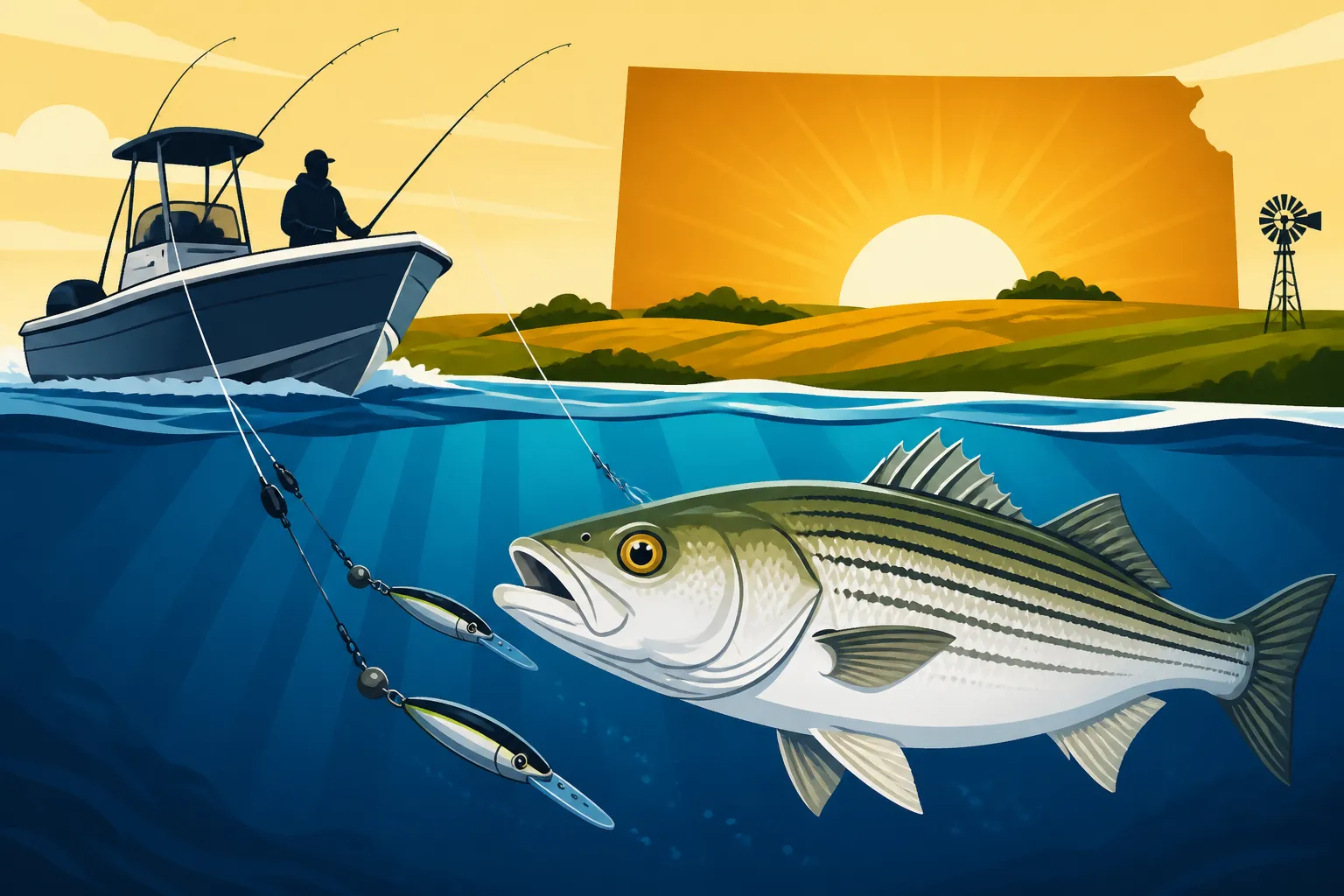
Beyond individual deep divers, umbrella rigs can be incredibly effective. These rigs mimic a small school of baitfish, often consisting of several teaser baits around a central, larger "hook bait." They create a much larger profile in the water, attracting stripers from a distance. However, they can be a handful to manage, especially when battling a fish.
To spread your lines out and cover a wider swath of water, planer boards are invaluable. These ingenious devices clip onto your line and, as you troll forward, they pull your line out to the side of the boat. This allows you to run multiple lines without tangles, effectively presenting lures to fish that might be spooked by the boat's motor. Inline planer boards are common for a simpler setup, but larger boards can also be used. Many excellent options for these lures and planer boards can be found on sites like Amazon, providing a convenient way to stock up on the essentials before your next trip. Always check your Kansas Fishing Regulations Explained and Kansas Fishing Seasons and Limits for any specific rules regarding the number of lines or hook limits.
Sonar and GPS for Precision Trolling
In the deep-water striper game, your eyes below the surface are your sonar and GPS units. Without them, you're essentially trolling blind, and that's a fast track to disappointment. A quality fish finder (sonar) allows you to "see" the underwater world. You can identify submerged humps, old creek channels, and significant depth changes that are striper magnets. More importantly, it helps you locate baitfish schools, which are often the key to finding active stripers. Look for units with good screen resolution and advanced features like CHIRP sonar, which provides clearer target separation and better detail. Brands like Garmin, Lowrance, and Humminbird offer a range of options, and choosing the right one can make a huge difference, as detailed in our Kansas Fish Finder Buying Guide.
Once you've found productive structure or schools of baitfish, your GPS becomes indispensable. It allows you to mark waypoints, so you can return to that exact spot again and again. Even more critically for trolling, GPS helps you maintain consistent trolling paths. If you get a bite at a specific depth and location, you can use your GPS to make repeated passes over that precise area, increasing your chances of finding more fish. The ability to track your boat's speed and direction with pinpoint accuracy means you're not guessing; you're executing a strategic plan. This combination of seeing the fish and knowing exactly where you are is the foundation of successful deep water striper trolling.
Mastering Trolling Techniques for Kansas Stripers
Trolling for stripers isn't just about driving around in circles; it's a fine art of boat control, depth management, and understanding how your lures are behaving. It requires constant attention and adjustment to dial in the bite.
Speed, Direction, and Depth Control
Achieving the right trolling speed is paramount for stripers. They are often chasing fast-moving baitfish, so your lures need to mimic that. Typically, speeds between 2.5 and 4.0 miles per hour are a good starting point, but you'll need to experiment. Sometimes a slight increase or decrease in speed can trigger a strike. Pay attention to your fish finder; if stripers are suspended high in the water column, a faster presentation might be in order. If they're hugging the bottom, a slower, more deliberate approach might be better.
Don't just troll in straight lines. Incorporating S-turns or gentle curves can make a significant difference. As your boat turns, your outside lines will speed up, and your inside lines will slow down, causing your lures to change depth and action. This erratic movement can often provoke a hesitant striper into striking. Varying depths is also crucial. Instead of just setting all your lures to one depth, try staggering them. You might have one lure running at 20 feet, another at 25, and a third at 30. This helps you quickly determine the preferred feeding depth on any given day. Factors like wind and current also influence your true lure speed and depth, so constant monitoring and adjustment, often with a good Kansas Trolling Motor Guide and a reliable GPS, are key.
Utilizing Lead Core Line and Downriggers
When stripers are holding deep, standard monofilament might not get your lure down effectively without a lot of added weight, which can deaden the lure's action. This is where specialized depth control methods come in.
Lead core line is a fantastic tool for reaching specific depths without heavy sinkers directly on your main line. The line itself has a lead core, making it dense and causing it to sink. It's often marked with different colors (usually every 10 yards or so), allowing you to calculate how much line you need to deploy to reach a certain depth at a given speed. For example, a common rule of thumb is that one color (10 yards) of lead core will get your lure down about 5 feet at a trolling speed of 2.5 mph. So, if you want to reach 25 feet, you might let out five colors. The stretch in lead core also helps absorb the shock of a striper's powerful hit, preventing hook pulls.
Downriggers, on the other hand, offer even more precise depth control. These devices use a heavy weight (called a "cannonball") attached to a wire cable, which is lowered to a precise depth. Your fishing line is then clipped into a release clip on the cannonball's cable. When a fish strikes, the line releases from the clip, allowing you to fight the fish directly without the drag of the heavy downrigger weight. Downriggers are excellent for presenting lures at exact depths, even when making turns or changing speeds slightly. They are particularly useful for targeting specific depth contours where stripers are stacked up. Many anglers utilize both lead core and downriggers in their spread to cover a broader range of depths and presentations, optimizing their chances of success.
Reading Your Electronics for Success
Your boat's electronics are your most valuable allies in deep water striper trolling. Learning to interpret the data they provide is like having x-ray vision into the underwater world. Your sonar isn't just showing you squiggly lines; it's painting a picture. You'll want to identify the thermocline as a distinct band on your screen – this is often where stripers will suspend. Look for large schools of baitfish, typically appearing as dense clouds or arches. Where there's bait, there are usually predators close by. Stripers themselves will show up as large, distinct arches, often slightly separated from the bait schools, indicating they're actively feeding or positioned to feed.
Pay attention to bottom composition too. Hard bottoms, rocky areas, and abrupt drop-offs will appear differently on your screen than soft, muddy flats. Stripers often relate to these changes. Your GPS, as mentioned, is crucial for replicating successful passes. When you mark a waypoint where you caught a fish or saw a significant school, use your GPS to guide your boat back over that exact trajectory. Observing your speed on the GPS is also vital to ensure you're maintaining the optimal lure action. Combining your understanding of fish behavior with precise electronic readings is what transforms aimless trolling into a highly effective, strategic pursuit. It takes practice, but the rewards are well worth the effort when you start consistently finding those elusive deep water stripers.
Best Times and Locations for Deep Water Striper Trolling
Finding stripers is often about being in the right place at the right time, and for deep water trolling, this means understanding their seasonal movements and identifying their preferred hangouts in our Kansas lakes.
Seasonal Patterns for Deep Water Stripers
Stripers are nomadic, constantly on the move, but their patterns become more predictable when you consider the seasons. In Kansas, the prime time for deep water striper trolling really kicks into gear during the late spring and summer months. As surface waters warm up, stripers begin their migration to deeper, cooler sections of the lake. They'll follow the thermocline, typically suspending just above it or in it, seeking that optimal temperature and oxygen balance. This means from late May through September, you'll generally find them deeper than 20 feet, often much deeper, especially during the peak heat of July and August. This is when deep-diving crankbaits and downriggers truly shine.
As fall approaches, the lake water begins to cool and "turn over," mixing the oxygen and temperatures more evenly. This can cause stripers to disperse and move shallower for a period, making deep trolling less effective. However, once the fall turnover is complete and the water stabilizes, stripers might settle back into deeper patterns, especially in the larger reservoirs like Wilson Lake, until the water gets truly cold in winter. During the winter, they'll still be deep but might be less active, requiring slower presentations. Understanding these Kansas Fishing Seasons Guide helps you anticipate where the fish will be and which techniques to employ.
Top Kansas Reservoirs for Striper Trolling
Kansas boasts some fantastic reservoirs that offer excellent opportunities for striper fishing, particularly for those willing to venture into deeper waters.
- Wilson Lake: Often hailed as the "Clearest Lake in Kansas," Wilson Lake is a premier destination for striped bass. Its deep, clear waters provide ideal habitat for stripers, and they often relate to the abundant rock structures, main lake points, and submerged timber. The western end, near the river channels, and the main lake body often hold schools of stripers during the warmer months. Anglers frequently target areas near Lucas Park or Hell Creek. For more specific insights, check out our Wilson Lake Fishing Guide.
- El Dorado Lake: Located closer to Wichita, El Dorado Lake is another excellent striper fishery. It has a good population of shad, which keeps the stripers well-fed and growing. The main lake basin, particularly near the dam and along the old river channels, can be highly productive for deep water trolling. Anglers often find success working humps and points in the middle and lower sections of the lake. Our guide on El Dorado Lake Striped Bass Fishing provides further details.
- Cheney Reservoir: While perhaps better known for its walleye and wiper populations, Cheney also holds a good number of stripers. Its expansive open water and deeper sections, especially in the main lake, can be excellent for trolling. Stripers here often follow large schools of shad, so finding the bait is key. Focus your efforts on the deeper drops and humps throughout the central and southern parts of the lake.
Each of these lakes offers unique challenges and rewards, but all require a deep-water approach during significant portions of the year to consistently connect with stripers.
Weather and Water Conditions
Never underestimate the power of weather and water conditions when deep water trolling for stripers. They are highly sensitive to changes in their environment, and adapting your strategy accordingly is critical.
- Sunny vs. Cloudy Days: On bright, sunny days, stripers tend to go deeper and hug structure more tightly to avoid direct light. This is when your deep-diving lures and downriggers will be most effective, targeting fish holding in the shadows or deeper parts of the thermocline. Cloudy days, however, can encourage stripers to move shallower or suspend higher in the water column, making them more active and potentially more accessible with shallower running lures or even umbrella rigs.
- Wind: Wind can be a blessing and a curse. A light chop on the water can break up the surface, making stripers less wary of your boat and lines. It also creates current and moves baitfish, which can activate predators. However, strong winds can make boat control difficult, hindering your ability to maintain consistent trolling speeds and patterns. On windy days, try to troll with or against the wind, or find sheltered coves and points that still offer deep water access.
- Water Clarity: Kansas reservoirs can vary significantly in clarity. In clearer lakes like Wilson, stripers rely heavily on sight, so matching your lure colors to natural baitfish (like shad) is often effective. In murkier waters, brighter colors like chartreuse, orange, or lures with rattles can be more productive, as they provide more vibration and contrast for fish to detect. Water clarity can also influence how deep fish are willing to venture, as they might feel more exposed in very clear, shallow water. Always observe the conditions when you launch and adjust your approach accordingly.
Common Challenges and Troubleshooting
Deep water trolling for stripers isn't without its hurdles. From snags to finicky fish, you'll encounter situations that can test your patience. Knowing how to troubleshoot these common challenges will save you time and frustration, keeping your lines in the water where the fish are.
Avoiding Snags and Fouled Lines
One of the most common frustrations in deep water trolling, especially in Kansas reservoirs with their submerged timber and rocky bottoms, is getting snagged. It's inevitable that it will happen, but you can take steps to minimize it. First, pay extremely close attention to your sonar. If you see significant timber fields or rock piles below your trolling depth, either steer clear or adjust your lure depth upwards. Running lures just above the structure is the goal, not through it.
Another strategy is to use a "depth finder" before deploying your expensive lures. A simple heavy jig or sinker on a hand line can be lowered to touch bottom, giving you a real-time sense of the exact depth. When a snag does occur, resist the urge to immediately power forward. Often, backing up slowly or turning the boat in the opposite direction from your troll can free a snagged lure. Sometimes, letting out a bit more line and then reeling in sharply can also dislodge it. For umbrella rigs, which are particularly prone to snags, consider using lighter leader material for the individual teasers so that if one snags, you only lose that portion, not the entire expensive rig. Having a good lure retriever on board can also be a lifesaver, allowing you to salvage many lures that would otherwise be lost to the depths.
Adjusting to Changing Fish Behavior
Stripers, like all fish, can be finicky. What worked yesterday might not work today, and what's effective in the morning might be useless by afternoon. This calls for constant observation and adjustment. If you've been trolling for a while without a bite, it's time to change things up.
Start by varying your trolling speed. Try speeding up for a few minutes, then slowing down. Sometimes, a slight increase or decrease is all it takes to trigger a strike. Next, experiment with depth. Even a 5-foot change can make a huge difference if the stripers have moved up or down the water column to follow bait or find a more comfortable temperature. Watch your sonar for clues. If fish are showing up deeper, deploy more line or adjust your downriggers. If they're shallower, bring your lures up.
Don't be afraid to change lures. If a particular color or type of crankbait isn't producing, switch it out. Try different sizes, colors, or even go from a single deep diver to an umbrella rig. Sometimes, the profile or vibration of a different lure is what catches their attention. Also, consider the time of day and light conditions; early morning or late evening bites might respond to different presentations than midday. The key is to be proactive, not reactive. If the fish aren't biting, assume you're doing something wrong and start methodically trying different combinations until you crack the code.
Dealing with Incidental Catches
When you're deep water trolling for stripers in Kansas, it's not uncommon to hook into other species. Our reservoirs are teeming with diverse fish, and while you might be targeting a powerful striper, you could just as easily find a feisty wiper, a heavyweight catfish, or even a large walleye on the end of your line.
- Wipers and Hybrid Stripers: These aggressive hybrids (a cross between white bass and striped bass) often inhabit the same deep-water zones as stripers and strike similar lures. They put up a fantastic fight, so enjoy the battle! Be aware of the length and creel limits for wipers, as they can sometimes differ from pure stripers. They are excellent eating fish, so if you're keeping fish, they're a welcome addition. For more on these powerful fish, check out our Kansas Striped Bass and Wiper Guide.
- Catfish: Channel catfish and even blue catfish can sometimes take deep-trolled crankbaits, especially if your lures are running near the bottom or through deeper channels. They’ll put a strong pull on your line, often feeling like a dead weight until they decide to really fight.
- Walleye: While you'd typically use different lures and techniques for walleye, larger walleye will occasionally strike a deep-diving crankbait intended for stripers, especially when found on deep points or humps. They're another prized catch in Kansas, so savor the moment if one takes your lure.
Regardless of what you hook, always practice proper fish handling. If you intend to release the fish, minimize its time out of the water, handle it gently, and use appropriate tools like de-hookers. Even incidental catches can provide a lot of fun and fill your cooler if they're within legal limits. Embrace the variety; it's part of the adventure of fishing Kansas waters!
| Trolling Method | Max Depth (Approx.) | Pros | Cons | Ideal Use Case |
|---|---|---|---|---|
| Deep Diving Lures | 20-30+ feet | Simple, direct, good vibration | Limited depth without added weight | Targeting specific structure, mid-depth stripers |
| Lead Core Line | 30-50+ feet | Consistent depth, no heavy weight on rod | Slow retrieve, can be bulky | Covering wide depth ranges, scattered fish |
| Downriggers | 50-100+ feet | Precise depth control, direct fight | Requires dedicated equipment, boat speed | Targeting specific depths, stacked fish, very deep water |
| Planer Boards | Surface | Spreads lines, covers wider area | Can be cumbersome, limited depth | Complement other methods, wider search pattern |
Disclaimer
Fishing conditions and regulations in Kansas can change rapidly. Always consult the latest Kansas Department of Wildlife, Parks and Tourism (KDWPT) fishing regulations before heading out. This guide is for informational purposes only and does not supersede official state regulations. Stay safe on the water and prioritize ethical angling practices.