Best Line Weight for Kansas Catfish
One of the biggest head-scratchers for any Kansas angler, especially when you're chasing those whiskered giants, is picking the right fishing line. It's not just about "strong enough"—it's about finding that sweet spot between invisibility, abrasion resistance, and enough backbone to really haul in a feisty channel cat or a massive flathead without snapping. This guide is all about helping you cut through the confusion and confidently choose the best line weight for your Kansas catfish adventures, no matter if you're on a tranquil farm pond or battling the currents of a big river.
Understanding Catfish Behavior and Habitat in Kansas
Before we even dive into numbers, let's talk about the stars of the show: Kansas catfish. These aren't dainty eaters; they're powerful, opportunistic, and they often hang out in places that love to snag your line. Knowing what you're up against is the first step in choosing your weapon.
The Diverse Catfish Family in Kansas Waters
Kansas is blessed with an incredible variety of catfish, each with its own personality and fighting style. We primarily encounter three main species: Channel Catfish, Blue Catfish, and Flathead Catfish. Each of these requires a slightly different approach when it comes to line selection.
Channel cats are arguably the most common and widespread. You'll find them in almost every water body across the state, from small community lakes to vast reservoirs and winding rivers. They typically range from a pound or two up to 15-20 pounds, though bigger ones are certainly out there. Channels are known for their spirited fights, often making quick runs and thrashing around near the surface. They're a blast to catch, and their size range means you can often get away with slightly lighter tackle, but don't underestimate their power. For a deeper dive into these fantastic fish, check out our Kansas Catfish Species Guide.
Blue catfish are the true heavyweights of the Kansas catfish scene, found predominantly in our larger reservoirs and major river systems like the Kansas River or the Missouri River. These are the fish that can easily tip the scales into the 30, 40, 50-pound range, and even much, much larger. A blue cat fight is a test of endurance; they make long, powerful runs and will dig deep, trying to rub your line on anything they can find. You absolutely need stout gear when targeting these behemoths.
Then there's the Flathead catfish, a solitary hunter that prefers live bait and lives in the nastiest, snaggiest cover you can imagine. Flatheads are like underwater bulldogs, specializing in short, incredibly powerful bursts and a relentless drive to get back into their sunken log piles or rock crevices. They might not make the long runs of a blue cat, but their sheer power and their habitat choice demand a line that can withstand immense pressure and abrasion. Landing a big flathead often feels like trying to pull a concrete block out of quicksand.
Where Catfish Live and How They Fight
The places where Kansas catfish choose to live are just as important as their species when deciding on line weight. Catfish are structure-oriented fish. This means they love to hide in and around submerged timber, brush piles, rock formations, bridge pilings, and deep holes. These are all places where your line can get severely abraded or outright cut if it's not up to the task.
Think about fishing for blue cats in the Kansas River. The current itself puts tremendous strain on your line, especially if you're using heavy weights to hold bottom. Add in the potential for snags from submerged debris, and you quickly realize that a lighter, less durable line just won't cut it. A big blue cat hooked in a strong current can snap even surprisingly strong line if it's not handled correctly. Similarly, a flathead living deep within a timber pile in a reservoir like Milford Lake will try to saw your line off the moment it feels the hook.
Conversely, if you're fishing for smaller channel cats in a relatively clean farm pond or a well-maintained community lake, you might not need the heaviest line. The environment is less punishing, and the fish, while still fun fighters, aren't likely to put the same extreme demands on your tackle. Understanding these environmental factors helps you strike the right balance between strength and subtlety. For more on where to find these whiskered beasts, check out our guide to the Best Catfish Lakes in Kansas or learn about Kansas River Catfish Spots.
Factors Influencing Your Catfish Line Weight Choice
Choosing the right line weight isn't a one-size-fits-all decision. It's a careful balance of several factors that, when considered together, will lead you to the most effective setup for your specific Kansas catfishing adventure.
Target Species and Size
As we touched on earlier, the type and size of catfish you're hoping to catch play a huge role. You wouldn't use the same fishing line for a five-pound channel cat as you would for a 50-pound blue cat, would you?
For your average channel catfish, especially those common 2-10 pounders you might find in many Kansas lakes and ponds, a line in the 10-20 pound test range is often perfectly adequate. This allows for good casting distance and still has enough strength to handle their zippy runs. If you're specifically targeting larger channels, perhaps those 15-20 pound brutes, bumping up to 20-30 pound test can give you extra confidence, especially if they're in areas with some snags. You'll want to be aware of the Kansas Channel Catfish Daily Limit as you're reeling them in.
When you start dreaming of those true trophy blue catfish or flatheads, particularly in the bigger impoundments like Tuttle Creek Lake or the mighty Missouri River, your line needs to get serious. For blue cats that routinely hit 30, 40, or even 50 pounds, a minimum of 40-50 pound test braided line is often recommended, sometimes even heavier. Flatheads, with their powerful dives into cover, also demand this kind of strength. While they might not be as widely distributed as channels, when you find a flathead, they're typically good-sized, and they fight dirty. Understanding the specific characteristics of different catfish species, including their average size and fighting tendencies, is crucial for selecting the appropriate line. For detailed information on these heavyweights, be sure to read about Kansas Flathead Catfish Daily Limit for regulations on these giants.
Fishing Environment and Cover
The environment you're fishing in is a massive determinant of your line choice. Kansas waters offer a huge range, from pristine, open sections of lakes to snag-infested river channels.
Snags and Structure: If you're fishing in areas with heavy cover—think fallen trees, rock piles, old bridge debris, or dense aquatic vegetation—you need line with excellent abrasion resistance. Catfish often hug these structures for ambush points and sanctuary. The moment you hook a fish, its natural instinct will be to dive straight back into that cover, trying to rub your line against anything rough it can find to break free. Braided line, while incredibly strong, can sometimes fray if constantly abraded, so a heavy monofilament or a fluorocarbon leader is often paired with braid in these situations. Conversely, a lighter monofilament might simply get shredded on the first encounter with a submerged branch.
Current: Fishing in rivers with strong currents, like sections of the Kansas River or the Republican River during spring flows, adds another layer of complexity. The current itself puts constant strain on your line, and a large catfish will use that current to its advantage, making powerful runs downstream. You need a line strong enough to withstand both the fish's fight and the relentless pull of the water. Thicker, heavier lines tend to catch more current, requiring heavier sinkers to hold bottom, which can make casting a challenge. This is where the thinner diameter of braided line, offering less resistance to current, can be a huge advantage.
Water Clarity: While catfish are less visually dependent than, say, a finicky walleye, water clarity can still play a minor role. In exceptionally clear water, a low-visibility fluorocarbon leader can sometimes be beneficial. However, in the often stained or muddy waters where catfish thrive, particularly in rivers, line visibility is usually less of a concern than pure strength and abrasion resistance.
Your Fishing Technique
The way you plan to catch catfish also heavily influences your line weight decision. Different techniques put different demands on your line.
Bank Fishing with Heavy Rigs: Many Kansas catfishermen love the simplicity of bank fishing. This often involves casting heavy sinkers (sometimes 3-4 ounces or more) to hold bait in place against current or wind. This repeated casting of heavy weights puts a lot of stress on your line. You need a line that can handle the shock of the cast without snapping. If you're learning the ropes, our How to Catch Channel Catfish From the Bank guide has more useful tips.
Drift Fishing and Trolling: If you're drift fishing from a boat, allowing your bait to move naturally with the current or wind, you might be covering more open water. Here, line strength is still paramount for fighting fish, but abrasion resistance might be slightly less critical than in snag-infested areas. However, the constant motion and potential for tangles with other lines (if fishing with multiple rods) still necessitate a durable, manageable line. For insights into this method, check out Drift Fishing for Kansas Catfish.
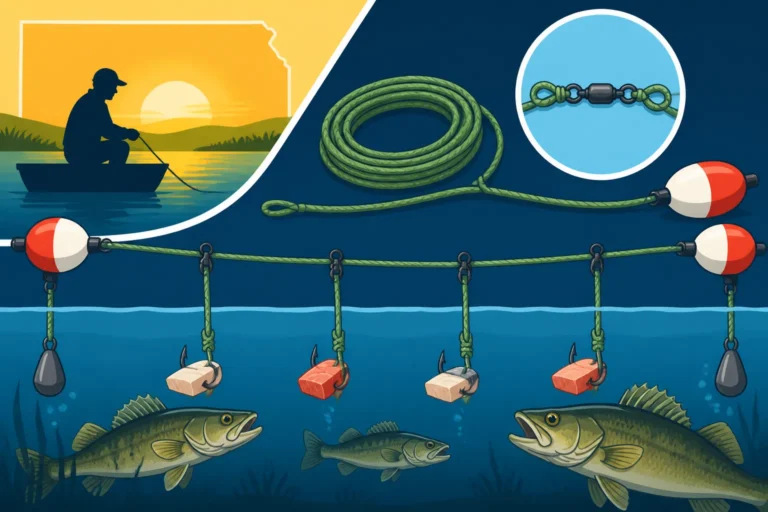
Jug Lines and Trotlines: While not directly related to rod-and-reel line weight, the lines used for trotlines and jug lines are often extremely heavy (50-100+ pound test) for obvious reasons—they're designed to passively catch multiple large fish and hold them securely. This highlights the general principle: bigger fish and more demanding conditions require significantly stronger line.
Rod and Reel Balance: Ultimately, your line choice needs to be balanced with your rod's power and your reel's drag settings. A heavy line on a light rod won't perform well, and a light line on a heavy rod is just asking for trouble. Ensure your entire setup works in harmony, from rod action to reel capacity to line test. A well-balanced system allows you to cast efficiently, detect bites, and fight fish effectively without overstressing any single component.
Recommended Line Weights for Kansas Catfish
Now that we've covered the "why," let's get into the "what" – the actual line weights and types that will serve you best for Kansas catfish. This isn't just about picking a number; it's about understanding the characteristics of different line materials too.
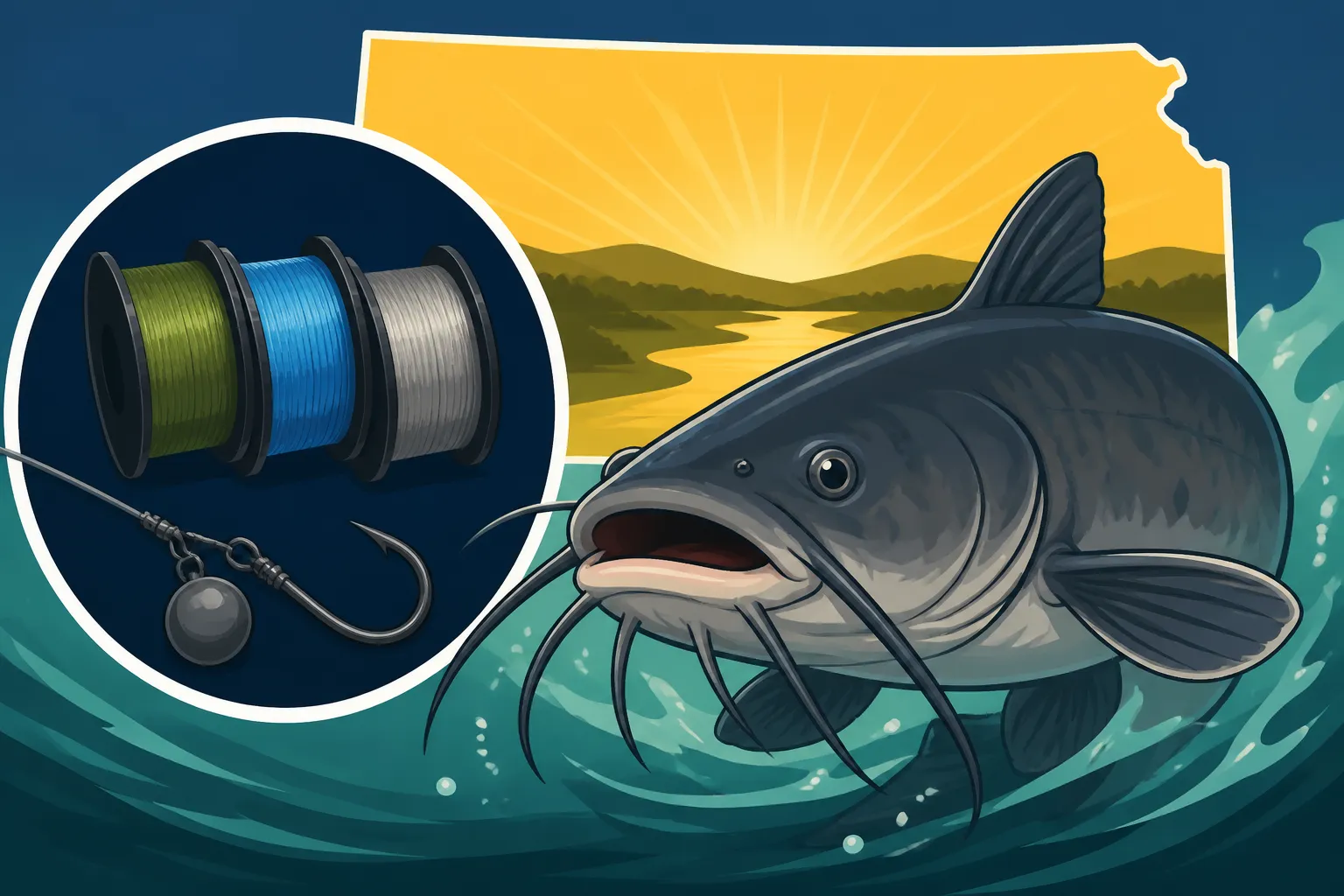
Monofilament, Fluorocarbon, and Braided Line for Catfish
You have three primary types of fishing line to choose from, and each has its own set of advantages and disadvantages for catfishing:
-
Monofilament (Mono): This is the classic, most widely used fishing line, made from a single strand of nylon. It's known for its stretch, which acts as a shock absorber during violent strikes and head shakes. Mono is also relatively inexpensive, easy to tie knots with, and offers good abrasion resistance in heavier tests. However, its larger diameter compared to braid means it catches more current and wind, and its stretch can make it harder to feel subtle bites at long distances or in deep water. It's a great all-around choice for many catfishing scenarios, especially for smaller to medium-sized fish and in less snaggy areas. You'll find a massive selection of fishing line types on platforms like Amazon, making it easy to compare mono options.
-
Fluorocarbon (Fluoro): This line shares some similarities with monofilament but is denser, less visible underwater, and much more abrasion resistant. Fluorocarbon has very little stretch, giving you better feel and hook-setting power. However, it can be more expensive, stiffer, and sometimes harder to tie knots with properly. For catfishing, fluorocarbon is most often used as a leader material, particularly in clearer water or when targeting flatheads that might rub your line on rough structure.
-
Braided Line (Braid): Made from multiple strands of synthetic fibers woven together, braided line boasts incredible strength-to-diameter ratio, virtually no stretch, and excellent sensitivity. This means you can use a much thinner line for a given breaking strength compared to mono, which helps cut through current and wind, and allows for more line on your reel. Braid's lack of stretch gives you superior feel for bites and direct hook sets. Its downsides include being more expensive, potentially more visible (though some colored braids are less so), and it can "dig in" on a reel spool if not wound tightly under pressure. Its thin diameter can also cut into rod guides or fingers if not handled carefully, and it can be prone to wind knots if you're not meticulous. For big blue cats and flatheads, particularly in heavy cover or strong currents, braid is often the main line of choice, frequently paired with a monofilament or fluorocarbon leader for added abrasion resistance. Reading reviews on Amazon can give you insights into real-world performance of different brands.
General Guidelines for Specific Scenarios
Let's break down some practical recommendations for various Kansas catfishing situations:
-
Small to Medium Channel Catfish (1-10 lbs): For these fun fighters in community ponds, smaller rivers, or less structured areas of larger lakes, a 10-20 lb test monofilament is an excellent choice. It offers good castability, enough stretch to absorb their head shakes, and decent abrasion resistance. If you prefer braid, a 20-30 lb test braid would give you more sensitivity and strength for its diameter.
-
Large Channel Catfish, Smaller Blue/Flathead (10-30 lbs): When targeting bigger channels or smaller specimens of blue and flathead cats in reservoirs or medium-sized rivers, you need to step it up. A 25-40 lb test monofilament or 30-50 lb test braided line would be more appropriate. If using braid, consider a 15-30 lb fluorocarbon or monofilament leader (2-4 feet long) to handle abrasion and provide a little shock absorption.
-
Trophy Blue Catfish & Flatheads (30+ lbs): This is where you bring out the heavy artillery. For monster cats in major river systems or the largest reservoirs, you'll want 50-80+ lb test braided line. Some anglers even go heavier, especially for flatheads in truly nasty timber. For leaders, a 50-80 lb monofilament or heavy fluorocarbon is essential to prevent break-offs from abrasion. Remember, these fish will test every piece of your tackle.
Here's a quick reference table:
| Catfish Species/Size | Environment | Recommended Main Line Type | Recommended Main Line Weight (Test) | Notes |
|---|---|---|---|---|
| Small Channel Cat (1-10 lbs) | Ponds, clean lakes | Monofilament | 10-20 lbs | Easy casting, good stretch. |
| Medium Channel Cat (10-20 lbs) | Reservoirs, small rivers | Monofilament or Braided | 20-30 lbs (Mono) / 30-40 lbs (Braid) | Good balance of strength and feel. |
| Small/Medium Flathead/Blue (10-30 lbs) | Reservoirs, rivers w/ moderate snags | Braided (with leader) | 40-50 lbs (Braid) | Excellent strength & sensitivity. |
| Trophy Blue/Flathead (30+ lbs) | Major rivers, heavy cover | Braided (with heavy leader) | 60-80+ lbs (Braid) | Max power, minimal stretch for hook sets. |
| General Purpose | Mixed environments | Braided (with leader option) | 30-50 lbs (Braid) | Versatile for various catfishing scenarios. |
The Importance of Leader Material and Knots
Even with the heaviest main line, your setup is only as strong as its weakest link. That's often your knot or your leader.
Leader Material: For braided line, a leader is almost always a good idea for catfishing. It serves several purposes:
- Abrasion Resistance: Monofilament and especially fluorocarbon leaders are much more resistant to nicks and scrapes from rocks, timber, or the rough mouth plates of a big catfish than braid.
- Shock Absorption: Mono leaders add a bit of stretch that braid lacks, helping to absorb the initial shock of a powerful strike or sudden run.
- Visibility: In clearer water, a less visible fluorocarbon leader can be advantageous, though for catfish, this is often less critical than strength and abrasion.
- Sacrificial Section: It's easier and cheaper to replace a short leader than to re-spool your entire reel with new main line if it gets damaged.
Typically, you'd use a monofilament or fluorocarbon leader that is slightly less or equal in breaking strength to your main braided line. For example, if you're using 65 lb braided line, a 40-60 lb monofilament or fluorocarbon leader would be appropriate. These leaders are usually 2-5 feet long, connected to your main line with a strong knot like an FG knot, Alberto knot, or uni-to-uni knot. Our guide on Best Line for Kansas Catfish Rigs offers more details on how to set up your entire system.
Knots: A great line choice is completely undermined by a weak knot. For catfishing, where immense pressure is often applied, learning to tie strong, reliable knots is non-negotiable. Some of the most popular and dependable knots for tying terminal tackle (hooks, swivels) to your line include the Palomar knot, improved clinch knot, and the snell knot (especially good for circle hooks). When connecting main line to leaders, as mentioned, the FG, Alberto, or uni-to-uni knots are excellent choices for their strength and ability to pass through rod guides smoothly. Always moisten your knots before cinching them down tightly to prevent friction-induced weakening.
Tips for Maximizing Your Catfish Fishing Success
Picking the right line weight is a massive step, but there are a few other things you can do to really dial in your catfishing success in Kansas. It's all about making sure every part of your setup works together in harmony.
Balancing Your Tackle System
Think of your fishing rod, reel, and line as a single, cohesive unit. Each component needs to be matched to the others for optimal performance. You wouldn't put 80-pound braid on a flimsy ultralight spinning rod, right? The rod simply wouldn't have the backbone to leverage that line's strength, and you'd likely damage the rod trying to fight a big fish.
Conversely, putting a light 10-pound mono on a heavy-action catfish rod designed for big blues would leave you under-gunned. The line would snap before the rod even bent significantly. When selecting a new rod or reel, always check its line rating, often clearly listed in product descriptions on sites like Amazon. This rating gives you a good range of line weights that the rod is designed to handle effectively. A medium-heavy rod might be rated for 15-30 pound line, for example. Sticking within these guidelines ensures that your rod can properly cast your chosen line and has the right amount of flex and power to fight a fish without putting undue stress on the line itself. Our guide to the Best Rod and Reel Combo for Catfish goes into more detail on matching your gear.
Regular Line Inspection and Maintenance
Your fishing line is constantly exposed to harsh elements: sunlight (UV rays), dirt, sharp rocks, fish teeth, and the stresses of casting and fighting fish. Over time, all these factors degrade your line's strength.
Before every fishing trip, and periodically throughout the day, take a few moments to inspect the last several feet of your line. Look for any signs of fraying, nicks, discoloration, or twists. If you see any damage, don't hesitate—cut off that compromised section and re-tie your terminal tackle. A small imperfection can lead to a heartbreaking break-off when that trophy catfish finally hits.
Monofilament line is particularly susceptible to UV degradation and can develop "memory" (coiling) over time, especially if stored on a reel for extended periods. It's generally a good idea to respool your reels with fresh monofilament at least once a season, or more often if you fish frequently. Braided line is more durable but can still fray and collect dirt, which can affect its casting performance. A quick wipe down with a damp cloth can help keep it clean. You can easily find bulk spools or specific brands of these lines available on Amazon to make respooling convenient.
Proper storage of your fishing gear, keeping reels out of direct sunlight when not in use, and ensuring your line isn't pinched or abraded in your tackle box will also extend its life and maintain its strength.
Practicing Good Angling Habits
Finally, even the best line in the world can't compensate for poor angling technique.
- Test Your Knots: Before making your first cast, give your newly tied knot a good, firm pull. Better for it to break in your hand than on the cast or with a fish on.
- Set Your Drag Correctly: Your reel's drag system is designed to allow line to slip under pressure, preventing breaks. A properly set drag is crucial for fighting big catfish. As a general rule, set your drag to about one-third of your line's breaking strength. For example, if you're using 30-pound test line, set your drag to about 10 pounds of pull. This allows the fish to run when it needs to, preventing snaps, while still putting enough pressure on it to bring it in.
- Play the Fish, Don't Horse It: When you hook a big catfish, resist the urge to simply crank it in as fast as possible. Instead, "play" the fish. Use your rod to pump it in, gaining line when the fish isn't pulling, and letting the drag do its job when the fish makes a run. This controlled fight puts less stress on your line and increases your chances of landing the fish.
- Understand Your Line: Get a feel for how your chosen line behaves. Does it stretch a lot? How does it feel when a fish hits? The more you fish with a particular line weight and type, the more intuitive your responses will become, leading to more successful hook-ups and landings. For more foundational knowledge, our Kansas Fishing Techniques for Beginners can set you on the right path.
By paying attention to these details, you'll not only choose the best line weight for Kansas catfish but also elevate your entire fishing experience, turning more bites into memorable catches.
Disclaimer
This article is for general informational purposes only and does not constitute professional advice. Laws, prices and regulations vary by location and change over time. Consult a qualified professional for guidance on your specific situation.