Best Line for Kansas Catfish Rigs
Oh, the age-old question for Kansas anglers: what's the best fishing line for chasing those magnificent catfish? It's a question that can keep you up at night, especially when you're dreaming of that monster flathead or a cooler full of fat channel cats. Choosing the right line isn't just about grabbing the cheapest spool; it's about understanding the unique challenges of battling a whiskered warrior in our diverse Kansas waters. This guide is here to untangle the confusion and help you select the perfect line to ensure your next big cat doesn't become "the one that got away."
Understanding Catfish Fishing in Kansas and Line Demands
Catfish angling in Kansas is a truly rewarding experience, offering a range of challenges from the smaller, feisty channel cats in community ponds to the colossal blue cats of our major reservoirs. But with this variety comes a demand for specific gear choices, especially when it comes to the fishing line you spool on your reel. You need a line that can stand up to the unique fight and habitat of these powerful fish.
The Diverse World of Kansas Catfish Species
Kansas is home to three primary species of catfish that anglers target: Channel, Flathead, and Blue Catfish. Each has its own characteristics that influence the kind of fishing line you'll want to use.
Channel catfish are often the most common and widely distributed. They're known for their strong, energetic fights, often making quick runs and head shakes. You'll find them in almost any waterbody, from small farm ponds to large rivers and reservoirs. They don't typically grow to the immense sizes of their blue or flathead cousins, but a good-sized channel cat can still put a serious bend in your rod. Their mouths, while rough, aren't as notoriously "raspy" as, say, a flathead's. For these guys, you need a line that offers a good balance of strength and manageability. You might be targeting them in open water, or near some lighter cover, which changes your demands slightly.
Flathead catfish are the brutes of the bunch. They prefer live bait and often lurk in heavy cover—think submerged timber, rock piles, and deep holes in rivers. When hooked, a flathead doesn't necessarily make long, screaming runs; instead, it digs deep, relying on its immense power to try and break you off in structure. Their mouths are also incredibly tough and abrasive. If you're going after flatheads, your line needs to be exceptionally strong and highly resistant to abrasion. Losing a fish because your line frayed on a sunken log is a heartbreak we all want to avoid.
Blue catfish are the true giants of Kansas waters, especially in reservoirs like Milford Lake or Tuttle Creek Lake. They can reach truly enormous sizes, and when they do, they combine the powerful runs of a channel cat with the sheer pulling strength of a flathead. Blues often roam open water but will also relate to deep channels and river bends. Catching a trophy blue cat requires a line that can handle incredible stress, both from the initial hookset and the prolonged battle. Their mouth structure is also robust, adding to the wear and tear on your line. Knowing the species you're after helps you determine the ultimate demands on your fishing line. Kansas Catfish Species Guide offers even more detail on these fantastic fish.
The Importance of Line Strength and Abrasion Resistance
When you hook into a powerful catfish, whether it's a 5-pound channel cat or a 50-pound blue, your fishing line is the critical connection between you and the fish. Without adequate strength, that connection quickly becomes a snapped line and a story about "the one that got away." Catfish, by their very nature, are strong fighters. They pull hard, they shake their heads violently, and they often try to rub your line against anything they can find in their underwater environment.
Beyond the raw power of the fish, the places where catfish live are often incredibly tough on fishing line. Rivers have currents that can push your line into snags. Reservoirs and ponds often feature submerged brush, rock piles, old fence lines, and even discarded debris from past storms or human activity. These elements act like sandpaper, constantly testing your line's abrasion resistance. A line with poor abrasion resistance will quickly fray, weaken, and ultimately break under pressure, especially when a catfish starts rubbing it against a sharp edge.
Imagine you're fishing a popular stretch of the Kansas River for blue cats. You've cast your cut bait near a deep scour hole, and suddenly your rod doubles over. You set the hook, and a monster blue cat starts stripping line. It immediately dives for a cluster of submerged logs you know are down there. If your line can't withstand the pressure of the fish and the constant friction against those logs, your chances of landing that fish diminish rapidly. This is why a sturdy, abrasion-resistant line is not just a luxury but a necessity for successful catfish angling in Kansas.
Common Fishing Line Types for Catfish Rigs
The market is flooded with different types of fishing line, and each has its own set of characteristics that make it more or less suitable for certain applications. For catfish, the three main players are monofilament, braided, and fluorocarbon. Understanding the pros and cons of each is crucial for making an informed choice for your Kansas catfish rigs.
Monofilament: The Classic Choice for Cushion and Stretch
Monofilament line, or simply "mono," is what most of us started fishing with. It's a single strand of nylon, and its ubiquity in the fishing world is no accident. It offers a forgiving stretch, decent knot strength, and it's generally quite affordable.
One of the biggest advantages of monofilament for catfish is its stretch. This inherent elasticity acts as a shock absorber. When a big catfish makes a sudden, powerful lunge or head shake, the mono can stretch a bit, cushioning the blow and preventing the line from snapping under sudden tension. This can be particularly beneficial if you're using rods with a stiffer action, or if you're not always able to react instantly to a fish's sudden movements. Its stretch also helps keep hooks from tearing out of a fish's mouth if they make a particularly violent lunge right at the boat or bank.
Monofilament is also generally easy to handle. It's forgiving when tying knots, and most standard fishing knots (like the improved clinch or Palomar) work well with it. It's less prone to tangles than some other line types, and it casts relatively smoothly. Many anglers appreciate its buoyancy, as it tends to float or sink very slowly, which can be advantageous for certain topwater presentations or when you want your bait to drift naturally.
However, mono does have its downsides. Its stretch, while beneficial for shock absorption, also means less sensitivity. You might not feel those subtle "taps" or "nudges" from a finicky catfish as readily as you would with a no-stretch line. It also has relatively poor abrasion resistance compared to fluorocarbon or braid, meaning it can fray more easily on rocks or submerged timber. Monofilament is also susceptible to UV degradation from the sun, and it tends to develop "memory," meaning it retains the shape of the spool, leading to coils and kinks, especially on spinning reels. This memory can affect casting distance and create tangles. For these reasons, many seasoned anglers tend to replace their monofilament line more frequently, typically once a season, if not more often with heavy use. Best Rod and Reel Combo for Catfish will help ensure your entire setup is balanced.
Braided Line: Power, Sensitivity, and Durability
Braided line is constructed from multiple strands of synthetic fibers, woven together to create a very strong, thin, and durable line. It has gained immense popularity among serious catfish anglers for some very compelling reasons.
The most significant advantage of braided line is its incredible strength-to-diameter ratio. You can use a much thinner diameter braid to achieve the same or even greater breaking strength than monofilament. This means more line capacity on your reel and less resistance in the water or current. This thin diameter, combined with virtually no stretch, provides unparalleled sensitivity. You can feel every bump, every subtle pick-up of your bait, and even the texture of the bottom. This sensitivity is a game-changer for detecting light bites, especially from finicky flatheads or deep-water blue cats.
Braided line also boasts superior abrasion resistance compared to monofilament, thanks to its tightly woven construction. It's much less likely to fray on rough structure, which is a huge benefit when you're fishing snaggy areas for big catfish that love to dive into cover. Its durability means it lasts much longer than monofilament, often several seasons, making the initial higher cost a worthwhile investment over time. Plus, its lack of stretch gives you immense hook-setting power, ensuring that even a long-distance hookset drives home cleanly.
However, braided line isn't without its quirks. It can be more visible in clear water, which might deter spookier fish, though catfish are generally not considered sight feeders. Its strength can also be a double-edged sword; if it gets wrapped around your finger during a powerful hookset or a fish run, it can cause severe cuts. Therefore, caution is always advised, and some anglers wear gloves. Knot tying with braid requires specific knots, as some standard knots can slip or weaken. Knots like the Palomar knot are generally recommended for braided line. Finally, braided line doesn't absorb shock like mono, so you need to be mindful of your drag settings and rod action to prevent hooks from tearing out or gear from breaking. This leads many anglers to use a leader system, which we'll discuss shortly.
Fluorocarbon: The Stealthy and Tough Leader Material
Fluorocarbon line is a newer player compared to mono, but it has carved out a significant niche, especially as a leader material for catfish anglers. It's made from a dense polymer that offers unique properties distinct from monofilament.
One of fluorocarbon's standout features is its near invisibility underwater. It has a refractive index very similar to water, meaning light passes through it rather than reflecting off it, making it incredibly difficult for fish to see. While catfish aren't typically known for being line-shy, in extremely clear water conditions, or for highly pressured fish, this stealth factor can make a difference.
Fluorocarbon also offers excellent abrasion resistance, often superior to monofilament and comparable to some braided lines, especially for its diameter. This makes it a fantastic choice for a leader when you're fishing around sharp rocks, submerged timber, or the rough mouths of big catfish. It has less stretch than monofilament, providing a good balance of sensitivity and some shock absorption. This lower stretch allows for better feel and more powerful hooksets than mono, without the absolute rigidity of braid.
The downsides of fluorocarbon include its stiffness, which can make it a bit more challenging to tie knots properly. Certain knots, if not tied with care and adequately lubricated, can weaken the line significantly. It's also generally more expensive than monofilament, though often less per spool than braided line. Because of its stiffness and higher cost, many anglers primarily use fluorocarbon as a leader material rather than spooling their entire reel with it, especially for main lines in heavier tests, but it is an option for main line use. It truly shines when paired with braided line as a leader, offering a stealthy, abrasion-resistant connection to your hook.
Matching Line to Kansas Catfish Rigs and Techniques
The best fishing line isn't a one-size-fits-all solution; it often depends on the specific rig you're deploying and the technique you're using to target Kansas catfish. Whether you're kicking back on the bank or running a spread of jugs, your line choice plays a pivotal role in your success.
Line for Bank Fishing and Still Fishing Setups
Bank fishing is arguably the most popular way to target catfish in Kansas, offering accessibility and simplicity. Still fishing, where your bait sits on the bottom or is suspended under a bobber, is the go-to technique for most bank anglers. For these setups, versatility and durability are key.
If you're primarily bank fishing with a traditional slip sinker rig or a three-way swivel rig, you'll want a line that offers a good balance. Monofilament, in the 15-25 lb test range, is a solid choice for many bank anglers. Its stretch helps absorb the shock of a big cat's initial run, especially if you're using a medium-heavy rod that might not have as much give. It's also forgiving if you're casting into areas with occasional snags, as its stretch can sometimes prevent a break-off by giving a little. However, remember its lower abrasion resistance, so if you're fishing near heavy rock or timber from the bank, you might consider a heavier mono or a short fluorocarbon leader for added protection.
For those who want more sensitivity and power from the bank, especially when casting longer distances or needing to pull fish away from cover, braided line is an excellent option. A 30-50 lb test braid will give you the backbone to turn big fish and feel even the lightest bites. Since braid is highly visible, you'll almost certainly want to tie on a 2-4 foot leader of 20-30 lb fluorocarbon. This combination offers the best of both worlds: the sensitivity and strength of braid, with the stealth and abrasion resistance of fluorocarbon right down to your bait. This setup is particularly effective when targeting flatheads or larger blue cats from the bank along river channels or reservoir points. Best Bank Fishing Gear Setup has more tips for these scenarios.
Line for Jug Fishing and Trotlines
Jug fishing and trotlining are distinct methods for targeting large numbers of catfish, often with bigger fish in mind. These techniques demand exceptionally strong and abrasion-resistant lines, as they're often deployed in harsh conditions and left unattended for periods.
For jug fishing, where individual lines are attached to buoyant jugs and set adrift, you need a main line that can withstand powerful runs and potential snags. Monofilament is commonly used for jug lines due to its affordability and stretch, which can help absorb shock. However, it needs to be heavy-duty. Anglers often opt for 50-100 lb test monofilament for their main jug lines, with shorter snoods of slightly lighter, but still robust, mono or even heavy braided line. The key here is not just breaking strength, but also resistance to twisting and tangles as the jug moves with the current and the fish fights.
Trotlines are perhaps the most demanding application for fishing line in catfishing. These long main lines, anchored at both ends, feature numerous baited hooks (snoods) spaced along their length. Trotlines are often set in primary river channels, deep scour holes, or along submerged creek beds in reservoirs—places notorious for snags and debris. For the main line of a trotline, anglers typically use extremely heavy braided nylon or tarred trotline string, with breaking strengths in the hundreds of pounds. This main line isn't about sensitivity; it's about brute strength and ultimate abrasion resistance to withstand currents, debris, and multiple large catfish. The individual snoods (the lines holding the hooks) are usually made of heavy-duty monofilament (80-150 lb test) or specialized tarred line, designed to be abrasion-resistant and tough enough to hold a struggling fish. These setups are often retrieved by hand, so the line's durability is paramount for both success and safety. For more on the specifics of these methods, check out Kansas Trotline Fishing License Rules and Kansas Jug Fishing License Rules.
Line for Boat Fishing: Drifting and Anchored
Boat fishing for catfish opens up a whole new world of techniques, from drifting across vast flats to anchoring over specific structure. Your line choice here can be fine-tuned to maximize your efficiency and feel.
When drifting for catfish, particularly for blue cats or channel cats on larger reservoirs like Cheney Reservoir or Wilson Lake, sensitivity and minimal drag are important. Braided line shines in this scenario. A 30-65 lb test braid allows for excellent feel, helping you detect subtle bites even when drifting at speed or in windy conditions. The thin diameter of braid also cuts through the water better, reducing drag on your bait and allowing you to use lighter sinkers. Paired with a 20-40 lb fluorocarbon leader, this setup provides both stealth and superior abrasion resistance where it matters most, near the hook.
If you're anchoring over specific structure—a brush pile, a rock hump, or a deep hole—for flatheads or big blue cats, you'll need maximum power and abrasion resistance. Again, heavy braided line (50-80 lb test or even higher for truly giant fish in heavy cover) is often the preferred choice for the main line. The no-stretch property of braid gives you direct control, allowing you to quickly pull a big fish away from snags before it can break you off. A heavy fluorocarbon leader (40-60+ lb test) is almost mandatory in these situations, as it protects your mainline braid from abrasive structure and the fish's rough mouth. The combination of strong braid and a tough fluoro leader is hard to beat for anchored boat fishing in challenging environments.
For those who prefer the simplicity and forgiveness of monofilament, a heavier mono (20-40 lb test) can still be effective, especially in less snaggy areas or when targeting smaller to medium-sized catfish. Its stretch can be an advantage when fighting fish right at the boat, preventing sudden break-offs. However, be aware of its reduced sensitivity compared to braid, which might lead to missed bites, particularly in deeper water or strong currents.
Optimal Line Strength (Test) for Kansas Catfish
One of the most common questions anglers have is, "What line test should I use?" The answer isn't a single number, but rather a range that depends on the species you're targeting, the size of fish you expect, and the specific fishing conditions. Too light, and you risk breaking off; too heavy, and you might sacrifice casting distance or sensitivity.
General Guidelines for Channel Catfish
For your average Kansas channel catfish, which often range from a couple of pounds up to 15-20 pounds, a versatile line test is essential. You want something strong enough to handle their spirited fights but not so heavy that it impedes casting or sensitivity.
If you prefer monofilament, a good starting point is between 12 to 20 lb test. For smaller channel cats in ponds or less snaggy rivers, 12-15 lb test mono offers good casting distance and a decent fight. When targeting larger channels or fishing around moderate cover, bumping up to 17-20 lb test provides more assurance against break-offs. This range gives you a good balance of stretch for shock absorption and enough strength to control most channel cats.
For braided line, you can go with a lighter equivalent due to its superior strength-to-diameter ratio. A 20 to 30 lb test braid is often ideal for channel cats. This provides incredible sensitivity, allowing you to feel even the most subtle bites. It also gives you superior casting distance and power to pull fish out of lighter cover. When using braid, always consider a fluorocarbon leader of 15-25 lb test for stealth and abrasion resistance, especially in clearer water or around snags.
Remember, these are general guidelines. If you're fishing a small, snag-free community lake primarily for pan-sized channels, you might even get away with 10 lb test mono. Conversely, if you're targeting channel cats in a river known for strong currents and heavy brush, leaning towards the heavier end of these ranges is a smart move.
Stepping Up for Flatheads and Blue Catfish
When you're serious about battling Kansas's biggest catfish—the powerful flatheads and massive blue cats—you need to step up your line game significantly. These fish can grow to enormous sizes and possess incredible strength, often living in or immediately retreating to heavy cover.
For targeting larger flatheads and blue catfish, especially those over 20 pounds, you're looking at much heavier line. If you're sticking with monofilament (which is less common for trophy cats but still used by some for specific reasons like jugging), you'll want to be in the 30 to 50 lb test range for your main line. Some anglers even go heavier for extreme scenarios, particularly for trotlining. However, the thickness of mono at these tests can reduce casting distance and increase water resistance.
Braided line is often the preferred choice for trophy catfishermen due to its combination of strength, thin diameter, and sensitivity. For serious flathead and blue cat angling, a 50 to 80 lb test braid is a common starting point. In particularly snag-filled areas or when targeting true monsters, some anglers will spool up with 100 lb test braid. This heavy braid provides the sheer stopping power needed to turn a big fish away from timber or rocks. The key with braid is always to use a robust fluorocarbon leader, typically in the 40 to 80 lb test range, or even higher (100+ lb) if you're fishing the gnarly structure for giant flatheads. This leader protects your main line from abrasion and the catfish's formidable mouth. Kansas Flathead Catfish Daily Limit and Kansas Blue Catfish Facts and Limits provide useful context for these species.
Balancing Line Strength with Rod and Reel
Choosing the right line test isn't just about the fish; it's also about ensuring your entire setup is balanced. Your fishing line, rod, and reel work as a system, and if one component is out of sync, it can lead to problems.
Your rod's power rating (e.g., medium-heavy, heavy, extra-heavy) indicates the amount of pressure it can withstand and the size of fish it's designed to handle. Using a line that's too heavy for a light-powered rod can overstress the rod, potentially breaking it during a strong fight. Conversely, using line that's too light on a heavy-powered rod means the rod won't flex properly, and you'll put all the stress on the line, risking break-offs. Always check your rod's specifications, which usually indicate a recommended line test range.
Similarly, your reel's drag system needs to be capable of handling the line you're using. If you spool 80 lb test braid on a reel designed for 20 lb mono, you might find that the reel's drag can't apply enough pressure to effectively fight a large fish, or worse, the drag components might fail. A reel's maximum drag often correlates with the line tests it's designed for. A balanced setup ensures that the drag can be set effectively, allowing line to pay out under extreme pressure without breaking the line or damaging the reel.
For example, a typical medium-heavy catfish rod might be rated for 15-40 lb line. If you choose to run 30 lb test braided line, you're well within that range, and your reel's drag should be able to handle it. However, trying to run 80 lb braid on that same rod would be asking for trouble. Always consider the manufacturer's recommendations for your rod and reel, and select a line test that falls comfortably within those parameters. This ensures not only effective fish fighting but also the longevity of your valuable gear.
| Line Type | Pros for Catfishing | Cons for Catfishing | Ideal Kansas Catfish Use |
|---|---|---|---|
| Monofilament | Economical, great shock absorption (stretch), easy to knot, good for beginners, floats. | Low abrasion resistance, UV damage, memory, less sensitive. | General purpose, lighter channel cat setups, jug fishing main lines. |
| Braided | High strength-to-diameter, no stretch (high sensitivity), excellent abrasion resistance, long-lasting. | Visible in clear water, can cut, tricky knot tying, higher initial cost. | Trophy flathead/blue cat, heavy cover, deep water, drifting. |
| Fluorocarbon | Near invisibility, excellent abrasion resistance, good sensitivity (low stretch), sinks. | Stiffer, higher cost than mono, knot tying can be challenging. | Leaders for braid (stealth & abrasion), clear water, finicky fish. |
Essential Line Considerations and Maintenance
Choosing the right line is only half the battle; knowing how to tie it, care for it, and outfit your rig with the appropriate terminal tackle is equally important. These details can mean the difference between landing a personal best and recounting a frustrating story of a lost fish.
Knot Tying: The Weakest Link in Your Rig
It's a common saying among anglers: a chain is only as strong as its weakest link. In fishing, that weak link is often the knot. A perfectly chosen, high-quality fishing line is worthless if the knot connecting it to your hook or swivel fails. Different line types demand different knots, and practicing until you can tie them reliably, even in the dark or cold, is crucial.
For monofilament, knots like the Improved Clinch Knot are classic for tying directly to hooks or swivels, while the Palomar Knot is also excellent and known for its strength. For connecting two pieces of mono, or mono to a fluorocarbon leader, a Uni Knot or Double Uni Knot is very reliable. Always wet your monofilament knots with saliva before cinching them down; this lubrication prevents friction heat from weakening the line.
Braided line requires specific attention because its slick surface can cause many traditional knots to slip. The Palomar Knot is widely regarded as one of the best and strongest knots for braid. The Uni Knot can also work well, especially for connecting braid to a leader (the Double Uni Knot or FG Knot are popular for this). When tying braid, it's even more crucial to cinch the knot down slowly and firmly, ensuring all turns are tight and neat. Remember to trim tag ends closely to prevent snags. Many anglers prefer to use a leader system when fishing with braid, which brings us to another set of knots, like the blood knot or the Albright knot, to connect the main braid to a fluorocarbon or monofilament leader.
For fluorocarbon, the Palomar Knot and Uni Knot are generally strong choices, but its stiffness means careful tying. Lubricate the knot well and pull it tight slowly and evenly. Given fluorocarbon's primary role as a leader material for many catfishermen, mastering a reliable leader-to-mainline connection (like the FG Knot for braid-to-fluoro) is highly beneficial. If you want to increase your confidence on the water, spend some time at home practicing these knots until they become second nature.
Line Care and Replacement for Longevity
Fishing line, regardless of its type, is a perishable item. Over time, it degrades, weakens, and becomes less reliable. Proper care and knowing when to replace your line are essential for consistent success.
For monofilament, the biggest enemies are UV light from the sun, abrasion, and memory. Sunlight gradually breaks down the nylon, reducing its strength. Always store your spools of mono in a dark place when not in use. After a few fishing trips, especially if you've been fishing around snags, run your fingers along the last 10-20 feet of line to check for nicks or abrasions. If you feel any roughness, cut that section off. Due to its susceptibility to UV damage and memory, most serious anglers replace their monofilament main lines at least once per season, or even more frequently with heavy use. Best Time to Buy a License Before Free Fishing Days is a great time to also respool your reels!
Braided line is far more durable and resistant to UV degradation. However, it can still fray from abrasion against rocks, timber, or even the rough mouths of catfish. It's also susceptible to physical damage if it gets snagged and stretched to its breaking point. Regularly check the last several feet of your braid for fraying or weakening. Because braid is expensive, many anglers will simply cut off a damaged section of line. If a significant amount of line (e.g., 50-100 feet) is damaged, or if the entire spool of line feels "mushy" or visibly faded after many seasons, it's time for a full replacement. A well-maintained spool of braid can last for several years, making it a sound long-term investment.
Regardless of line type, proper spooling is also part of good line care. Ensure your reel is spooled evenly and not overfilled, which can lead to tangles and knots. If you're seeing persistent twists or kinks, especially on spinning reels, it might be a sign that your line is getting tired or was spooled incorrectly. A little proactive maintenance goes a long way in preventing frustrating break-offs on the water.
Leader Systems and Terminal Tackle
Incorporating a leader system into your catfish rig is a strategic move that can significantly enhance your success, especially when using braided main lines. A leader is a shorter section of line tied to the end of your main line, which then connects to your hook and other terminal tackle.
Why use a leader?
- Abrasion Resistance: This is perhaps the biggest reason for catfish. A tougher, more abrasion-resistant leader material (like fluorocarbon) protects your main line from the rough mouths of catfish, sharp rocks, and submerged timber. It's much easier and cheaper to replace a 2-foot leader than an entire spool of expensive braided line.
- Stealth: If you're using highly visible braided line, a nearly invisible fluorocarbon leader provides a stealthy presentation to your bait, which can be advantageous in clear water, even if catfish aren't typically known for being line-shy.
- Shock Absorption: If your main line is no-stretch braid, a short section of monofilament or fluorocarbon leader can offer a touch of shock absorption, helping to prevent hooks from tearing out of a fish's mouth during a violent head shake.
- Knot Security: It's often easier to tie secure knots between your main line, leader, and terminal tackle if you're working with line types that knot well together.
For catfish, a fluorocarbon leader is almost universally preferred due to its outstanding abrasion resistance and low visibility. The length of your leader can vary, but typically 2-4 feet is a good starting point. The test strength of your leader should be appropriate for the size of fish and cover you're targeting, often slightly lighter than your main braid, but still robust (e.g., 50 lb braid to 40 lb fluoro leader).
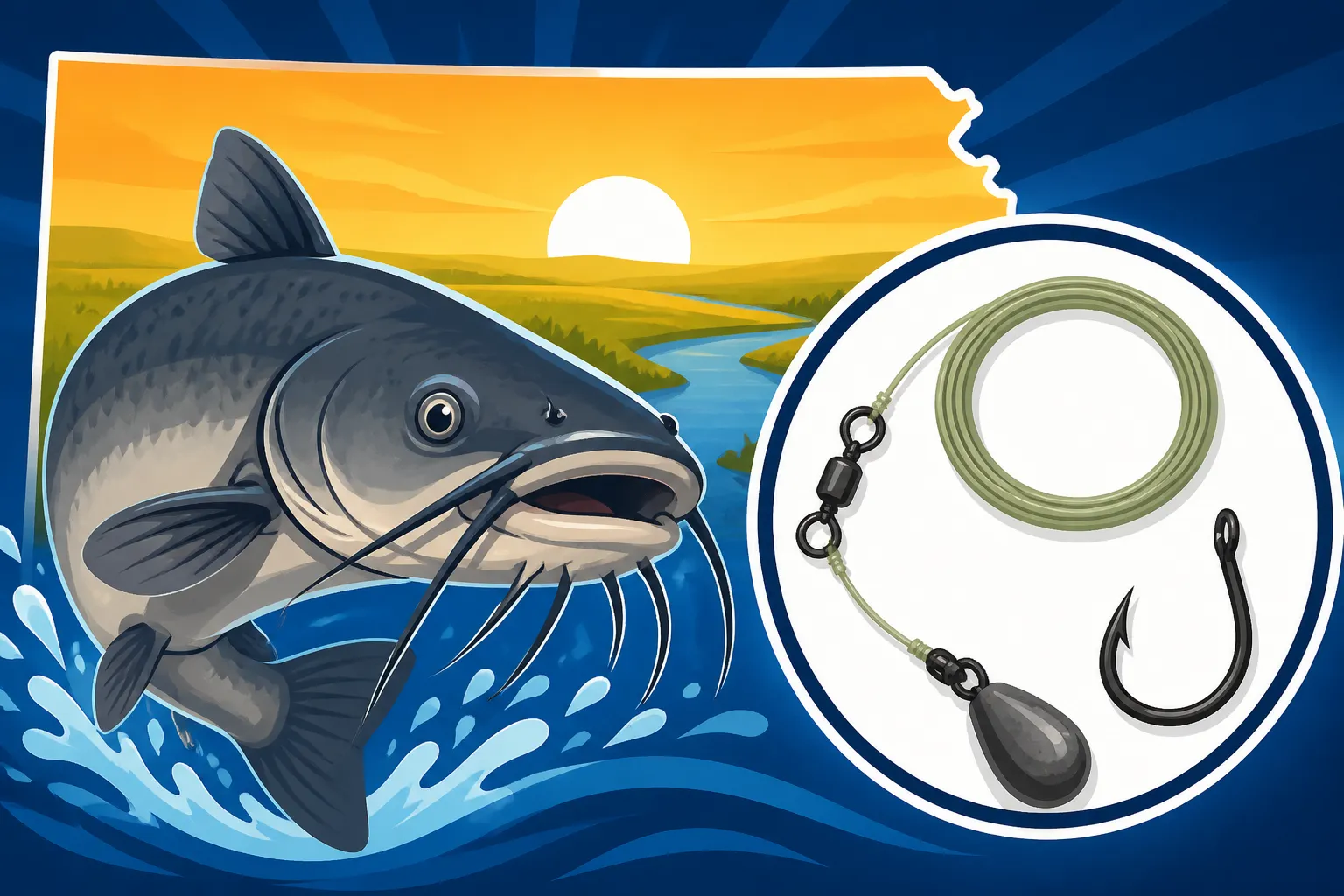
Terminal tackle—the hooks, swivels, and weights—must also be matched to your line choice and target species.
- Hooks: For catfish, strong, sharp hooks are paramount. Circle hooks are highly recommended as they typically hook fish in the corner of the mouth, making for easier release and less gut hooking. Choose a size appropriate for your bait and target species (e.g., 4/0 to 8/0 for channels, 8/0 to 12/0 for big blues and flatheads). Best Hooks for Kansas Crappie Fishing discusses some related tackle choices.
- Swivels: Heavy-duty barrel swivels or ball bearing swivels (size 1 to 5/0) are essential to prevent line twist, especially when drifting or using spinning baits. A good swivel also acts as a stop for slip sinker rigs.
- Weights/Sinkers: Match your sinker weight to the current, depth, and desired casting distance. For still fishing, egg sinkers, no-roll sinkers, or pyramid sinkers are common. A slip sinker rig, where the line slides freely through the sinker, is highly effective as it allows the fish to pick up the bait without feeling the weight immediately. Best Sinkers for Kansas River Fishing offers further detail.
By paying attention to your knots, line care, and optimizing your leader and terminal tackle, you'll create a catfish rig that's not only effective but also robust enough to withstand the rigors of Kansas catfishing.
Buying Your Catfish Line in Kansas (and Beyond)
So, you've decided on the perfect line type and test for your next Kansas catfishing adventure. Now comes the task of actually acquiring it. Thankfully, there are many convenient options, whether you prefer to shop locally or online.
Where to Find Quality Fishing Line
Kansas anglers have a few excellent avenues for purchasing quality fishing line. Each has its own advantages, depending on what you're looking for.
Local Bait and Tackle Shops: These are often the unsung heroes of the angling community. Smaller, independent bait and tackle shops not only carry a curated selection of lines and gear specifically suited for local Kansas waters but also offer invaluable advice. The folks working there are often avid anglers themselves, happy to share tips on what lines are performing well in nearby lakes and rivers, what specific test is recommended for your target species in a particular spot, or even how to tie a tricky knot. Supporting these local businesses also helps keep the local fishing scene vibrant.
Large Sporting Goods Stores: Retailers like Bass Pro Shops are fantastic resources for a vast selection of fishing line from virtually every major brand. You'll find everything from bulk spools of monofilament to specialized braided and fluorocarbon lines. The advantage here is sheer variety, allowing you to compare different brands and types side-by-side. While the advice might be more general than a dedicated local shop, the quantity of options is hard to beat. You can also often find good deals and sales, especially if you're looking to stock up.
Online Retailers: For sheer convenience and competitive pricing, online giants like Amazon offer an unparalleled selection of fishing line. You can browse countless brands, read user reviews, and have your line delivered right to your doorstep. This is particularly useful if you're looking for a very specific type or brand of line that might not be readily available in local stores, or if you prefer to purchase in bulk. However, you miss out on the immediate gratification and in-person expert advice that local shops provide. When buying online, always double-check the line's specifications (test, diameter, length) and read reviews to ensure you're getting a quality product.
No matter where you choose to buy, prioritize quality. A cheap, low-quality line can fray easily, knot poorly, and ultimately cost you fish. Investing in a reputable brand with good reviews is always a wise decision.
Budgeting for Your Line Investment
When you first look at the price tags on some spools of braided or fluorocarbon line, you might experience a bit of sticker shock compared to inexpensive monofilament. However, it's crucial to view fishing line as an investment, not just another expense.
Consider the longevity. While a large spool of quality monofilament might cost less up front, you'll likely replace it annually, or even more often if you fish frequently in harsh conditions. Braided line, with proper care, can last for several seasons. Over time, the cost per year of using braided line might actually be comparable to, or even less than, constantly replacing monofilament. Fluorocarbon leaders, while more expensive than mono per yard, are only used in short sections, making the actual cost of a leader system quite manageable.
Think about the confidence and success factor. Losing a trophy catfish due to cheap, unreliable line is far more costly in terms of experience and frustration than the few extra dollars you might have spent on a better line. A stronger, more sensitive line can lead to more hooksets, more landed fish, and ultimately, a more enjoyable and productive time on the water.
Set a budget based on your frequency of fishing, the species you're targeting, and the conditions you face. If you're a casual angler primarily chasing smaller channel cats in open ponds, a mid-range monofilament will serve you well. If you're a hardcore trophy cat hunter going after giant blue cats in snag-infested rivers, investing in premium braided line and robust fluorocarbon leaders is a non-negotiable part of your gear budget. It’s all about finding that sweet spot where quality meets value for your specific angling needs.
Reading Line Labels and Specifications
Walking down the fishing line aisle can feel like deciphering a secret code if you're not familiar with the terminology on the packaging. Understanding these specifications is key to making an informed purchase.
Here's what you'll typically find and what it means:
- Line Type: Clearly states Monofilament, Braided, or Fluorocarbon. Sometimes you'll see "Copolymer" which is a type of monofilament blending different nylons for specific properties.
- Test (or Breaking Strength): This is the most prominent number, usually expressed in pounds (e.g., 20 lb test). It indicates the amount of static force the line can withstand before breaking. Keep in mind that real-world breaking strength can vary based on knot quality, abrasion, and dynamic forces.
- Diameter: Often listed in millimeters (mm) or sometimes inches. This tells you how thick the line is. A thinner diameter generally means less visibility, less water resistance (important in current), and more line capacity on your reel. For braided line, you'll notice a much smaller diameter for a given test strength compared to monofilament.
- Length: This is the amount of line on the spool, usually in yards or meters (e.g., 300 yards). Make sure you buy enough line to fill your reel, plus a bit extra for trimming damaged sections.
- Color: Line comes in various colors. Monofilament often comes in clear, green, or high-visibility options like yellow or orange (useful for seeing bites or line movement). Braided line is commonly green, gray, or high-vis colors. The general rule is to match your line color to the water conditions (green for stained water, clear for clearer water), though for catfish, visibility isn't always the top concern, especially if using a leader.
- Features/Properties: Manufacturers will often highlight specific features like "low stretch," "high abrasion resistance," "UV resistant," "super sensitive," or "superior knot strength." These descriptions help differentiate products and cater to specific angling needs.
By taking a moment to understand these labels, you can confidently select the fishing line that perfectly matches your Kansas catfishing strategy, your gear, and your target species, setting you up for a much more successful and enjoyable time on the water.
Disclaimer
This article is for general informational purposes only and does not constitute professional advice. Laws, prices and regulations vary by location and change over time. Consult a qualified professional for guidance on your specific situation.