Kansas White Bass Identification
It can be incredibly frustrating to be out on a beautiful Kansas lake, reeling in fish after fish, only to stop and wonder, "Is this a white bass, or did I just catch a wiper?" The confusion is real, especially when similar-looking species share the same waters and even the same schools. This comprehensive guide will walk you through the distinct features of the Kansas white bass, helping you confidently identify your catch and avoid those head-scratching moments on the water.
The Basics of White Bass in Kansas
White bass are a fantastic sport fish throughout Kansas, known for their aggressive strikes and spirited fights. They are often found in large schools, making them a popular target for anglers, particularly during their exciting spring runs. Understanding their fundamental characteristics is the first step toward accurate identification.
Why White Bass Are Popular in Kansas
Let's face it, there's nothing quite like hooking into a feisty white bass when they're on a feeding frenzy. Anglers across Kansas love white bass for several reasons. First, their sheer abundance in many of our reservoirs and larger rivers means there's a good chance of a successful outing, even for beginners. You don't need highly specialized gear to catch them, which makes them incredibly accessible. They're also fantastic table fare, offering flaky, white meat that's delicious whether fried, baked, or grilled. Many families consider a white bass fishing trip a staple of their outdoor recreation, heading to places like Milford Lake White Bass Run when the time is right. The excitement of a white bass run, with schooling fish hitting everything in sight, is an experience every Kansas angler cherishes.
General Characteristics and Habitat
White bass are a member of the temperate bass family, Morone, which also includes striped bass and hybrid striped bass (wipers). This family resemblance is precisely why identification can be tricky! In Kansas, you'll typically find white bass in large impoundments like Cheney Reservoir, Wilson Lake, and Tuttle Creek Lake, as well as major rivers such as the Kansas River. They are schooling fish, preferring open water areas, especially around points, humps, and submerged structure. They feed primarily on shad and other small baitfish, often herding them to the surface, creating those exciting "boils" where anglers can cast directly into a feeding frenzy. Knowing these habits can help you locate them, but once you've got one on the line, the real identification challenge begins.
Key Identification Features of Kansas White Bass
When you pull a fish out of the water, a quick visual inspection can tell you a lot. White bass have several distinguishing marks that, once you know them, make identifying them much easier.
Body Shape and Coloration
White bass generally have a deep, compressed body shape, appearing somewhat "tall" for their length compared to the more torpedo-like build of a pure striped bass. Their coloration is predominantly silvery, often with a darker, bluish-gray or greenish-gray back that fades to a bright white belly. This contrast can be quite striking. The overall impression is one of a clean, bright, and somewhat stout fish. Unlike some other species, their coloring doesn't vary dramatically, making it a fairly reliable indicator across different water bodies in Kansas.
Stripe Patterns and Number
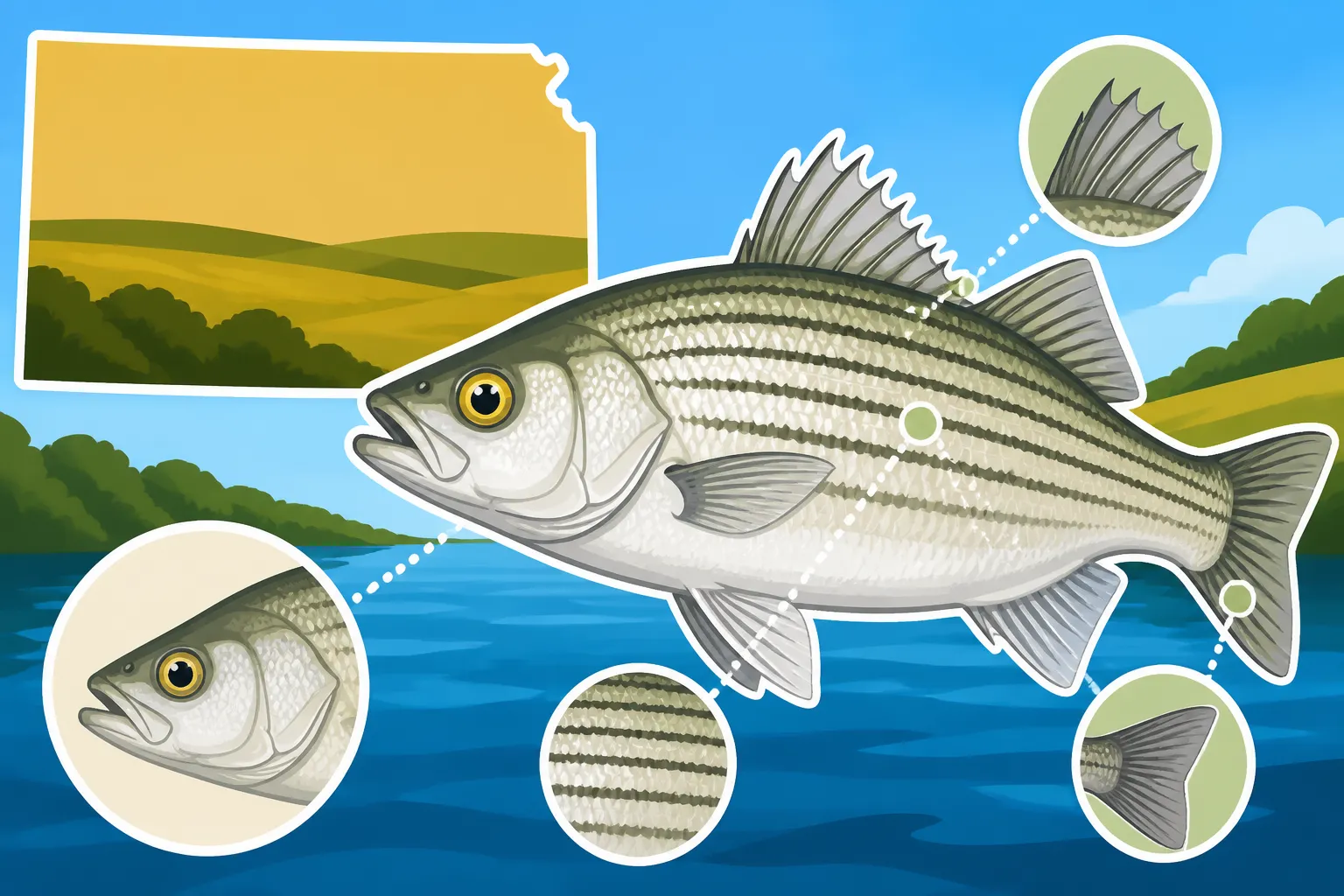
This is perhaps the most crucial identifier for white bass, and where most of the confusion with wipers and stripers arises. A true white bass will typically have several longitudinal stripes running along its body. The key is that only one of these stripes—the one just above the lateral line—will be prominent and continuous from the gill plate all the way to the tail. The stripes below this main one are generally fainter and often broken or discontinuous, especially towards the tail.
Imagine you're holding a fish from Cheney Reservoir Walleye Fishing or Tuttle Creek Lake Catfish Fishing, but it's a white bass. Run your finger along its side. You'll notice that while there are multiple stripes, only that single, upper-lateral stripe runs uninterrupted. Any other stripes might appear faded, or they might stop and start, creating a broken pattern. This distinct single continuous stripe is your best friend when trying to tell a white bass apart from its hybrid cousins. You might even find it helpful to carry a small laminated guide, perhaps one you picked up from Amazon, that visually highlights these differences.
Fin Characteristics and Dorsal Fin Separation
The dorsal fins are another key area to examine. White bass have two distinct dorsal fins. The front dorsal fin is spiny, meaning it has sharp, rigid rays. The rear dorsal fin has soft rays. The critical point here is the separation between these two fins. On a white bass, the spiny dorsal fin and the soft-rayed dorsal fin will be clearly separated, or at most, only slightly connected by a very low membrane at the base. There will be a noticeable gap or a very thin bridge between them.
If you gently try to fold them down, you'll feel this separation. This is a subtle but consistent feature. Pay close attention to the number of spines and rays if you want to get super technical, but for on-the-water identification, simply observing the degree of separation between the two dorsal fins is usually enough. It's a quick check that can confirm your suspicions alongside the stripe pattern.
Mouth and Tongue Patch
Don't overlook the inside of the fish's mouth! It might sound a bit odd, but the tongue of a white bass holds a unique identifier: a single, distinct tooth patch. To check this, gently open the fish's mouth and look at its tongue. You'll feel or see a single, oval-shaped patch of rough, sandpaper-like teeth right in the middle. This might seem like a small detail, but it's a definitive trait that helps differentiate it from a hybrid striped bass, which has two distinct tooth patches. We'll dive into that more in the next section, but for now, remember: one tooth patch on the tongue means it's a white bass.
Differentiating White Bass from Lookalikes
This is where the rubber meets the road. In Kansas, the biggest challenge for anglers is telling white bass apart from their close relatives, the hybrid striped bass (wipers) and purebred striped bass. Getting this right is not just about bragging rights; it's often about staying within the Kansas Daily Creel Limits by Species and other Kansas Fishing Regulations Explained.
White Bass vs. Hybrid Striped Bass (Wiper)
The hybrid striped bass, or wiper, is a cross between a striped bass and a white bass, and it's intentionally stocked in many Kansas reservoirs for its fast growth and strong fighting ability. This crossbreed shares characteristics from both parents, making identification confusing.
The primary difference lies in the stripes. While a white bass has only one continuous stripe (the one above the lateral line), a wiper will typically have multiple stripes that are broken, interrupted, or discontinuous. Imagine a series of dashed lines, rather than one long, solid line. Often, these broken stripes extend all the way to the tail, and they are usually more pronounced and numerous than the fainter, broken stripes on a white bass. Wipers also tend to be deeper-bodied and more robust than white bass of similar length, often looking like a "beefed-up" version.
The tongue patch is another key differentiator. Remember how white bass have a single tooth patch on their tongue? Wipers, conversely, will have two distinct tooth patches on their tongue. They might be close together, but you should be able to feel two separate, rough areas. This is a definitive test that can clear up any stripe pattern ambiguities. If you're ever in doubt after examining the stripes, a quick "finger test" on the tongue can give you the answer. For more details, check out Kansas Hybrid Striped Bass Identification.
White Bass vs. Purebred Striped Bass
Purebred striped bass are less common in Kansas than white bass or wipers, but they do exist in some larger reservoirs and rivers, particularly those connected to the Missouri River system. Stripers grow much larger than either white bass or wipers, often reaching impressive sizes.
The main visual distinction is body shape: pure stripers have a much more elongated, torpedo-like, and streamlined body compared to the deeper, more compressed body of a white bass. Their stripes are usually very distinct, dark, and run continuously and parallel along the entire length of the body, often extending onto the head. There are typically more continuous stripes on a pure striper than on a white bass, and they are generally not broken or interrupted like a wiper's.
Like wipers, purebred striped bass also possess two distinct tooth patches on their tongue, separating them from the white bass's single patch. If you've caught something truly massive with perfectly straight, unbroken stripes and two tongue patches, you've likely got a purebred striper on your hands, and you'll want to double-check those species-specific regulations.
White Bass vs. Largemouth/Smallmouth Bass (True Bass)
While less commonly confused by experienced anglers, beginners might occasionally mix up a white bass with a largemouth or smallmouth bass, especially in the excitement of a catch. These are "true bass" (from the Micropterus genus) and belong to a different family entirely.
The differences are quite stark:
- Dorsal Fin: Largemouth and smallmouth bass have a single dorsal fin that is deeply notched, but still one continuous fin. White bass, as we discussed, have two clearly separate dorsal fins.
- Body Shape: True bass are generally chunkier and less compressed than white bass.
- Coloration/Markings: Largemouth bass typically have a dark, horizontal stripe or blotchy pattern down their side. Smallmouth bass have vertical bars or splotches. Neither has the distinct longitudinal stripes of a white bass.
- Mouth: True bass have large mouths, often extending past the eye (largemouth) or to about the middle of the eye (smallmouth). Their mouths are typically toothless or have very small, sandpaper-like teeth, but they lack the prominent tooth patch(es) on the tongue that characterize the Morone family.
Once you've seen a white bass and a largemouth side-by-side, it's usually easy to tell them apart. But in the moment, when you're just starting out, it's a common point of confusion.
Here's a handy table to help summarize the key differences:
| Feature | White Bass | Hybrid Striped Bass (Wiper) | Purebred Striped Bass |
|---|---|---|---|
| Body Shape | Deep-bodied, compressed | Deeper-bodied, robust | Elongated, streamlined, torpedo-like |
| Stripe Pattern | 1 continuous stripe (above lateral line); others broken/faint | Multiple broken/discontinuous stripes, often extending to tail | Multiple continuous, parallel stripes, often to head |
| Dorsal Fins | Clearly separated (or barely connected at base) | Clearly separated | Clearly separated |
| Tongue Tooth Patches | Single patch | Two distinct patches | Two distinct patches |
| Typical Max Size | Up to ~18 inches | Up to ~25+ inches | Can exceed 40 inches |
Practical Tips for On-the-Water Identification
When you're out fishing, especially during a hot bite, you need quick, reliable ways to identify your catch. Here are some actionable tips you can use right on the boat or bank.
The "Finger Test" for Tooth Patches
This is arguably the most definitive test when distinguishing between white bass, wipers, and stripers. As soon as you land a fish you suspect might be a white bass or a hybrid, gently open its mouth. Use a clean finger (or the blunt end of a small tool) to feel the tongue.
- If you feel one single, central, sandpaper-like patch on the tongue, you almost certainly have a white bass.
- If you feel two distinct, separate patches of teeth, even if they're close together, it's either a hybrid striped bass (wiper) or a purebred striped bass.
This test is quick, doesn't harm the fish, and is incredibly reliable. Make it a habit, and you'll become an expert in no time. You can even find small pocket guides on Amazon that illustrate this, making it easy to reference on the go.
Counting Stripes and Observing Continuity
Once you've done the tongue test, or as your initial visual check, focus on the stripes. Carefully examine the stripes running horizontally along the fish's side.
- For white bass: Look for that one prominent stripe just above the lateral line that runs cleanly and without interruption from the gill cover to the tail. All other stripes below it should be fainter and noticeably broken or interrupted.
- For wipers/stripers: You'll see multiple stripes that are broken or dashed, and often quite pronounced. If you see more than one strong, continuous stripe, or if all the stripes are clearly broken, it's not a white bass.
This visual inspection is quick and can often give you the answer before you even handle the fish much. Remember, practice makes perfect; the more fish you examine, the faster you'll spot these differences.
Size and Weight Expectations
While size isn't a definitive identification feature, it can offer a strong clue. White bass in Kansas typically top out around 1 to 2 pounds, though larger specimens of 3-4 pounds are caught occasionally. Anything significantly larger than that, say a fish pushing 5 pounds or more, should immediately raise a red flag that it might be a wiper or even a striper. Wipers, with their hybrid vigor, can grow much faster and larger than white bass. Purebred striped bass can become truly massive, easily reaching double-digit weights.
So, if you've got a chunky 4-pound fish on the line, take an extra moment to do the stripe and tongue tests. If it's a small fish, say under a pound, it's almost certainly a white bass or a young wiper, but the tongue test will confirm it without a doubt. Always consider the average size you'd expect for each species in your particular fishing spot when making your ID.
Why Accurate Identification Matters
Beyond satisfying your curiosity, knowing precisely what fish you've caught has real-world implications, especially when fishing in Kansas. It's not just about being a knowledgeable angler; it's about being responsible and staying compliant with regulations.
Understanding Regulations and Creel Limits
This is perhaps the most critical reason for accurate identification. Different fish species, even closely related ones like white bass and wipers, often have different daily creel limits and sometimes even length limits. For example, the Kansas White Bass Guide might specify one limit, while wipers could have another. Imagine you're having an incredible day catching what you think are white bass, only to find out later that half of them were wipers, and you've now exceeded the limit for that species. This oversight, though unintentional, could lead to penalties. The Kansas Department of Wildlife and Parks sets these regulations to manage fish populations sustainably, and it's our responsibility as anglers to know and follow them. Always check the current Kansas Fishing Regulations Explained before you head out.
Conservation and Species Management
Every time you correctly identify a fish, especially if you're participating in catch-and-release or reporting your catches, you're contributing to better conservation efforts. State wildlife agencies rely on accurate data to understand fish populations, stocking success, and overall ecological health. If anglers consistently misidentify species, it can skew these data sets, potentially leading to less effective management strategies. By taking the time to learn the differences, you're becoming a steward of Kansas's aquatic resources, ensuring that future generations can enjoy the same fantastic fishing opportunities. This is particularly important for species like wipers, where the success of the stocking program is monitored closely.
Enhancing Your Fishing Strategy
Knowing exactly what you're catching also empowers you to become a more effective angler. Different species often prefer different baits, lures, depths, and structures. If you're consistently catching white bass, you know your presentation and location are likely spot-on for that species. If you start catching more wipers than expected, it might signal that you've stumbled upon a school of hybrids, which could prompt you to adjust your tactics to specifically target them with different Best Lures for Kansas White Bass or Kansas Wiper Fishing Techniques.
For instance, during the Kansas White Bass Run Timing, you might be using small jigs or inline spinners. If you suddenly start hooking into bigger fish with broken stripes, you might want to switch to a slightly larger lure, knowing you're now on a wiper school. This insight allows you to fine-tune your approach, maximizing your success and making every trip more productive and enjoyable. Whether you're a seasoned pro or just learning about Kansas Fishing Techniques for Beginners, good identification skills are an invaluable tool in your fishing arsenal.
Disclaimer
This article is for general informational purposes only and does not constitute professional advice. Laws, prices and regulations vary by location and change over time. Consult a qualified professional for guidance on your specific situation.