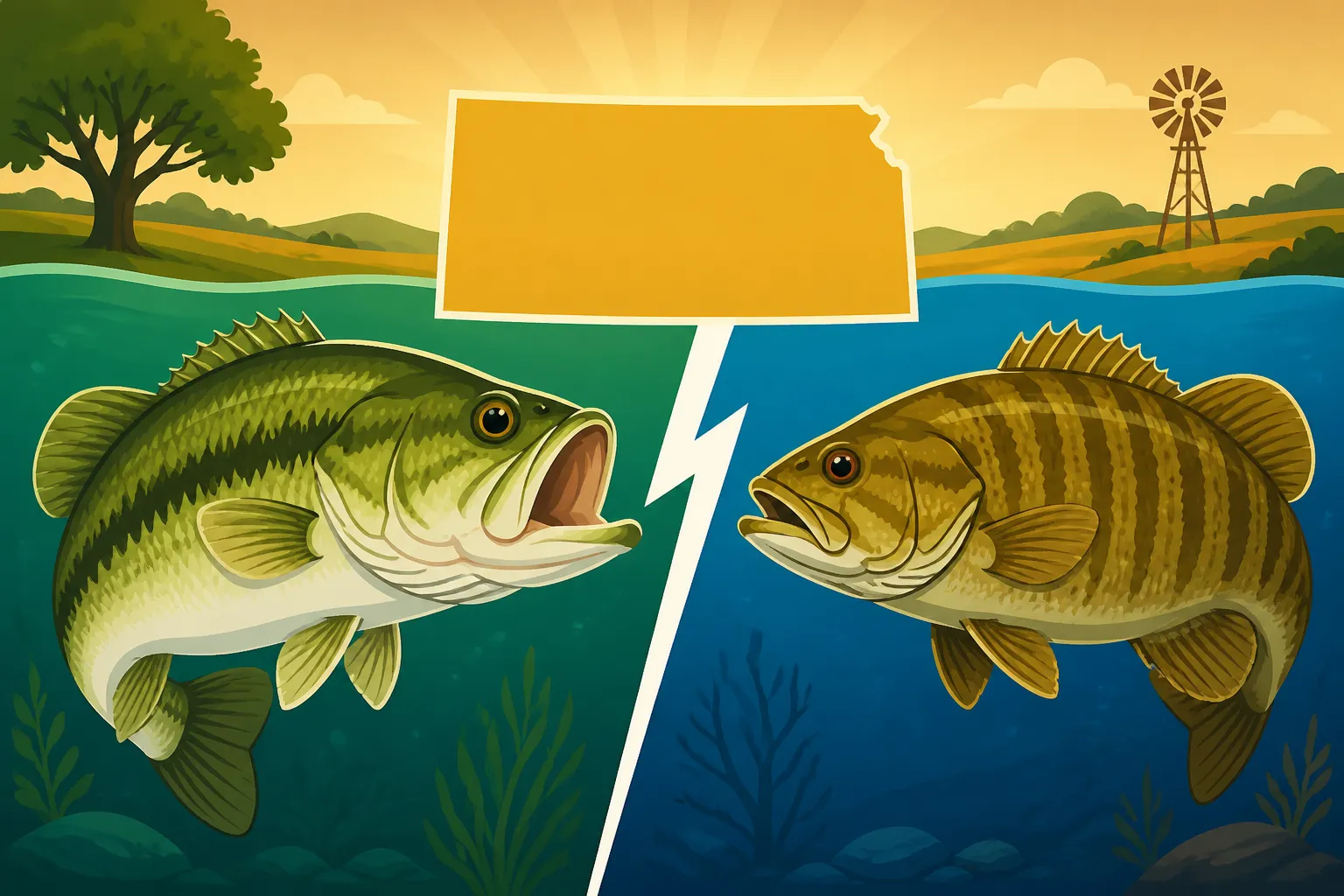
Largemouth vs Smallmouth Bass Identification
It can be incredibly frustrating to reel in a beautiful bass, admire its fight and beauty, only to then second-guess yourself about its exact species. Is it a largemouth? Or is it that feisty smallmouth you've been chasing? In Kansas, where both species offer fantastic angling opportunities, knowing the difference isn't just academic; it directly impacts how you fish, where you look, and even how you comply with local regulations. This guide is designed to help you confidently distinguish between these two popular bass species, ensuring you’re always in the know on the water.
The Tale of Two Mouths and More: Key Visual Distinctions
When you pull a bass out of the water, there are a few tell-tale signs that scream either "largemouth!" or "smallmouth!" These aren't just minor differences; they're quite distinct once you know what to look for. Focusing on these visual cues is your first and best line of defense against misidentification.
Jawline and Mouth Size: The Most Obvious Clue
This is often the go-to identifier for a reason – it's usually the easiest to spot. Grab the fish gently and take a good look at its mouth, specifically where the upper jaw ends in relation to its eye.
For a Largemouth Bass, you'll notice that the upper jaw (or maxillary) extends significantly past the back edge of the eye when its mouth is closed. Think of it like a truly generous, wide grin. Their mouths are designed to engulf prey, and this extended jawline is a clear indicator of that feeding style. If you can imagine drawing a vertical line down from the back of the eye, a largemouth's jaw will almost always cross that line. This characteristic is so prominent that it gives the fish its very name. Anglers often appreciate this wider mouth when a fish engulfs a larger lure, making hook sets more solid. You can learn more about these fish in our Kansas Largemouth Bass Facts guide.
Smallmouth Bass, on the other hand, have a much more modest jawline. Their upper jaw typically ends right at the middle of the eye, or perhaps just slightly behind it, but almost never extends beyond the back edge of the eye. It's a more proportionate, compact mouth. While still a formidable predator, their feeding style is often about darting and snapping, rather than the wide-gaping ambush of their largemouth cousins. When you hold a smallmouth, its head will often appear smaller in proportion to its body, partly due to this less exaggerated jaw. For more specific details, check out Kansas Smallmouth Bass Facts.
Dorsal Fin Separation and Body Shape
Beyond the mouth, the fish's overall body structure and its fins, particularly the dorsal fin, offer another layer of identification.
A Largemouth Bass has a very distinct, deep notch in its dorsal fin. This fin, which runs along the fish's back, often looks like two separate fins because the separation between the spiny front section and the soft-rayed rear section is so pronounced. If you were to run your finger along it, you'd feel a clear, almost valley-like dip. Their body shape tends to be deeper and more compressed laterally, meaning they're taller than they are wide. Many describe them as looking more "slab-sided" or like a "dinner plate" when mature, especially the trophy specimens often found lurking in dense cover.
The Smallmouth Bass presents a different picture. Its dorsal fin also has a notch, but it's much shallower and less defined than that of a largemouth. The spiny and soft-rayed sections appear much more continuous, almost like a single, elongated fin. When you run your hand along it, the transition is smooth, not a drastic dip. In terms of body shape, smallmouths are generally more streamlined and torpedo-shaped. They are often described as being more "football-like" or cylindrical, built for powerful, quick movements in current. This athletic build helps them navigate the rocky, flowing waters they prefer.
Coloration and Markings: Nature's Camouflage
While coloration can vary quite a bit depending on water clarity, diet, and even the fish's mood, there are some general patterns and markings that tend to hold true for each species.
Largemouth Bass typically exhibit a color palette of darker greens and olive tones on their backs and sides, fading to a lighter, often white or yellowish belly. The most iconic marking is a prominent, often jagged, dark horizontal stripe or series of blotches running along its lateral line from gill to tail. This stripe can be very distinct in clear water fish or more broken up in others, but it's almost always there. Sometimes, you'll see faint vertical bars too, but the horizontal line is the dominant pattern.
Smallmouth Bass, by contrast, tend to have a more brownish or bronze hue on their backs and sides, sometimes with hints of gold or copper, particularly in clear water. Their bellies are typically lighter, often cream-colored. Instead of a strong horizontal stripe, smallmouths often display 8-16 faint, dark vertical bars or blotches along their sides. These bars can be quite subtle and might even disappear when the fish is stressed or excited. Another common feature, though not universal, is that many smallmouth bass will have reddish eyes, which adds to their distinctive appearance. Comparing these two is a key part of our broader Kansas Bass Fishing Guide.
Where They Live and How They Behave: Habitat and Habits in Kansas
Understanding where these two bass species prefer to live and how they typically behave can be as helpful as visual identification, especially when you're targeting a specific type of fish. Knowing their haunts can save you a lot of casting time!
Largemouth Bass: The Structure Lover
The Largemouth Bass is undeniably a creature of cover. They thrive in environments that offer plenty of submerged structure and vegetation where they can ambush prey. Think of them as the kings of the hidden lair.
In Kansas, you'll find largemouth bass absolutely loving the weedy coves, submerged timber, lily pads, and brush piles that are common in many reservoirs and countless farm ponds. They are drawn to docks, laydowns, and any sort of dense cover that provides shade, security, and a prime ambush point for unsuspecting baitfish, crawfish, or even frogs. They prefer warmer, shallower water and often gravitate towards the calmest parts of a lake or pond. Places like El Dorado Lake are renowned for their largemouth populations, offering anglers ample opportunities to explore these cover-rich environments. El Dorado Lake Bass Fishing is a great example of a fishery where these characteristics play out.
Behaviorally, largemouths are quintessential ambush predators. They'll often lurk motionless in the densest part of a weed bed or next to a submerged log, waiting for prey to swim by before exploding with surprising speed. They aren't typically schooling fish in the same way smallmouths are, though you might find several fish in a productive area if the cover is extensive. They are less migratory than smallmouths, tending to stay within a relatively small home range as long as food and cover are plentiful. When fishing private waters, understanding these preferences can significantly increase your success, as covered in Fishing Rules for Private Ponds in Kansas.
Smallmouth Bass: The Rocky Residence
Smallmouth Bass are a different breed entirely when it comes to habitat. They crave clear, cooler water and hard-bottomed environments. If you're looking for a smallmouth, forget the lily pads and dense weeds.
In Kansas, smallmouth bass are most commonly found in large, clear reservoirs with extensive rocky shorelines, gravel points, and deep, current-swept humps. They thrive in environments where the bottom composition is dominated by rock, gravel, and chunk rock, rather than silt or mud. Good examples include the renowned waters of Milford Lake and Wilson Lake, where vast stretches of rock offer ideal smallmouth habitat. Even certain river stretches, particularly those with good current and rocky bottoms, like parts of the Kansas River, can hold excellent populations. Our Milford Lake Fishing Guide highlights just how crucial rocky structure is for these fish. For river anglers, understanding Kansas River Fishing Guide can point you to prime smallmouth spots.
Their behavior reflects their preferred habitat. Smallmouths are often more active hunters, cruising rocky points, ledges, and drop-offs in search of food. They are much more comfortable in areas with some current and will use it to their advantage, positioning themselves to pick off baitfish carried downstream. They are also much more prone to schooling, especially in open water or along extensive underwater structure, making them a favorite target for anglers who enjoy active pursuit. Unlike largemouths, you won't typically find smallmouths tucked deep into heavy vegetation; they prefer the open, hard-bottomed zones where they can use their speed and agility to run down prey.
Adjusting Your Approach: Fishing Tactics Based on Species
Knowing the difference between a largemouth and a smallmouth isn't just for a quick ID; it profoundly influences how you plan your fishing trip, from the lures you tie on to the techniques you employ. Adapting your strategy based on the bass species you're targeting is key to consistent success.
Largemouth Lures and Techniques
When you're chasing Largemouth Bass, your tackle box should reflect their love for cover and their ambush predator nature. You'll want baits that can penetrate dense vegetation or mimic creatures hiding within it. Many anglers find great success exploring new lures and gear available through retailers like Amazon, allowing them to experiment and find what works best.
Your go-to lures will often include soft plastics like Texas-rigged or Carolina-rigged plastic worms, creature baits, and jigs tipped with trailers. These baits are excellent for pitching into heavy cover, allowing you to slip them into tight spots where largemouths are hiding. Spinnerbaits and chatterbaits are also highly effective for working through sparse cover or along weed lines. For surface action, topwater frogs and hollow-bodied lures are fantastic for drawing explosive strikes from fish lurking beneath lily pads or matted grass. Understanding Topwater Fishing for Kansas Bass is crucial for these scenarios.
Technique-wise, pitching and flipping are essential for getting your bait into dense cover with minimal disturbance. Cranking square-bill crankbaits around stumps and laydowns, or slow-rolling a spinnerbait through submerged brush, are also highly effective. The key is often to get your bait right into their living room, triggering a reaction strike from these territorial fish. Mastering Structure Fishing for Kansas Bass will greatly benefit your largemouth game.
Smallmouth Lures and Techniques
Fishing for Smallmouth Bass requires a shift in mindset and tackle. Since they prefer open, rocky areas and often hunt actively, your lures should cater to that environment and behavior. Again, platforms like Amazon provide a huge array of options for specialized smallmouth tackle, from specific jerkbaits to finesse jigs.
Crankbaits and jerkbaits are staples for smallmouth anglers, especially those that mimic baitfish and can be retrieved effectively over rocky bottoms or suspended in the water column. Tube jigs, grubs, and small swimbaits are incredibly versatile for working rocky points, ledges, and drop-offs. Drop-shot rigs and shaky head jigs are also popular for finesse presentations in deeper, clearer water, especially when fish are less aggressive. Blade baits and spoons can be deadly when smallmouth are schooling and feeding on baitfish.
As for techniques, covering water is often paramount. Casting and retrieving crankbaits across rocky points or along breaklines is a common approach. Dragging or hopping tube jigs and grubs along the bottom to mimic crawfish is also very effective. When you find a school of smallmouth, often identified on your fish finder, vertical jigging can be a fantastic way to catch multiple fish. How to Fish Structure for Smallmouth Bass offers excellent insights into targeting these fish in their preferred rocky environments.
Why Identification Matters Beyond the Catch
Beyond simply knowing what you've caught, being able to accurately identify largemouth and smallmouth bass has practical implications that can directly impact your fishing experience and adherence to regulations.
First and foremost, regulations vary. In Kansas, specific length limits and daily creel limits can differ between bass species, and sometimes even by specific body of water. Mistaking one for the other could inadvertently lead to violations. For example, a lake might have a slot limit for largemouths but different rules for smallmouths to protect specific populations. Always consult Kansas Fishing Regulations Explained for the most current rules to ensure you're fishing legally and responsibly.
Secondly, identification aids in conservation. Knowing which species you're catching helps you understand local fish populations and contribute to their sustainability. If you're consistently catching one species over another, or noticing changes in size or health, that information can be valuable for managing fisheries. Responsible angling relies on understanding the fish we pursue.
Finally, it simply makes you a better, more knowledgeable angler. The more you understand the nuances of each species – their preferred habitat, feeding patterns, and behavioral traits – the better equipped you'll be to target them effectively. It adds a whole new dimension to your fishing strategy and increases your overall enjoyment of the sport.
| Feature | Largemouth Bass | Smallmouth Bass |
|---|---|---|
| Upper Jaw Extent | Extends past the back edge of the eye | Typically ends at or before the back edge of the eye |
| Dorsal Fin | Deep, distinct notch, almost two separate fins | Shallow notch, appears more continuous |
| Body Shape | Deeper, more compressed (slab-sided) | More slender, cylindrical (football-shaped) |
| Coloration | Dark green/olive, prominent horizontal stripe | Brown/bronze, often faint vertical bars |
| Eye Color | Often dark | Often reddish |
| Preferred Habitat | Weeds, lily pads, timber, slow water, ponds | Rocks, gravel, current, clear/cooler water, reservoirs |
Disclaimer
This article is for general informational purposes only and does not constitute professional advice. Laws, prices and regulations vary by location and change over time. Consult a qualified professional for guidance on your specific situation.