Channel Catfish vs Blue Catfish Identification
It's incredibly common for Kansas anglers, especially those new to chasing whiskers, to get a little mixed up when trying to distinguish between a Channel Catfish and a Blue Catfish. Both are powerful fighters, offer excellent table fare, and roam many of the same waters, but knowing the difference is super important for adhering to regulations and refining your fishing strategies. This guide will help you confidently identify whether you’ve landed a Channel or a Blue, ensuring you stay compliant and become a more effective angler.
Understanding the Subtle Differences
When you first pull a big cat out of the water, especially in the heat of the moment, it can be tough to tell if it's a Channel Catfish or a Blue Catfish. They both have that classic whiskered, bottom-feeder look, and they both put up an incredible fight. But trust me, there are distinct features that, once you learn them, make identification much clearer. It's not just about bragging rights; it's about respecting the local fishing regulations and understanding the habits of the fish you're targeting. Many times, what seems like a small detail can be the key.
Why Misidentification Happens
Imagine you're out on the Kansas River or one of our big reservoirs, the sun is setting, and your rod bends over with a monster tug. You fight it, land it, and it's a big, greyish cat. Your heart is pounding, and you're thinking, "Is this a new personal best?" In that excitement, looking for subtle fin counts or jaw alignment might not be your first instinct. This is exactly where the confusion often sets in. Both species can grow large, both can be found in similar environments, and sometimes their coloration can even overlap depending on water clarity and diet. For instance, a Channel Catfish from clear, rocky water might appear much lighter and more streamlined than one from a muddy, nutrient-rich pond. Likewise, smaller Blue Catfish might not exhibit all the pronounced features that make larger ones so distinctive.
General Characteristics of Catfish
Before we dive into the specifics of Channel and Blue cats, let's remember what makes a catfish a catfish. They all have those distinctive barbels, or "whiskers," around their mouths, which they use to taste and feel their way around murky waters. They lack scales, instead having a smooth, leathery skin. Most importantly for anglers, they are powerful, opportunistic feeders that can grow to impressive sizes, making them a fantastic sport fish throughout Kansas. Understanding these common traits helps us appreciate the unique adaptations of each species we encounter, whether it's a robust Channel Cat or a gargantuan Blue Cat. You can learn more about the various whisker fish in our Kansas Catfish Species Guide.
Identifying Channel Catfish
The Channel Catfish is probably the most widely recognized and caught catfish species across Kansas. They're found in nearly every type of water imaginable, from small farm ponds to massive reservoirs and rivers. When you picture a typical catfish, you're likely imagining a Channel Cat. They are incredibly adaptable, which contributes to their widespread presence and makes them a favorite target for many anglers.
Body Shape and Coloration
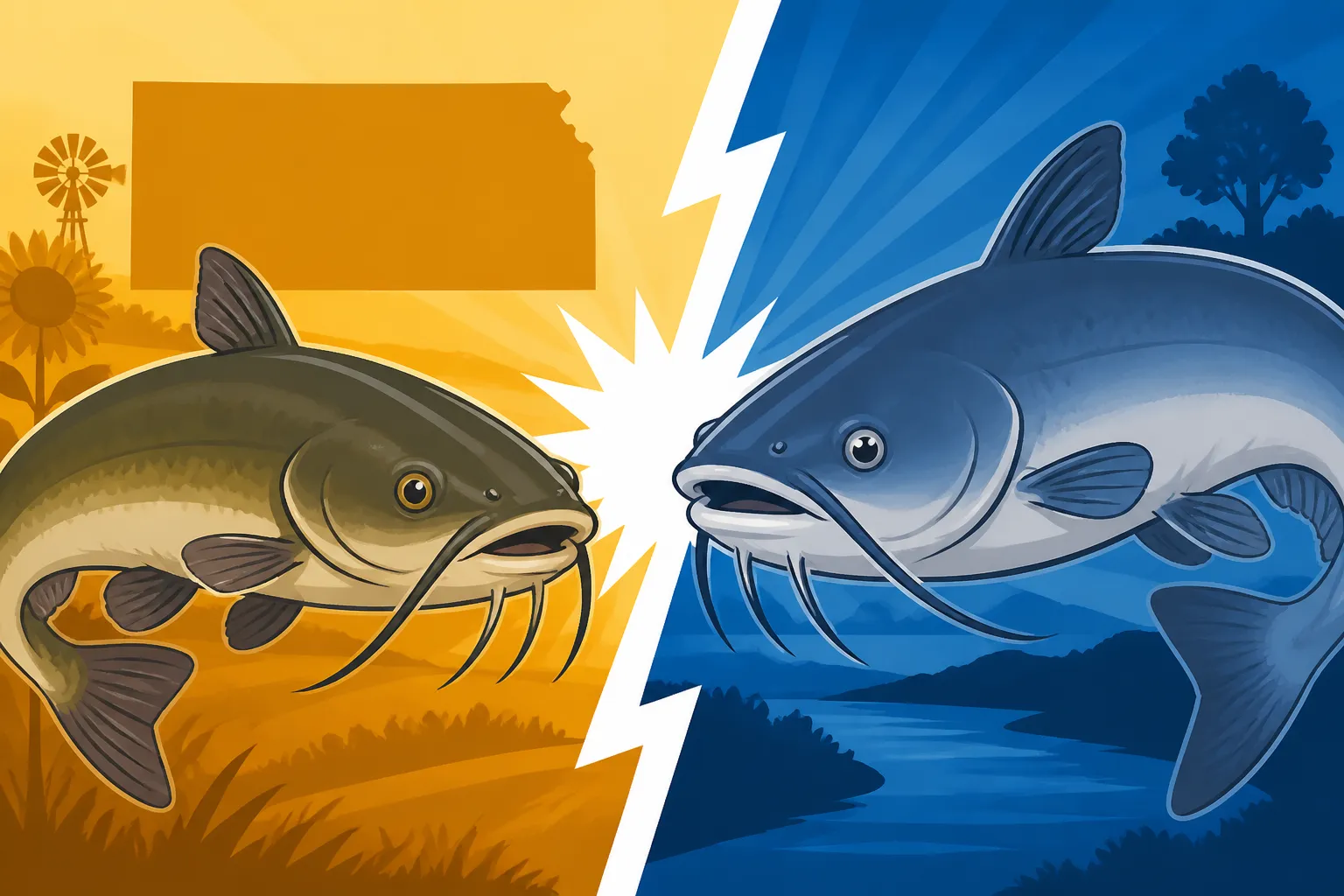
Channel Catfish typically have a sleek, elongated body. Think of them as the more "athletic" looking of the two. Their most common coloration is a greenish-brown to grey on their back, fading to lighter sides and a white belly. Here's the key: younger Channel Cats, and sometimes even larger ones, will often display scattered dark spots along their sides. These spots can be quite pronounced on smaller fish but tend to fade significantly, or even disappear entirely, as the fish ages and grows larger. So, if you catch a two-pound cat covered in spots, it's almost certainly a Channel. A five-pounder might have faint spots, while a twenty-pounder might be completely spotless, which can be part of the identification challenge.
Their heads are relatively small compared to their body, and their eyes are positioned on the upper part of their head. They have a moderately rounded snout. The overall impression is one of agility and grace, even for a larger fish.
Anal Fin Characteristics
This is one of the most reliable ways to tell a Channel Cat from a Blue Cat, especially once you get your eye in. The anal fin of a Channel Catfish is rounded, or slightly convex, along its outer edge. More importantly, it has a relatively low ray count, typically between 24 and 29 rays. While counting fin rays on a squirming fish isn't always practical on the boat or bank, you can often visually tell the difference just by the shape. Run your finger gently along the edge of the anal fin; if it feels more like a gentle curve, you're likely looking at a Channel Cat.
Think of it like this: the anal fin of a Channel Catfish looks somewhat "short" and distinctly rounded, like a smoothly carved arc, especially compared to the long, straight-edged fin of a Blue Cat. This characteristic is so consistent that even without precise counting, an experienced eye can usually tell.
Tail Shape and Mouth
Channel Catfish possess a deeply forked tail, almost like a swallow's tail, which is very prominent and well-defined. This deep fork is another key indicator. Their mouth is typically terminal, meaning it's located at the very front of the head, and the upper jaw does not noticeably protrude beyond the lower jaw. Sometimes, it can even appear as if the lower jaw slightly protrudes, giving them a bit of an underbite, but generally, they are even.
When inspecting the mouth, pay attention to the jaw alignment. If the upper jaw clearly extends past the lower, you might be looking at a Blue Cat, but if it's even or the lower jaw is slightly forward, a Channel Cat is more likely. The barbels on a Channel Catfish are usually grey or black, blending with their body color. This deeply forked tail, combined with the rounded anal fin, forms a solid diagnostic pair for identifying Channel Cats. For more specific details on this species, check out Kansas Channel Catfish Facts and Limits.
Identifying Blue Catfish
Blue Catfish are the true giants of the Kansas catfishing world. While perhaps not as ubiquitous as Channel Cats, where they do exist, they tend to dominate in terms of size and often population. They are primarily found in larger rivers and the expansive main bodies of our major reservoirs, preferring strong currents and deeper, open waters. Landing a trophy Blue Cat is often considered the pinnacle of catfishing for many anglers in the state, offering an unparalleled fight.
Body Shape and Coloration
Blue Catfish live up to their name with a more robust, stocky build that often has a distinct bluish-grey coloration on their backs, fading to lighter blue-grey or white on their sides and belly. Unlike Channel Cats, Blue Catfish never have spots on their bodies at any age. If you catch a large, unspotted grey or blue catfish, especially one over 10 pounds, you're very likely looking at a Blue Cat. Their heads are proportionally larger and broader than a Channel Catfish, giving them a more powerful, formidable appearance.
The body is often described as having a "hump" or elevated profile behind the head, giving them a more substantial, almost hulking look compared to the sleeker Channel Cat. This makes them look built for power and navigating strong currents. Their overall coloration can sometimes be confusing in muddy water, appearing more brownish, but the lack of spots is a consistent identifier.
Anal Fin Characteristics
Here's another critical and highly reliable distinction. The anal fin of a Blue Catfish is long and straight, or sometimes even slightly concave, along its outer edge. It looks much longer and more angular than a Channel Cat's fin. Crucially, it has a much higher ray count, typically ranging from 30 to 35 rays, sometimes even more. When you visually compare it to a Channel Cat's fin, the Blue Cat's anal fin appears noticeably straighter and extends further along the belly.
Imagine drawing a straight line from the front to the back of the fin; with a Blue Cat, that line would run quite true. This long, straight-edged anal fin is one of the quickest ways to identify a Blue Catfish, even from a distance, once you know what to look for. This particular feature is so reliable that it's often the first thing experienced anglers look at.
Tail Shape and Mouth
Like Channel Cats, Blue Catfish also have a deeply forked tail. In fact, their tail can sometimes appear even more deeply forked than a Channel Cat's, with longer, more pointed lobes. So, while the forked tail is common to both, it's not the primary distinguishing factor between them.
The most telling feature of a Blue Cat's mouth is that the upper jaw distinctly protrudes beyond the lower jaw, creating a clear "overbite." This gives their face a somewhat unique profile, almost like they're permanently frowning. The barbels on a Blue Catfish are typically black or dark grey. This overbite, combined with the long, straight anal fin and the lack of spots, creates a comprehensive identification profile for the magnificent Blue Cat. To delve deeper into this species' characteristics, refer to Kansas Blue Catfish Facts and Limits.
Side-by-Side Comparison: Channel vs. Blue Catfish
To make things even clearer, let's put these distinguishing features into a handy table. This visual comparison can be a real game-changer when you're on the water and need a quick reference. Keep in mind that individual fish can vary, but these general rules hold true for the vast majority. It’s a good idea to bookmark this or even print it out for your tackle box.
| Feature | Channel Catfish | Blue Catfish |
|---|---|---|
| Coloration | Greenish-brown to grey, often with dark spots (especially smaller fish) | Bluish-grey, no spots at any size |
| Body Shape | Sleek, elongated, more streamlined | Robust, stocky, often with a "hump" behind the head |
| Head Size | Proportionally smaller and narrower | Proportionally larger and broader |
| Anal Fin | Rounded or convex outer edge, 24-29 rays | Long, straight outer edge, 30-35+ rays |
| Tail Shape | Deeply forked | Deeply forked (often more pronounced) |
| Mouth | Terminal (jaws even) or slight underbite | Upper jaw protrudes (overbite) |
| Habitat | Wide variety (ponds, lakes, rivers) | Larger rivers, main lake bodies, strong currents |
| Typical Size | Common up to 15-20 lbs, but can grow larger | Can grow much larger, often exceeding 50 lbs |
This table provides a quick visual reference for the primary differences. When you're fishing, try to run through this mental checklist, or even keep a laminated copy with your gear. It's truly amazing how quickly you'll start noticing these distinctions once you train your eye.
Why Accurate Identification Matters for Anglers in Kansas
Beyond satisfying your curiosity, knowing the difference between a Channel Catfish and a Blue Catfish is crucial for responsible and successful fishing in Kansas. There are practical implications that directly impact your fishing trip, from what you can legally keep to how you might best target them.
Regulations and Bag Limits
This is perhaps the most critical reason for accurate identification. In Kansas, like many states, regulations such as daily creel limits and length limits can differ between species. What might be perfectly legal for a Channel Catfish could lead to a fine if it's actually a Blue Catfish. For instance, you need to be aware of the Kansas Catfish Daily Limits for each species, as they aren't always the same.
Imagine you're having an incredible day, and the bite is on. You're catching fish left and right, and you've got a stringer full. If you haven't been meticulously identifying each catch, you could unknowingly exceed the limit for one species while being well under for another. This isn't just a minor oversight; it's a violation of Kansas Fishing Regulations Explained and can result in penalties. Always double-check the current regulations before heading out, especially if you plan to keep fish. This information is readily available from the Kansas Department of Wildlife, Parks and Tourism (KDWP) and helps ensure the sustainability of our fisheries.
Fishing Techniques and Habitat Preferences
While both are catfish, their preferred habitats and behaviors can lead to different effective fishing strategies. Channel Catfish are incredibly adaptable and can be found in a vast array of environments, from shallow ponds with muddy bottoms to the deeper parts of reservoirs and slow-moving rivers. They are generally less particular about current and structure. As such, techniques like Kansas Catfish Fishing Techniques might involve fishing shallower humps, submerged timber, or even just soaking bait on the bottom in a still cove. They are often less nomadic and might be found in predictable spots. The Best Bait for Kansas Catfish for Channels can range from prepared stink baits to cut bait or worms.
Blue Catfish, on the other hand, typically prefer larger, deeper bodies of water with strong current, such as the main channels of major rivers like the Kansas River or the deep, open waters of our large reservoirs. They often relate to structure like river bends, deep holes, humps, and current seams. Targeting Blue Cats often involves heavier tackle, larger baits (often fresh cut bait from local baitfish), and fishing deeper water or specific current breaks. Knowing you're targeting Blue Cats might mean motoring out to the main river channel or dropping anchor near a submerged creek bed, rather than casting from the bank of a smaller cove. Your gear setup, from rod power to line strength, might also change if you're specifically pursuing these larger species. For instance, an angler looking to tackle a big Blue might need a more robust Best Rod and Reel Combo for Catfish than one targeting smaller Channels in a farm pond.
Conservation and Management
Each fish species plays a unique role in the ecosystem, and their populations are managed differently. By accurately identifying fish, anglers contribute to better data collection, which helps wildlife agencies make informed decisions about stocking, regulations, and habitat conservation. Misidentifying a species could skew population estimates or lead to inappropriate management strategies.
For instance, if Blue Catfish populations are struggling in a particular area, conservation efforts might focus on specific size limits or catch-and-release programs for that species. If anglers are consistently misreporting Blue Catches as Channel Cats (or vice-versa), it hinders the accuracy of these critical management efforts. As responsible anglers, our actions contribute to the long-term health of Kansas fishing, ensuring that future generations can enjoy these incredible species. It's a small but significant way we can all give back to the sport we love.
Practical Tips for On-the-Water Identification
Even with all the knowledge, making that split-second decision when you've got a lively fish in your hands can be tricky. Here are a few practical tips to help you make the right call every time.
Bring a Reference Guide
It might sound old-school, but carrying a small, waterproof field guide or a laminated copy of this comparison table can be incredibly helpful. You can often find excellent, detailed fish identification posters or cards on platforms like Amazon that are designed to be used in the field. Having a visual aid allows you to quickly compare the fish in your hand to clear illustrations or photographs, pointing out those key features like anal fin shape or jaw protrusion. This is especially useful for beginners who are still training their eyes to spot the nuances.
It’s one thing to read about fin rays and jawlines, and another entirely to see it clearly depicted while you’re holding the fish. A good reference guide can also cover other less common species you might encounter, making it a valuable addition to your tackle box.
Take Clear Photos
When in doubt, snap a good photo! Make sure the fish is well-lit and you get clear shots of the key identification features: the anal fin, the head profile showing the jaw, and the overall body shape and coloration. You can always review the photos later, or even ask a more experienced angler or consult online resources if you're still unsure. Just remember to handle the fish gently and return it to the water quickly if you plan to release it.
Digital cameras on modern smartphones are perfect for this. Getting a few different angles can really help. A shot of the full body, one of the head profile, and a close-up of the anal fin will provide all the necessary information for a definitive identification. This can also be a fun way to document your catches and share your fishing adventures.
Observe Multiple Features
Don't rely on just one characteristic. While the anal fin ray count is very reliable, it's always best to look at a combination of features. Does it have spots and a rounded anal fin? That screams Channel Cat. Does it have an overbite and a long, straight anal fin with no spots? That's a strong indicator of a Blue Cat. The more identifying characteristics that align, the more confident you can be in your call.
Sometimes, an individual fish might have a slightly faded spot pattern or a less pronounced overbite than typical. By checking three or four different features, you reduce the chance of misidentification due to individual variation. It's like building a case: the more evidence you have, the stronger your conclusion. This holistic approach ensures accuracy, preventing potential issues with regulations and enhancing your understanding of the fish you're catching.
Beyond Identification: Enjoying Kansas Catfish
Once you've mastered the art of identifying Channel and Blue Catfish, a whole new world of angling possibilities opens up in Kansas. You'll be better equipped to target specific species, understand their habits, and respect the regulations designed to protect them. Whether you're after the widespread and eager-to-bite Channel Cat or the elusive, tackle-busting Blue Cat, Kansas offers incredible opportunities for catfish enthusiasts.
Remember, both species offer superb eating quality. Many anglers consider Channel Catfish to be one of the best freshwater table fish, especially smaller ones. Blue Catfish, particularly those from cleaner, moving waters, are also highly prized for their firm, white meat. Learning How to Fillet a Channel Catfish can make your catch even more rewarding.
There’s nothing quite like the thrill of a hard-fighting catfish on the end of your line. From the bustling Kansas River Catfish Spots to the quiet solitude of a farm pond, these whiskered warriors provide endless entertainment. By understanding the subtle yet significant differences between Channel and Blue Catfish, you're not just becoming a more knowledgeable angler; you're becoming a more responsible steward of Kansas's incredible aquatic resources. So, get out there, practice your identification skills, and enjoy the fantastic catfishing opportunities our state has to offer!
Disclaimer
This article is for general informational purposes only and does not constitute professional advice. Laws, prices and regulations vary by location and change over time. Consult a qualified professional for guidance on your specific situation.