Best Topwater Lures for Bass
The exhilarating rush of a Kansas bass exploding on a topwater lure is something every angler dreams of, but sometimes it feels like cracking a secret code. You might spend hours casting, hoping for that epic surface strike, only to be met with frustrating silence. This guide aims to demystify the art of topwater fishing for Kansas bass, providing you with the knowledge to choose the best lures and employ the most effective techniques to turn those dreams into reality.
The Undeniable Excitement of Topwater Bass Fishing in Kansas
There's truly nothing quite like seeing a bass ambush your lure from the surface. It's a highly visual, adrenaline-pumping experience that sets it apart from every other fishing technique. For many anglers across Kansas, from the vast expanses of Milford Lake to the more intimate community ponds, the topwater bite is the holy grail.
Why Topwater Bites Get the Adrenaline Pumping
It's a visual game. Unlike subsurface lures where you feel a strike, with topwater, you see the explosion. That moment when the water erupts and a bass absolutely annihilates your lure is pure exhilaration. It validates the frustration of fishing for hours without a visual payoff, making that one topwater blow-up worth the wait. Think about those glassy mornings on Clinton Lake or El Dorado Lake, when the surface tension is broken by a violent splash – it’s a memory that sticks with you long after the fish is released.
This isn't just about catching fish; it's about the show. Many anglers, myself included, will often choose to throw topwater even when other techniques might be more productive, simply for the sheer thrill. It’s a primal reaction, a burst of energy from the unseen depths, and it’s why so many of us become addicted to bass fishing. The suddenness and violence of a topwater strike are unmatched, turning a quiet morning into a heart-stopping event in an instant. It's a feeling that makes all the effort and patience worthwhile, reinforcing why we love the sport.
When Kansas Bass Look Up: Understanding Their Instincts
Bass are opportunistic predators, and they're constantly scanning for easy meals. Anything that falls or swims across the surface, be it an injured baitfish, a frog, a cicada, or even a mouse, becomes a target. This natural feeding behavior is precisely what topwater lures mimic. They exploit the bass's instinct to ambush prey from below, especially during periods of low light or when fish are holding tight to cover. Bass will naturally look upwards for food, making surface presentations incredibly effective during these times.
Think about those early mornings or late evenings when the sun is low, casting long shadows over the water. This is prime time because bass feel more secure hunting in dimmer conditions. Overcast days can extend this bite throughout the day, as the reduced light penetration keeps them active higher in the water column. Even on bright, sunny days, if you find areas with heavy shade – under docks, overhanging trees, or thick mats of vegetation – bass will often hold there, waiting for an overhead meal. Understanding the Kansas Fishing Seasons Guide and how light conditions change throughout the year can significantly improve your topwater success, allowing you to anticipate when bass will be most receptive to surface offerings.
Essential Topwater Lures for Your Kansas Tackle Box
Choosing the right topwater lure can make all the difference. Each type has a unique action and excels in specific situations, making a diverse selection crucial for any serious Kansas bass angler.
Poppers: The Classic Surface Disturbance
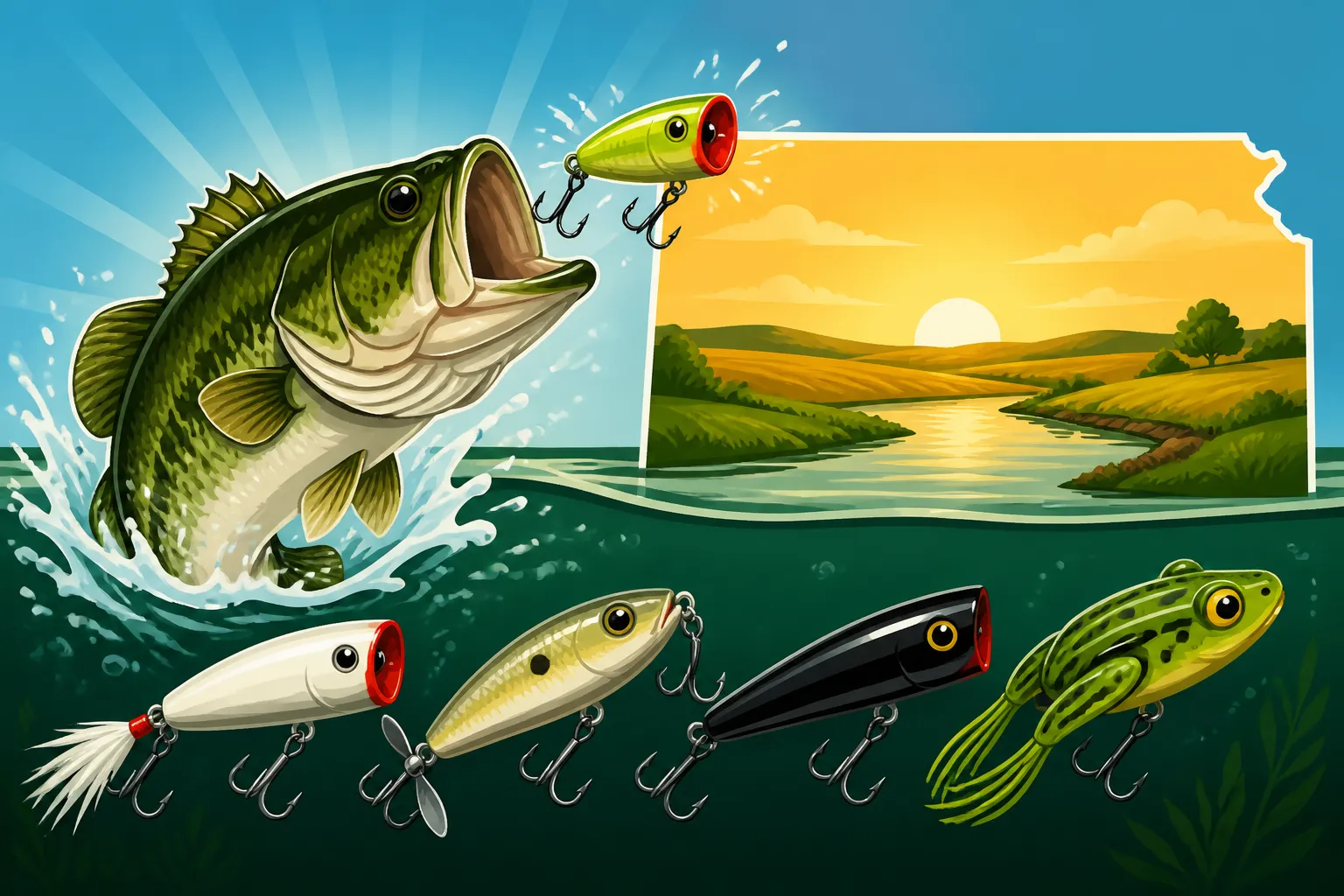
Poppers are arguably the most iconic topwater lure, instantly recognizable by their cupped face. When retrieved, this face catches water, creating a distinct "pop" or "chug" sound that mimics a struggling baitfish or a frog landing on the surface. Lures like the Heddon Pop-R or the Rapala Skitter Pop are staples in many Kansas anglers' boxes because of their effectiveness and ease of use. They are incredibly versatile and relatively easy to work, making them a great starting point for anyone getting into topwater fishing.
The beauty of a popper lies in its ability to create commotion while staying in a small strike zone. You can make it spit, gurgle, or simply make subtle ripples. For bass tucked under boat docks at Perry Lake or along submerged timber in Tuttle Creek Lake, a popper worked with a series of quick pops followed by a pause can be absolutely deadly. The pause is crucial, allowing the bass to zero in and commit to the strike. Different sized poppers work for different situations; smaller ones for subtle presentations, larger ones for drawing fish from further away or in choppier water. You can find a wide variety of these, as well as many other great fishing products, on Amazon.
Walk-the-Dog Lures: The Subtle S-Glide
These cigar-shaped lures don't make a loud splash but instead create a mesmerizing side-to-side "walk" across the water's surface, often referred to as a "walk-the-dog" retrieve. Lures like the legendary Heddon Zara Spook or the newer Reaction Innovations Vixen are perfect examples of these enticing baits. Mastering this retrieve takes a bit of practice – a rhythmic twitching of the rod tip while reeling in slack – but once you get it down, it's incredibly effective, especially for drawing out wary bass in clearer water.
The subtle, sashaying action of a walk-the-dog lure perfectly imitates an injured baitfish or a snake swimming on the surface. This makes them fantastic for fishing over shallow flats, along points, or around schooling baitfish where a more aggressive presentation might spook the fish. They excel in calmer conditions where their nuanced movement can be fully appreciated by a lurking bass. When targeting Kansas Largemouth Bass Facts on open water or chasing Kansas Smallmouth Bass Facts on rocky points, these lures can be game-changers, often triggering violent, aggressive strikes from bigger fish that might ignore other presentations. Their ability to cover water efficiently and their unique action make them a must-have.
Buzzbaits: The Propeller's Call to Action
If you want to make some serious noise on the surface, a buzzbait is your go-to. Comprising a metal blade that spins and gurgles on the retrieve, attached to a lead head with a skirted hook, these lures create an irresistible commotion. The incessant squeaking and splashing as the blade churns water sends out vibrations that bass can't ignore, often prompting reaction strikes from even dormant fish. Brands like Strike King or Booyah offer excellent buzzbait options that are proven performers.
Buzzbaits shine in heavy cover and shallow water. If you're fishing along weed lines, over flooded timber, or through sparse lily pads in places like El Dorado Lake or Clinton Lake, a buzzbait can be incredibly effective. The key is a steady, relatively fast retrieve that keeps the blade churning just under or on the surface. Don't be afraid to let it hit cover; sometimes that deflection is exactly what triggers a strike. They are fantastic search baits, allowing you to cover a lot of water quickly and find active fish, especially during the Kansas Summer Fishing Guide when bass are often lurking in dense cover, making them harder to reach with other lures.
Hollow-Body Frogs and Toads: Through the Slop and Back
For the truly heavy stuff – dense lily pads, thick matted grass, or even sparse duckweed – nothing beats a hollow-body frog or soft plastic toad. Designed to be virtually weedless with hooks tucked tightly against the body, these lures can be dragged over the nastiest cover where other baits would instantly snag. Brands like Spro Bronzeye Frog or Livetarget frogs are highly popular choices among anglers. Their realistic profiles and ability to penetrate thick vegetation make them indispensable for fishing extreme shallow cover where bass often hide.
Fishing a frog requires patience and precision. You can "walk" them across open pockets, twitch them over mats, or let them sit enticingly in small holes. The strikes are often explosive and sometimes miss the lure entirely, which can be frustrating. A key tip is to wait a full "one-thousand-one, one-thousand-two" after the strike before setting the hook, allowing the bass to fully engulf the bait. This technique is paramount when targeting big largemouth bass tucked deep in the cover of Kansas farm ponds or the backwaters of larger reservoirs. Finding a good selection of these can be easily done on Amazon, providing you with the tools to tackle the thickest cover.
Prop Baits: Subtle Splatter and Flash
Prop baits are a bit of a hybrid, offering more flash and disturbance than a walk-the-dog lure but less aggressive than a buzzbait. These lures typically have one or two small propellers, either at the front, back, or both, that spin and splash water when retrieved. Lures like the classic Heddon Tiny Torpedo or the Vixen Prop are examples. They create a distinct gurgling or churning sound, often with a subtle flash from the spinning blades, mimicking a struggling baitfish or insect making subtle movements on the surface.
They excel in situations where bass might be a little wary of louder presentations, perhaps in calm, clear water or after heavy fishing pressure. A stop-and-go retrieve, punctuated by short jerks, allows the propellers to churn and then pause, giving bass time to react. They're excellent for fishing around the edges of cover, open pockets in sparse vegetation, or along shorelines with scattered laydowns. When Best Time of Day to Fish in Kansas calls for a subtle approach, especially around sunrise or sunset on a calm morning, a prop bait can be incredibly effective at drawing out those cautious strikes. Their versatile action fills a critical niche in a topwater arsenal.
| Lure Type | Best Action/Retrieve | Ideal Conditions | Kansas Target Areas | Learning Curve |
|---|---|---|---|---|
| Popper | Pop, chug, pause | Choppy water, cover | Docks, brush piles, submerged timber | Easy |
| Walk-the-Dog | Side-to-side glide | Calm to light chop, open | Flats, points, schooling bass | Medium |
| Buzzbait | Fast, steady retrieve | Heavy cover, shallow | Weed lines, flooded timber | Easy |
| Hollow-Body Frog | Walk, twitch, pause | Dense vegetation, mats | Lily pads, thick grass | Medium |
| Prop Bait | Jerk, twitch, reel | Calmer water, open | Open pockets, edges of cover | Easy |
Mastering the Art of Topwater Presentation in Kansas Waters
Having the right lures is only half the battle. Knowing how to present them effectively and understanding the behavior of Kansas bass will dramatically increase your success rate.
Reading the Water: When and Where to Cast Your Lure
Knowing when and where to throw a topwater is often more important than the specific lure you choose. As mentioned, low light conditions are prime. Think of dawn, dusk, and heavily overcast days as your golden windows. These periods of diminished light offer bass a tactical advantage over their prey and make them more confident to strike on the surface. However, don't rule out topwater on bright, sunny days, especially if you focus on shaded areas. Bass will often move into the cool, dark recesses under boat docks, overhanging trees, or deep within dense cover, where they'll readily strike a topwater lure that invades their comfort zone.
Focus your casts around key Structure Fishing for Kansas Bass elements. This includes any type of cover or contour changes: submerged brush piles, standing timber, rock piles, ledges, points, humps, and, of course, weed lines and lily pads. On reservoirs like Milford Lake Fishing Guide or Cheney Reservoir Fishing Guide, target main lake points that extend into deeper water, or shallow coves with good vegetation. In smaller community lakes or farm ponds, any visible cover like cattails, laydowns, or even changes in bank contour can hold bass waiting for a meal. Remember, bass are ambush predators, so put your lure where they can hide and dart out to attack unsuspecting prey on the surface.
Retrieve Techniques: Bringing Your Topwater Lure to Life
The retrieve is everything in topwater fishing. You’re not just casting and reeling; you’re telling a story, mimicking a live creature. For poppers, it's often a "pop-pop-pause" rhythm. A hard snap of the rod tip makes a loud pop, while a gentler twitch creates a subtle gurgle. The pause is critical; sometimes a bass needs a moment to track the lure and decide to strike. Vary the length of your pauses and the intensity of your pops until you find what the fish prefer on that particular day.
For walk-the-dog lures, achieving that characteristic "sashay" requires a rhythmic downward twitch of the rod tip, followed by reeling in slack, then repeating. It's like patting your head and rubbing your belly at the same time, but once it clicks, it's effortless and incredibly effective. Buzzbaits are generally a steady retrieve, just fast enough to keep the blade spinning on the surface, creating that enticing gurgle. Frogs, when worked over mats, can be twitched, paused, and walked. The key across all lure types is experimentation. No two days are the same, and the bass will often tell you what they want. Don't be afraid to try different speeds, pauses, and cadences until you unlock the bite.
The Critical Hookset: Don't Jump the Gun!
This is perhaps the biggest challenge and most common mistake in topwater fishing, leading to countless missed opportunities and frustrated sighs. The visual explosion of a bass striking your lure is so thrilling that our natural instinct is to immediately set the hook. However, bass often "boil" on the lure, swipe at it, or even just suck it in quickly, and if you set too early, you'll pull the lure away from their mouth before they've truly engulfed it. This frustration is real, and every angler, from novice to seasoned pro, has been there.
The golden rule for topwater hooksets is: Wait until you feel the fish. After you see the splash, take a breath, count to "one-thousand-one," or just feel the weight of the fish on your line before sweeping your rod to the side for a solid hookset. This gives the bass time to fully engulf the lure and ensures the hooks are in its mouth, not just slapping at its body. It takes discipline and often goes against your gut reaction, but it dramatically increases your hook-up ratio. A strong, sharp hook is also crucial, and you might consider upgrading the treble hooks on some of your store-bought lures for better penetration. This patience is key to turning those epic strikes into landed fish. For more comprehensive tips on Kansas Bass Fishing Guide, be sure to check out our detailed guide.
Gearing Up for Optimal Topwater Success
Your equipment plays a vital role in how effectively you can present topwater lures and successfully land those aggressive bass. The right rod, reel, and line can significantly enhance your experience.
The Right Rod, Reel, and Line for Topwater Action
Having the proper equipment can significantly enhance your topwater fishing experience and success. For most topwater applications, a medium-heavy power, fast-action baitcasting rod, typically between 7 feet and 7 feet 6 inches, is ideal. This length provides excellent casting distance, which is often crucial for reaching distant cover or schooling fish, especially on larger Best Fishing Lakes in Kansas. The medium-heavy power gives you the backbone to drive hooks home and control larger bass, while the fast action provides the sensitivity for working the lure and enough tip to cast accurately. For lighter topwater baits, a medium power rod might be more appropriate. You can explore a wide array of options on Amazon to find the perfect rod for your style.
Pair that rod with a quality baitcasting reel with a gear ratio in the 6.1:1 to 7.1:1 range. This allows for quick line retrieval to pick up slack when walking a dog or to catch up to a fast-moving fish. When it comes to line, braided line is a top choice for most topwater setups. Its zero stretch properties provide excellent sensitivity and direct power for hooksets, crucial for lures like frogs that require aggressive hook-ups through dense cover. Opt for 30 to 50 lb test braid for maximum strength and minimal stretch. If you're concerned about visibility in clear water, a short leader of 15-20 lb fluorocarbon or monofilament can be tied to the braid. For more in-depth guidance on choosing your setup, check out our Best Rods and Reels for Kansas Fishing guide.
Strategic Tackle Box Additions for Topwater Fishing
Beyond the lures themselves, a few key items in your tackle box can make a big difference in your topwater fishing success. Always carry extra sharp treble hooks or single hooks for your frogs. Factory hooks can sometimes be dull or too weak for aggressive topwater strikes, and upgrading them can prevent lost fish, saving you from heartbreak. Split ring pliers are invaluable for quickly changing hooks or split rings on your lures without damaging your fingernails or the lure itself.
Don't forget the essentials for personal comfort and safety. Polarized sunglasses are non-negotiable for topwater fishing; they cut glare and allow you to see strikes more clearly, track your lure, and spot submerged cover or cruising bass before you cast. Sunscreen and a wide-brimmed hat will protect you during those long hours under the Kansas sun. A good pair of long-nose pliers or hook removers are essential for safely unhooking fish, especially when dealing with multiple treble hooks on a thrashing bass. Having a well-stocked Best Tackle for Kansas Game Fish selection ensures you're ready for any situation you encounter on Kansas waters. Considering how Weather Patterns and Kansas Fishing Success are intertwined, being prepared for changing conditions with the right gear is always a good idea.
Disclaimer
Fishing involves inherent risks, including but not limited to, changing weather conditions, personal injury, and property damage. Always exercise caution, be aware of your surroundings, and comply with all local, state, and federal regulations. The information provided in this guide is for informational purposes only and does not constitute professional advice.