Best Anchor for Reservoir Fishing
One of the biggest frustrations when you're out on a Kansas reservoir, trying to dial in on that perfect fishing spot, is fighting a stubborn wind or current that just won't let your boat settle. You drop your anchor, hoping to hold position over that submerged brush pile or rocky point, only to find yourself slowly drifting away, pulling your lines off target. This guide is all about helping you choose and use the best anchor for reservoir fishing, so you can stop drifting and start catching.
Why a Good Anchor Matters on Kansas Reservoirs
Fishing on Kansas reservoirs isn't like casting into a quiet farm pond. These are vast, dynamic bodies of water, often subject to strong winds, currents from dam operations, and various underwater features that can make holding your position a real challenge. A reliable anchor isn't just about convenience; it's a fundamental tool for safety and success.
The Challenges of Reservoir Bottoms
Kansas reservoirs, like Milford Lake or Cheney Reservoir, have incredibly varied bottoms. You might encounter hard clay, loose gravel, rocky ledges, thick mud, or even old submerged timber. A "one-size-fits-all" anchor rarely performs optimally across all these conditions. Some anchors excel in soft mud but skip over rocks, while others bite hard into rock but struggle to penetrate thick silt. Understanding the common bottom types in your favorite fishing spots will greatly influence your best anchor choice. Without the right anchor, you could spend more time repositioning your boat than actually fishing, especially when the wind kicks up unexpectedly.
Safety First: Holding Your Position
Beyond just staying on a fish-holding structure, a good anchor is a crucial safety device. Imagine being out on a busy weekend on Wilson Lake, surrounded by other boats and recreational users. If your engine dies or you lose power, a dependable anchor can prevent you from drifting into hazardous areas, other vessels, or even onto shore. It provides peace of mind, knowing that you can secure your boat quickly and effectively if an emergency arises or if conditions suddenly turn foul. Always consider your anchor as part of your essential Kansas Boating Safety Equipment Requirements.
Maximizing Your Fishing Success
Let's be honest, you're out there to catch fish! And often, the best fishing means precisely presenting your bait or lure to a specific piece of structure. Whether you're vertical jigging for walleye over a submerged hump at Tuttle Creek Lake, or soaking cut bait for catfish on a channel swing, holding your boat still is paramount. A poor anchor setup means constant adjustments, re-casts, and spooking fish as your boat scrapes bottom or swings wildly. A good anchor allows you to focus on your technique, manage your lines effectively, and ultimately, put more fish in the cooler. It helps you stay in the strike zone longer, increasing your chances of success.
Types of Anchors Best Suited for Kansas Reservoirs
Choosing an anchor can feel like picking a new fishing rod – there are so many options! But for the unique characteristics of Kansas reservoirs, a few types consistently rise to the top. It's often beneficial to have more than one type on board, or at least one versatile option.
Fluke (Danforth) Anchors: The All-Arounder
The fluke anchor, often referred to as a Danforth, is arguably one of the most popular anchor types for smaller to medium-sized boats on freshwater reservoirs. Its design features two large, flat flukes that pivot and dig deep into soft or sandy bottoms, creating impressive holding power for its weight. This makes it an excellent choice for many areas of Kansas' larger lakes that have softer, silty, or sandy expanses. They are relatively compact for storage, and you can find them readily at places like Bass Pro Shops or online retailers like Amazon.
However, a fluke anchor can struggle on extremely hard clay or thick rock bottoms, where the flukes might not be able to dig in effectively, causing the anchor to drag. If you frequently fish rocky shorelines or submerged rock piles, you might find yourself resetting it often. They also don't hold as well in very thick, heavy vegetation. Still, for general reservoir fishing, especially when targeting open water structure or softer bottom areas, a fluke anchor is a fantastic primary choice. Remember, the effectiveness also ties into your Best Anchor Rope Length for Lakes and the amount of chain you use.
River Anchors (Grapnel/Claw): For Current and Structure
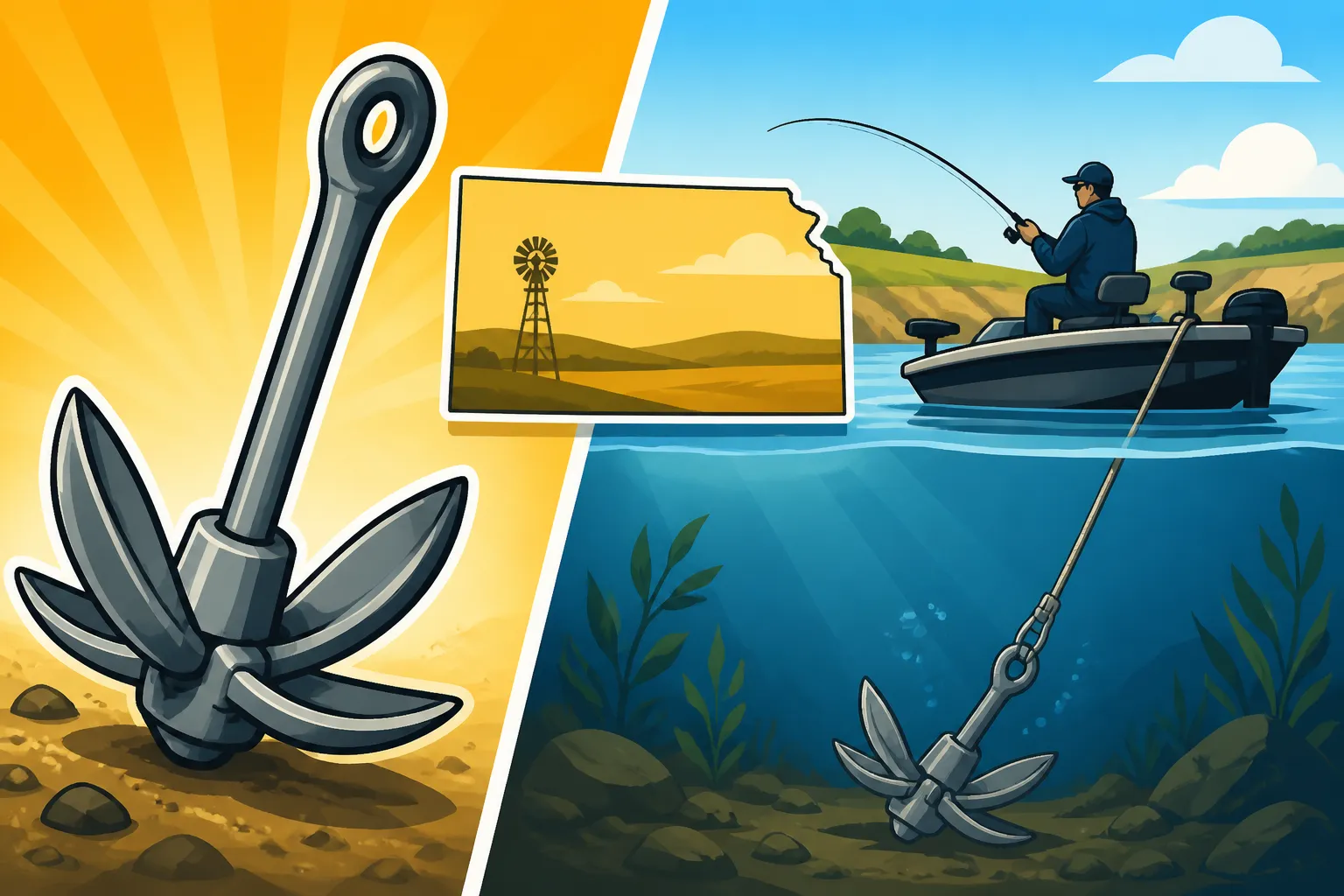
Despite the name, "river anchors" or grapnel/claw anchors are surprisingly effective in many reservoir situations, especially where currents are present or the bottom is exceptionally rocky or full of snags. A true grapnel anchor features four or more prongs that can fold up for storage, while a claw anchor (like a Bruce anchor) has a distinctive scoop shape. These anchors are designed to grab onto rocks, submerged logs, or other irregular bottom features. Their robust construction and ability to "hook" into structure give them excellent holding power in challenging conditions.
For anglers who frequently fish river sections feeding into reservoirs, like those found around the Republican River arm of Milford Lake, or in areas with consistent current near dam outflows, a river anchor is invaluable. They also work well for bank fishing situations from a boat where you might be anchoring near rip-rap or rocky banks. The downside is that they can get snagged more easily than a fluke anchor, which can lead to frustrating retrieval issues. However, with a good retrieval system or a trip line, these can be a lifesaver for specific, challenging spots.
Mushroom Anchors: Not Just for Ponds
While typically associated with smaller boats, kayaks, and canoes on calmer waters or for marking buoys, the mushroom anchor deserves a mention, particularly for specialized reservoir fishing scenarios. As its name suggests, it's shaped like a mushroom, with a wide, concave bottom designed to suction into soft mud or silt. They rely more on suction and dead weight for holding power rather than digging into the bottom.
For anglers using smaller watercraft, such as fishing kayaks (and you might want to look into a Best Kayak for Kansas Reservoir Fishing if this is your style), a smaller mushroom anchor can be surprisingly effective in muddy coves or calm, shallow areas of reservoirs. They are less likely to snag than other anchor types, making them a good option where the bottom is known to be clean mud. However, they perform poorly on hard bottoms, sand, or in significant wind and current, where they tend to drag. For larger boats or in exposed areas, they don't offer enough holding power to be a primary anchor, but they can serve well as a secondary, quick-drop anchor for specific, calm conditions.
Choosing the Right Anchor Weight and Rode for Your Boat
Selecting the correct anchor type is only half the battle; ensuring it's the right weight and properly rigged with adequate rode (the combination of chain and rope) is equally critical for effective anchoring. This system works together to provide the necessary holding power.
Understanding Anchor Weight Requirements
The weight of your anchor isn't just about how heavy your boat is; it's about the anchor's ability to dig in and hold against wind, current, and waves. Generally, boat manufacturers and anchor companies provide guidelines based on boat length. A common rule of thumb for recreational fishing boats in reservoirs is to choose an anchor that is slightly heavier than the minimum recommendation, especially if you plan to fish in windy conditions or on large, open water bodies like Perry Lake or El Dorado Lake. If you're using a lighter boat, like many of the Best Boats for Kansas Reservoirs that prioritize maneuverability, you still need sufficient anchor weight.
For example, a 16-foot aluminum Jon boat might get by with a 10-15 pound anchor in calm conditions, but a 20-foot fiberglass bass boat fishing in a 20 mph wind might need a 20-25 pound anchor or more to reliably hold position. Always err on the side of slightly heavier for Kansas reservoirs, as weather can change quickly. A heavier anchor offers more assurance that you'll stay put, reducing stress and increasing your time fishing instead of fighting the elements.
The Importance of Rode (Chain and Rope)
This is where many anglers miss a critical piece of the anchoring puzzle. The rode isn't just rope; it's a combination of anchor chain and anchor rope, and the chain is absolutely essential. The chain serves two primary purposes:
- Angle of Pull: It creates a lower, more horizontal angle of pull on the anchor. This allows the anchor to dig in more effectively and stay buried. Without chain, the rope pulls the anchor upwards, causing it to break free and drag.
- Weight and Scope: The weight of the chain itself helps hold the anchor down, especially in choppy water. It also helps absorb shock loads from waves, preventing the anchor from being jerked loose.
A good rule of thumb for Kansas reservoir fishing is to use at least one foot of chain for every foot of boat length, or even more for larger boats or harsher conditions. For the rope portion, you need enough length to achieve proper "scope." Scope is the ratio of the length of your deployed rode (distance from boat to anchor) to the depth of the water plus the distance from the waterline to where your anchor attaches to the boat. A minimum 5:1 scope is recommended for most conditions, meaning for every 10 feet of water depth, you need at least 50 feet of rode out. For really tough conditions, a 7:1 scope is even better. You can often find pre-rigged anchor lines with chain at Bass Pro Shops or look for individual components on Amazon to build your own system.
Anchor Deployment and Retrieval Tips
Proper deployment is key. Don't just heave your anchor overboard in a tangled mess. Position your boat upwind or upcurrent of your desired spot. Slowly motor forward while lowering the anchor, letting out sufficient rode for proper scope. Once the anchor touches bottom, let out more line as the boat drifts back, allowing the anchor to set. Feel for that solid "thunk" or resistance as it digs in.
For retrieval, motor slowly towards your anchor, taking up slack as you go. When you're directly over the anchor, pull straight up to break it free. If it's stubborn, move your boat in a small circle around the anchor while keeping tension on the line; this can sometimes dislodge it from a snag. Having a good cleat to tie off to and considering a small anchor winch for heavier setups can make a huge difference in ease and safety. This is also where things like a Kansas Fishing License Guide come in, ensuring you're legal while out on the water.
Advanced Anchoring Techniques for Tricky Conditions
Sometimes, a single anchor just isn't enough to keep your boat precisely where you want it. Kansas reservoirs, with their fickle winds and sometimes strong currents, often call for more advanced techniques. Mastering these can make the difference between a frustrating day and a successful one.
Using Two Anchors for Stability
When the wind is really howling, or you want to hold your boat perfectly still to present baits to a very specific target like a submerged tree line or a deep hole, a single anchor might not cut it. This is where using two anchors comes into play. There are a couple of popular methods for two-anchor setups:
- Fore and Aft (Bow and Stern): This method involves deploying one anchor from the bow and another from the stern. By adjusting the length of the rode on each, you can literally "pin" your boat in place, preventing it from swinging side-to-side. This is fantastic for finesse fishing or situations where precise boat positioning is critical. Imagine you're trying to cast to a particular brush pile off your port side; with fore and aft anchoring, you can hold that angle perfectly. Just be mindful of other boaters if you're spreading out a lot of line.
- V-Anchoring (Two Bow Anchors): In this setup, two anchors are deployed from the bow, spread out in a V-shape. This creates a broader base of stability than a single anchor, helping to reduce boat swing in strong winds or currents. It gives you more flexibility to adjust your bow position slightly by taking up or letting out line on one side. This is particularly useful when fishing a wide flat or a gradual slope where you want to cover a broader area without constantly repositioning. It’s also a common technique on many large bodies of water, including the often-windy Milford Lake Fishing Guide areas.
Always ensure you have enough extra rode on board to effectively deploy two anchors, and communicate your intentions to nearby boats if you are in a crowded area.
Anchor Management Systems and Accessories
The right anchor accessories can greatly improve the functionality and ease of your anchoring system.
- Anchor Trolley: For kayak anglers, an anchor trolley is an absolute game-changer. This simple system, often made with a ring and pulleys, allows you to easily move your anchor line from the bow to the stern (or anywhere in between) without having to un-anchor and re-anchor. This means you can quickly adjust your angle to the wind or current, keeping your kayak perfectly positioned for casting. For an in-depth look, check out guides on Best Kayak Anchor Trolley Setup.
- Anchor Pulleys and Cleats: Heavy-duty pulleys make it easier to haul up a heavy anchor, especially when combined with a good cleat for securing the line. Ensure your cleats are sturdy and rated for the weight and forces your anchor system might experience.
- Anchor Balls/Buoys: These are invaluable for quick, temporary anchoring or for easily marking your anchor line if you need to release it in an emergency or to chase a big fish. They also make retrieval easier by helping to float the line and reduce the weight you're pulling.
- Anchor Winches: For larger boats or those with heavy anchors, an electric anchor winch (windlass) can be a significant investment, but it's one that pays off in convenience and reduced effort, especially after a long day of fishing or in rough weather.
Think about how you typically fish and what challenges you face, then consider which accessories might make your life easier. You can browse many of these options at your local sporting goods store or online through sites like Amazon.
Dealing with Stuck Anchors
Every angler who anchors eventually faces this moment of dread: your anchor is stuck. It happens, especially with river anchors or if a fluke anchor buries deep into a stubborn root system or rock crevice. Don't panic and certainly don't just pull harder until something breaks.
Here are a few strategies for freeing a stuck anchor:
- Change Your Angle: The most common solution. Motor or drift in a large circle around the point where your anchor line enters the water, pulling from different directions. Often, pulling from the opposite direction of deployment will free it.
- Anchor Retrieval Ring: This is a simple but brilliant device. It's a heavy-duty ring that you clip onto your anchor line, then attach a buoy to the ring. You then motor past the anchor's position. The ring slides down the anchor line to the anchor, and the buoy's buoyancy (plus your forward motion) helps to pull the anchor free by reversing the pull on its shank.
- Trip Line: This requires some foresight but is the most effective prevention. A trip line is a separate, lighter line attached to the crown (the top) of your anchor, opposite the shank where your main rode attaches. The other end of the trip line is attached to a small buoy. If your anchor gets stuck, you can pull on the trip line, which pulls the anchor out backward, freeing it from the snag. This is an excellent tactic when fishing particularly snaggy spots, such as old creek channels or rocky structures where trophy Kansas Walleye Fishing Techniques are often employed.
| Anchor Type | Best For | Pros | Cons |
|---|---|---|---|
| Fluke (Danforth) | Sand, Silt, Soft Mud, General Reservoir | Excellent holding in soft bottoms, compact storage | Struggles on hard/rocky bottoms, can drag in weeds |
| River (Grapnel/Claw) | Rocky Bottoms, Current, Submerged Structure | Grabs onto irregular surfaces, good in current | Prone to snagging, can be difficult to retrieve |
| Mushroom | Calm, Shallow Muddy Areas, Kayaks, Canoes | Won't snag easily, compact, inexpensive | Poor holding in wind/current, ineffective on hard bottoms |
Always ensure your anchor and all its components are in good condition before each trip. A rusty chain or frayed rope can fail when you need it most. Having a spare anchor on board is also a wise idea, just in case. After all, you don't want to be caught adrift while enjoying the Best Fishing Lakes in Kansas!
Disclaimer
This article is for general informational purposes only and does not constitute professional advice. Laws, prices and regulations vary by location and change over time. Consult a qualified professional for guidance on your specific situation.