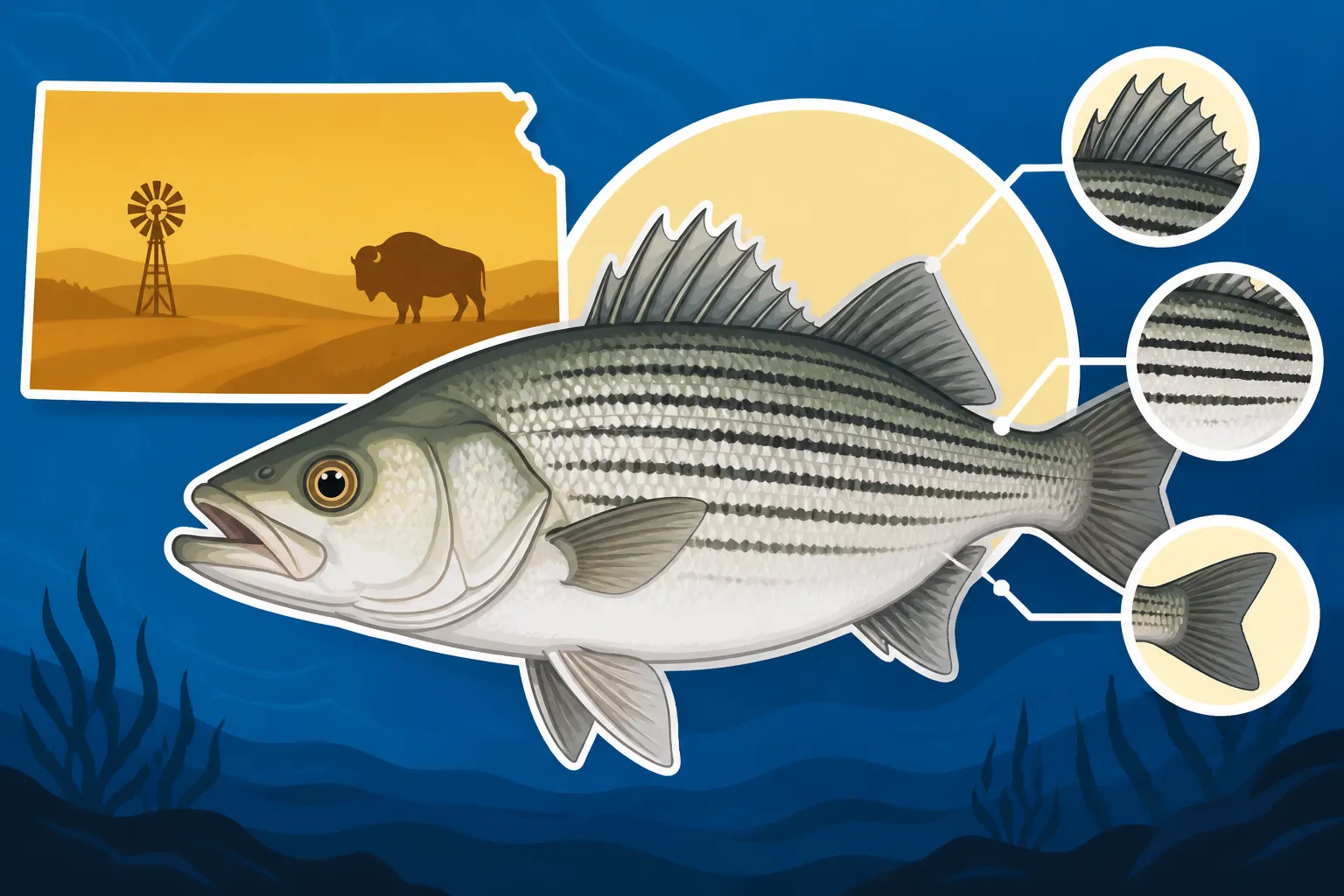
Kansas Hybrid Striped Bass Identification
One of the most exciting fish to pursue in Kansas waters is the hybrid striped bass, often called a "wiper," but identifying them correctly can sometimes feel like a tricky riddle, leading to confusion about regulations and even what kind of fish you actually caught! This comprehensive guide will walk you through the distinctive characteristics of the Kansas hybrid striped bass, helping you confidently tell them apart from their parent species, the white bass and the true striped bass.
The Hybrid Striper Phenomenon in Kansas
The hybrid striped bass, or wiper, is a true powerhouse in the Kansas fishing scene, renowned for its aggressive fighting style and impressive size. These fish aren't naturally occurring; they're the result of a deliberate cross-breeding program, and Kansas has been at the forefront of successfully stocking these feisty swimmers in many of its major reservoirs. Understanding their origins is the first step to appreciating why they look and act the way they do.
A Tale of Two Parents: White Bass Meets Striper
A hybrid striped bass is exactly what it sounds like: a hybrid. It's the offspring of a female striped bass and a male white bass. This genetic blend gives them a unique combination of traits from both parents. From the white bass, they inherit a more compact, high-backed body shape, but from the true striped bass, they get the potential for much larger size, incredible strength, and those distinctive lateral stripes. The goal of creating this hybrid was to produce a hard-fighting, fast-growing fish that could thrive in reservoir environments where true striped bass might struggle to reproduce naturally, and it's been a massive success in places like Kansas.
Because they are a cross, they often display characteristics that are intermediate between the two parent species, which is where the identification challenge often lies. They grow much faster and larger than white bass but generally don't reach the immense sizes of true striped bass. This makes them a perfect target for anglers looking for a challenging fight without needing specialized offshore-level tackle.
The Kansas Connection: Stocking and Popularity
Kansas reservoirs are ideal habitats for hybrid striped bass. These large, open bodies of water provide the vast expanses of baitfish, like shad, that wipers absolutely gorge themselves on. The Kansas Department of Wildlife and Parks (KDWP) has actively stocked these fish for decades, making them a staple in many of our best fishing lakes. Reservoirs like Cheney, Wilson, and El Dorado are particularly famous for their thriving wiper populations, offering fantastic fishing opportunities year-round.
The popularity of hybrid stripers among Kansas anglers stems from several factors. Their aggressive strikes and powerful runs make for an exhilarating experience on the rod. They are also known for schooling, especially during the white bass run periods, which can lead to incredible "blitz" fishing where multiple anglers hook up simultaneously. Furthermore, wipers are excellent table fare, offering firm, flaky white meat that many anglers enjoy. Their success in Kansas waters is a testament to the KDWP's thoughtful stocking programs and the robust ecosystems of our reservoirs.
Key Visual Identifiers of Hybrid Stripers
When you pull a fish out of the water, especially if it's got stripes, your first thought might be, "Is this a white bass? A striper? Or a wiper?" There are several key visual clues that can help you quickly determine if you've got a hybrid striped bass on your line. Paying close attention to these details will make you an expert identifier in no time.
The Broken Line Pattern: Your First Clue
The most definitive and often easiest way to identify a hybrid striped bass is by looking at its lateral lines. True striped bass (often just called "stripers") have very distinct, unbroken, parallel lines running from their gill plate to their tail. White bass, on the other hand, typically have fainter, often broken lines, with only one prominent, unbroken line. The hybrid striped bass, or wiper, combines these features in a very specific way.
A hybrid will have lateral lines that are distinctly broken or interrupted, particularly below the lateral line. You'll often see these breaks occurring unevenly along the body, with some lines appearing more solid and others quite jagged or fragmented. Sometimes, the lines might even be offset from each other as they continue towards the tail. If you see a fish with strong, dark lateral lines, but many of them are clearly discontinuous, you've almost certainly got a hybrid striper. This broken-line pattern is a hallmark feature and should be the first thing you look for.
Body Shape and Proportions: More Than Just Length
While size can be misleading since young true stripers can look similar to adult hybrids, the overall body shape and proportions offer another strong clue. White bass tend to be more "panfish-shaped," with a deeper body depth relative to their length, often giving them a "humpy" or stocky appearance, especially when mature. True striped bass are generally much more elongated and torpedo-shaped, built for speed in open water.
Hybrid striped bass fall somewhere in between but lean more towards the white bass's deeper body profile. They are thicker and more robust than a white bass of similar length, and their body depth is noticeably greater than a true striper of the same length. Think of them as a "beefed-up" white bass; they have that higher back and deeper body, but they can stretch out to a much longer and heavier fish. When you hold one, you'll feel the significant girth and power, which is usually more substantial than a white bass. This blend of robustness and length is characteristic of the hybrid.
Dorsal Fin Spacing: A Crucial Detail
Another critical, but often overlooked, identifier is the spacing between the two dorsal fins. All three species—white bass, hybrid striped bass, and true striped bass—have two dorsal fins. The first dorsal fin is spiny, and the second is soft-rayed. The key difference lies in how close these two fins are to each other.
On a white bass, the two dorsal fins are typically connected or very close together, often with just a membrane connecting them, or at most, a very minimal gap. For a true striped bass, the two dorsal fins are clearly separated, but the separation is generally less pronounced than on a hybrid. The hybrid striped bass, however, will have two dorsal fins that are distinctly separated, often by a significant gap. You should be able to easily place a finger or even two between the base of the first and second dorsal fins without touching either fin. This wider gap is a reliable physical characteristic to look for. Kansas Fish Species Guide offers more insights into various fish species.
Differentiating Hybrids from White Bass
This is perhaps the most common identification challenge anglers face in Kansas: telling a hybrid striped bass apart from a large white bass. Both are aggressive, schooling fish found in the same waters, and both have stripes. But missing the subtle differences can mean miscounting your catch or even violating regulations. Let's break down how to confidently distinguish these two species.
Size and Overall Girth Comparison
The most immediate and often striking difference, especially with mature fish, is the overall size and girth. White bass are generally smaller fish. A really good white bass might reach 14 to 16 inches and weigh a couple of pounds, though larger ones are certainly caught. They tend to have a somewhat "stubby" or compact appearance, with a relatively deep body.
Hybrid striped bass, or wipers, on the other hand, grow significantly larger and are much more robust. A typical keeper wiper in Kansas might be 18 to 24 inches long and weigh anywhere from 4 to 10 pounds, with much larger fish being caught regularly. They retain some of the white bass's deeper body shape but are much more elongated and powerfully built. When you lift a wiper, you immediately notice its weight and thick, muscular body compared to a white bass of similar length. The sheer power you feel on the line is also a dead giveaway that you've hooked a wiper, as they fight much harder than a white bass.
Head Shape and Mouth Size Differences
Take a closer look at the head and mouth, and you'll find more distinguishing features. White bass typically have a more rounded, blunt head profile and a smaller mouth, proportionate to their generally smaller size. Their jaw doesn't extend much beyond the eye.
Hybrid striped bass will have a head that is more pointed and elongated than a white bass, giving them a more predatory appearance. Their mouth is also noticeably larger, extending further back on the head, often past the middle of the eye. This larger mouth is a clear indicator of their preference for consuming larger baitfish, like gizzard shad, which allows them to grow to such impressive sizes. If you're struggling with the lines, look at the "face" of the fish; the wiper's more angular head and larger mouth are good clues. For more on white bass, check out Kansas White Bass Identification.
The Lateral Line Test: Straight vs. Broken
While we've touched on this, it bears repeating and emphasizing for this specific comparison. This is often the most reliable visual test. Carefully examine the lateral lines running along the fish's body.
- White Bass: Generally, white bass have a single, prominent, unbroken lateral line. The other lines above and below it are usually much fainter, shorter, and often quite broken or discontinuous. You might see some faint, broken lines, but one primary line will stand out as solid.
- Hybrid Striped Bass (Wiper): Hybrids will have multiple, strong, dark lateral lines that are distinctly broken and offset. You'll see several of these lines, not just one, showing clear interruptions and jagged patterns. Think of it like a series of dashes and dots rather than solid strokes. If you see multiple prominent, yet broken, lines, it's a wiper. This "broken multiple lines" pattern is the single most consistent identifier. If you need a waterproof reference card to help you in the field, you can often find great laminated guides on Amazon that detail these specific differences.
Telling Hybrids Apart from True Striped Bass
Distinguishing a hybrid striped bass from a true striped bass can be particularly challenging, especially when dealing with smaller stripers that haven't yet reached their full potential size. Both are formidable fighters, and both have stripes, making careful observation key to correct identification.
True Striper's Solid Lines and Sleeker Build
The most straightforward way to differentiate a true striped bass from a hybrid is, again, by examining the lateral lines. True striped bass are famous for their seven or eight distinct, dark, and unbroken lateral lines that run horizontally from behind the gill plate all the way to the tail. These lines are generally solid, parallel, and continuous, like painted stripes on a boat. There might be a very slight bend or curve, but they will not be fragmented or offset like those on a hybrid.
Furthermore, true stripers typically possess a more elongated, slender, and streamlined body shape compared to the somewhat stockier build of a hybrid. They are built for sustained speed and endurance in open water. While hybrids can grow large, a true striped bass has the potential to become a truly massive fish, weighing many dozens of pounds, a size rarely achieved by hybrids in inland waters. A good resource for understanding these differences can be found in Kansas Striped Bass and Wiper Guide.
Dorsal Fin Separation: A Clear Indicator
We discussed dorsal fin spacing as a key identifier, and it's especially useful when comparing hybrids to true stripers. Remember, all three species have two dorsal fins – a spiny one in front and a soft-rayed one behind.
- True Striped Bass: The two dorsal fins on a true striped bass are clearly separated, but the gap between them is generally not as wide as on a hybrid. You can usually fit a finger comfortably between them, but it's not a vast expanse.
- Hybrid Striped Bass (Wiper): The hybrid will have a more pronounced and wider separation between its two dorsal fins. You should be able to fit at least one finger, if not two, easily in the gap without touching either fin. This larger gap is a distinct trait inherited from their white bass parentage and is a reliable feature to check when you're on the water, trying to make a quick ID.
Habitat and Behavior Clues
While not physical markers, understanding typical behavior and preferred habitats can offer supporting evidence for your identification. True striped bass, when present in a Kansas reservoir, tend to prefer deeper, cooler, more open water, especially during the warmer months. They are often found suspended over significant depths, chasing large schools of baitfish. They can be a bit more elusive and require different tactics, like deep-water trolling.
Hybrid striped bass, while also open-water predators, often exhibit behaviors more akin to white bass. They are frequently found closer to structure, points, or humps, and are notorious for chasing shad up to the surface in explosive "topwater blitzes" or "boils." They are more adaptable to varying water temperatures and conditions found in Kansas reservoirs. While this isn't a definitive ID method, if you're catching fish in a full-blown topwater feeding frenzy on a shallow point, it's highly likely you're targeting wipers or white bass, not true stripers. Learning about Kansas Fishing Regulations Explained will help you know the rules for each species.
Why Accurate Identification Matters
In the world of Kansas fishing, knowing exactly what you've caught goes far beyond bragging rights or personal curiosity. Accurate identification of fish species, especially when it comes to look-alikes like hybrid striped bass, white bass, and true striped bass, is crucial for several very important reasons. Ignoring these distinctions can lead to unintended consequences, both for you as an angler and for the health of our fisheries.
Avoiding Accidental Regulation Violations
The most immediate and practical reason for correct identification is to avoid breaking fishing regulations. In Kansas, different species often have different daily creel limits and sometimes even length limits. For example, the daily creel limit for white bass is typically quite generous, while the limit for hybrid striped bass might be much more restrictive, and true striped bass could have even different rules entirely. Imagine thinking you're loading up on white bass, only to discover later that half your cooler is full of wipers over the limit. That's a mistake no angler wants to make, as it can result in citations, fines, and even the confiscation of your catch and gear.
Understanding Kansas Daily Creel Limits by Species is a fundamental part of responsible angling. The KDWP sets these limits based on scientific data, aiming to manage fish populations sustainably. When you accurately identify your catch, you ensure you're adhering to these important rules, protecting both yourself from penalties and the fish populations from overharvest. This often means taking a moment to count fins and check those lateral lines before deciding to keep a fish.
Contributing to Healthy Fish Populations
Beyond individual legal compliance, accurate identification plays a vital role in the broader conservation efforts for Kansas fisheries. Stocking programs, habitat management, and regulation changes are all based on data collected about specific fish species. If anglers are consistently misidentifying what they catch and report, or simply not adhering to species-specific limits, it can skew these data sets. This, in turn, can lead to less effective management strategies.
For instance, if wipers are being overharvested due to misidentification as white bass, the wiper population could decline, impacting future fishing opportunities. Conversely, if anglers are mistakenly releasing legal white bass because they think they're undersized wipers, it's a lost opportunity for sustainable harvest. By correctly identifying and following regulations for each species, we all contribute to the long-term health and abundance of all fish species in Kansas waters, ensuring great fishing for generations to come.
Maximizing Your Fishing Experience
Finally, knowing exactly what you're catching just makes for a better fishing experience! When you can confidently identify a hybrid striper, it enhances your understanding of the fishery. You can better tailor your tactics, baits, and lures to target that specific species. For example, if you know you're in a prime wiper spot, you might opt for larger, more aggressive lures or heavier tackle suitable for their powerful fights. Kansas Wiper Fishing Techniques can guide you further.
It also improves your ability to learn and adapt. If you're consistently catching one species where you expected another, you can adjust your approach. Accurate identification helps you learn more about fish behavior, preferred habitats, and effective techniques, ultimately making you a more skilled and successful angler. Plus, there's a certain satisfaction in knowing your fish and sharing that knowledge with fellow anglers on the water.
Practical Tips for On-the-Water Identification
Even with all the knowledge in the world, identifying fish on a rocking boat or a windy bank can be tricky. Having a few practical, on-the-spot tips can make all the difference. These quick checks can help you make a confident identification before you decide to release or keep your catch.
The "Fin Separation" Trick
One of the quickest and most reliable checks you can do right when you land a fish is the "fin separation" trick. Gently lay the fish on its side or hold it carefully, and look at the two dorsal fins on its back.
- White Bass: The two dorsal fins will be either completely connected by a membrane or so close together that there's barely any space between them. You won't be able to comfortably slip your finger into the gap.
- Hybrid Striped Bass (Wiper): There will be a noticeable and distinct gap between the two dorsal fins. You should be able to easily fit at least one finger, sometimes two, into the space at their base without touching either fin.
- True Striped Bass: The gap will be present and clear, but generally not as wide as on a hybrid. It's often an intermediate gap between a white bass and a wiper.
This is a physical characteristic that doesn't change with age or water conditions, making it a very trustworthy indicator. Just a quick glance and a gentle probe can usually give you the answer you need.
Photography and Reference Guides
When in doubt, don't be afraid to take a quick picture! Modern smartphones make it easy to snap a clear photo of your catch. Focus on getting good shots of the entire body, especially the lateral lines and the dorsal fins. If you're still unsure, you can refer to a portable reference guide or even look it up later.
Many anglers carry small, laminated fish identification cards with them, often available at tackle shops or online (check Amazon for waterproof options!). These cards typically show diagrams or photos highlighting the key differences between look-alike species. Having one handy is like having a little expert in your pocket. Before you head out, make sure you know Where to Find the Kansas Fishing Regulations Summary to keep all the rules straight.
When in Doubt: Err on the Side of Caution
This is perhaps the most important tip of all. If, after checking all the visual cues, you are still genuinely unsure whether you have a hybrid striped bass, a white bass, or a true striped bass, it is always best to err on the side of caution. This means following the more conservative regulations.
For instance, if the daily limit for white bass is 30, but for wipers it's only 2 or 3, and you're not 100% sure what you've caught, treat it as a wiper. This approach ensures you never accidentally violate regulations and contributes to responsible resource management. It's better to release a fish you could have kept than to keep a fish you shouldn't have. This practice not only keeps you out of trouble but also supports the health and sustainability of our cherished Kansas fisheries. Always remember, the goal is to enjoy the sport responsibly.
Hybrid, White, and True Striper: A Quick Comparison
To help solidify these identification points, here's a quick comparison table summarizing the key features to look for when distinguishing between these three exciting Kansas fish species.
| Feature | White Bass | Hybrid Striped Bass (Wiper) | True Striped Bass |
|---|---|---|---|
| Lateral Lines | Faint; 1 prominent, mostly unbroken line; others broken/faint | Multiple strong lines; distinctly broken/offset | Multiple strong lines; mostly solid/unbroken |
| Body Shape | Deeper body, stockier, more "humpy" profile | Robust, deep-bodied, but more elongated than white bass | Elongated, sleek, torpedo-shaped |
| Dorsal Fin Spacing | Connected or very close together | Distinct, wide gap between fins | Clear gap, but generally less wide than hybrid |
| Head Shape/Mouth | More rounded head, smaller mouth (does not pass eye) | More pointed head, larger mouth (often passes eye) | Pointed head, large mouth (often passes eye) |
| Typical Size (Kansas) | 10-16 inches, 1-3 lbs | 18-28+ inches, 4-15+ lbs | 20-40+ inches, 5-50+ lbs (can be much larger) |
| Fight Style | Aggressive, but less powerful | Extremely powerful, sustained runs | Very powerful, long, sustained runs |
This table should serve as a handy reference the next time you're out on the water, debating what's on the end of your line. Keep these points in mind, and you'll become a pro at identifying Kansas's striped predators! And if you're looking for gear to land these beauties, from heavy-duty rods to fish finders, Amazon is a great place to browse options.
Disclaimer
This article is for general informational purposes only and does not constitute professional advice. Laws, prices and regulations vary by location and change over time. Consult a qualified professional for guidance on your specific situation.