Can You Keep a Trophy Walleye Over 21 Inches in Kansas?
It's incredibly frustrating, isn't it, when you finally hook into that absolute behemoth of a walleye, a true Kansas monster, and then your mind immediately jumps to the question: can I even keep this fish? Navigating the intricate web of fishing regulations in Kansas, especially concerning specific species like walleye and their length limits, can feel like trying to untangle a hundred snagged lines at once. This guide is here to cut through the confusion and give you a clear, empathetic understanding of whether you can keep a trophy walleye over 21 inches in Kansas.
Navigating Kansas Walleye Length Limits: The 21-Inch Question
You've got that picture-perfect walleye in your hands, the kind that makes your fishing buddies green with envy, and you know it's easily pushing past the 21-inch mark. The first thing you need to understand is that Kansas, like many states, employs a variety of strategies to manage its walleye populations, and these strategies often include specific length limits. The 21-inch mark is a really important one in many Kansas waters, often defining the line between a harvestable fish and a protected one.
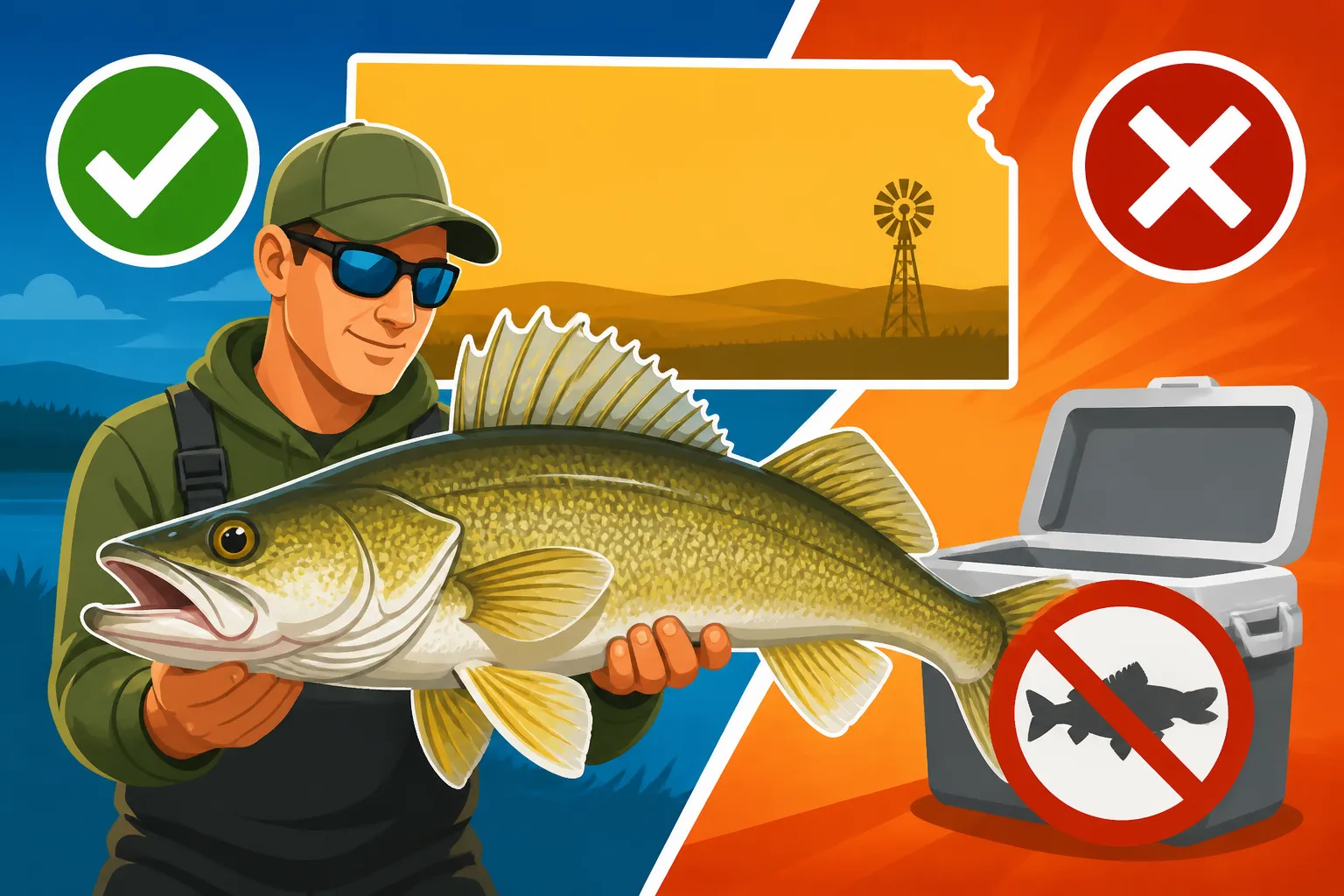
For many of Kansas's premier walleye fisheries, the answer to keeping a trophy walleye over 21 inches is often no, or at the very least, highly restricted. This is primarily due to what's known as a "protected slot limit" or a "maximum length limit" designed to safeguard the larger, more mature walleye that are crucial for successful spawning and maintaining healthy fish populations.
Understanding Statewide vs. Lake-Specific Regulations
One of the biggest sources of confusion for anglers is the difference between statewide regulations and specific lake rules. While there might be a general guideline for walleye across Kansas, many individual lakes, especially our larger reservoirs like Milford Lake or Cheney Reservoir, will have their own unique sets of rules. These lake-specific regulations often supersede the general statewide ones to address the particular needs of that fishery.
For example, a common regulation pattern for walleye in Kansas might involve a slot limit where all walleye between, say, 15 and 21 inches, must be immediately released. This means you can keep fish under 15 inches (if the local rule allows for a harvest of smaller fish, which isn't always the case for walleye) and, if specified, only one fish over 21 inches as part of your daily creel limit. However, for many of our prime trophy walleye waters, the rule is even stricter: any walleye over 21 inches must be released. This is where the confusion often lies because the 21-inch mark can function as both a lower or upper boundary depending on the specific water. It’s absolutely vital to check the current regulations for the specific lake you are fishing before you even cast a line. You can usually find these detailed rules in the Kansas Fishing Regulations Summary. Kansas Fishing Regulations Explained can give you a deeper dive into how these rules are structured.
Common Walleye Length Limit Scenarios
Let’s talk specifics because it's never a one-size-fits-all situation. You might encounter a few different scenarios when it comes to walleye length limits in Kansas:
- Minimum Length Limit: This is straightforward. All walleye under a certain size (e.g., 15 inches, 18 inches) must be released. You can only keep fish above that minimum. This is often paired with a daily creel limit. You might find this rule where the goal is to protect sub-adult fish and allow them to grow.
- Protected Slot Limit: This is probably the most common scenario for trophy walleye management. Here, fish within a certain size range (e.g., 15-21 inches) are protected and must be released. This allows smaller fish to be harvested (if there's a minimum allowing it) and, crucially, protects the prime spawning-sized fish. Often, if a slot exists, you might be allowed to keep one fish over the upper end of the slot as part of your daily limit. However, sometimes the slot includes the largest fish, meaning anything over the upper limit (like 21 inches) must be released too.
- Maximum Length Limit: This is less common as a standalone rule for walleye but sometimes combined with a minimum. For example, you might be allowed to keep walleye between 15 and 21 inches, but anything over 21 inches must be released. This specifically protects those true lunkers to ensure they continue to contribute to the gene pool.
- No Length Limit: Very rare for walleye, but it can exist in certain unique situations, often where populations are overabundant, or the species is less of a management priority. Don't count on this for walleye, especially trophy-sized ones!
As you can see, that 21-inch mark is consistently a critical point in these regulations. For a clearer picture, check out Kansas Walleye Length Limits and Kansas Walleye Daily Limit of Two Fish.
Here’s a quick glance at how length limits often work for walleye:
| Regulation Type | Example Rule (Hypothetical) | What it Means for an Angler | Impact on Trophy Walleye (21+ inches) |
|---|---|---|---|
| Minimum Length Limit | 15-inch minimum, 5 fish daily limit | Any walleye under 15 inches must be released. You can keep up to 5 fish that are 15 inches or longer. | You can keep a trophy walleye over 21 inches, as it meets the minimum. |
| Protected Slot Limit | 18-21 inch protected slot, 2 fish daily limit | All walleye between 18 and 21 inches must be released. You can keep 2 fish, but only one of those can be over 21 inches, and the other must be under 18 inches. | You can keep one trophy walleye over 21 inches, but any others you catch must be released. |
| Maximum Length Limit | 21-inch maximum, 2 fish daily limit | All walleye over 21 inches must be released. You can keep 2 fish, both of which must be 21 inches or less. | You cannot keep a trophy walleye over 21 inches; they must all be released. |
| No Harvest Over X Inches | 15-21 inch harvest slot, 1 fish daily limit, no harvest over 21 inches | You can keep one walleye that is between 15 and 21 inches. Any walleye under 15 inches or over 21 inches must be released. | You cannot keep a trophy walleye over 21 inches, they are protected. This is a common setup for some of our premier trophy lakes. |
Remember, these are illustrative examples. Always, always check the current regulations for the specific body of water you intend to fish.
Why Trophy Walleye Are Protected in Kansas
It might feel a bit disheartening to have to release that monster walleye you worked so hard for, but these regulations aren't put in place to frustrate you. Quite the opposite, actually. They are carefully crafted by fisheries biologists to ensure the long-term health and vitality of our walleye populations. There’s some real science and a lot of passion behind these rules. If you've ever wondered Why the Kansas Walleye Limit Is Only Two Fish, this section will shed some light on the deeper reasons.
The Role of Spawners
Those big walleye, especially the females, are incredibly valuable to the ecosystem. They are the prime spawners, producing the most eggs and often having the best genetic material for future generations. When you take out a large number of these big fish, you significantly reduce the reproductive potential of the lake. It's like removing the star players from a championship team – it hurts the entire lineup.
By protecting walleye over a certain size, like 21 inches, fisheries managers aim to:
- Increase Spawning Success: More large, healthy spawners mean more eggs laid and a better chance for a robust hatch of young walleye.
- Maintain Genetic Diversity: These older, larger fish have proven their ability to survive and thrive, passing on those strong genes to their offspring.
- Enhance Age Structure: A healthy fishery has a good mix of fish of all ages. Protecting trophy-sized fish helps ensure there are always some "grandparent" fish in the water, which can even help guide younger fish to prime foraging and spawning areas.
It's a delicate balance, trying to provide angling opportunities while also safeguarding the future of the fishery, and sometimes that means making tough decisions about what we can and cannot keep.
Creating a World-Class Fishery
Kansas wants to be a destination for walleye anglers, and that means managing for quality, not just quantity. If every angler kept every large walleye they caught, it wouldn't be long before the population of truly big fish dwindled, and the fishing experience would suffer for everyone.
Think about it this way: protecting those trophy-sized fish ensures that there are always a few giants lurking, giving every angler the chance to hook into a true lunker. It creates the excitement and the potential for a "fish of a lifetime" encounter, even if that encounter ends with a respectful release. This strategy has proven successful in developing and maintaining fisheries that consistently produce big fish, drawing anglers from all over. It’s all about creating and sustaining that "trophy potential" that makes fishing so thrilling.
What to Do When You Catch a Big Walleye
So, you’ve hooked into that magnificent walleye, well over the typical 21-inch threshold, and the regulations for your specific lake say you have to let it go. Don't fret! This isn't the end of the story; it's an opportunity. Catching and releasing a trophy fish, especially a species as prized as a walleye, is an art form in itself, and it’s incredibly rewarding. It’s a chance to truly appreciate the fish and contribute to the fishery's future.
Responsible Catch and Release Practices
The key to a successful release is minimizing stress and injury to the fish. Here are some critical steps to ensure that trophy walleye swims away strong:
- Land it Quickly: Don't play the fish to exhaustion. Try to bring it in as efficiently as possible to reduce stress.
- Use the Right Gear: Heavy enough line and a sturdy rod will help you land the fish faster. A good quality net with a rubberized, knotless mesh is essential for protecting the fish's slime coat and fins. You can find excellent options for nets on Amazon.
- Minimize Air Exposure: A walleye needs water to breathe. Keep it in the water as much as possible. If you need a photo, get your camera ready before you lift the fish, snap quickly, and then return it to the water. A good practice is to keep at least part of the fish submerged during photos.
- Handle with Care: Support the fish horizontally, especially those larger ones. Avoid holding them vertically by the jaw, as this can damage their internal organs and spine. Use wet hands to avoid removing their protective slime layer.
- Remove Hooks Gently: Use needle-nose pliers or a de-hooking tool to remove the hook quickly. If the fish is deeply hooked, especially in the gills, it might be best to cut the line as close to the hook as possible. The hook will often rust out, or the fish's body will encapsulate it.
- Revive Properly: Hold the fish gently in the water, facing into any current. If there’s no current, move it back and forth slightly to push oxygenated water over its gills. Only release it when it can swim away under its own power. You’ll feel it start to kick strongly.
Practicing these techniques ensures that your moment of triumph doesn't become a death sentence for a valuable breeder fish.
Capturing the Memory
Just because you can't put a 21-inch-plus walleye on the dinner table doesn't mean you can't preserve the memory. In fact, many anglers find catch-and-release photography and replica mounts to be even more fulfilling.
- The Perfect Photo: As mentioned, minimize air time. Get a buddy to help if possible. Use a wide-angle lens if you have one to make the fish look even bigger. Ensure the fish is wet and healthy-looking. A good camera and a waterproof phone case are essential, and you can find many great accessories for outdoor photography on Amazon.
- Replica Mounts: Many taxidermists specialize in creating incredibly lifelike replica mounts based on photos and measurements. You can measure the fish's length and girth (a soft tape measure is helpful for this) before releasing it, and then work with a taxidermist to create a stunning mount for your wall. This way, the fish lives to spawn another day, and you still get to admire its beauty for years to come. This is truly the best of both worlds for a trophy catch.
Beyond the Limit: Strategies for Consistently Catching Walleye
Understanding the regulations, especially around that crucial 21-inch mark, allows you to shift your focus from harvesting every fish to enjoying the challenge and thrill of the catch. Kansas offers incredible walleye fishing, and by adapting your strategies, you can consistently hook into these prized fish, whether they're destined for the frying pan or a respectful release.
Mastering Walleye Fishing Techniques
The Kansas walleye fishery is diverse, requiring a versatile approach. Focusing on proven Kansas Walleye Fishing Techniques will drastically increase your success rate, regardless of length limits.
- Trolling: This is a classic for a reason. Covering water with crankbaits or spinner rigs is incredibly effective, especially on our larger reservoirs. Vary your speed, depth, and lure color until you find what the walleye are keying into. Different depths often require different lures; shallow running cranks for shallower fish, and deep divers or even lead core for those suspended in the thermocline. A good fish finder is invaluable for identifying baitfish schools and structure, and there are many high-quality, user-friendly models available on Amazon that can instantly elevate your trolling game.
- Jigging: When walleye are concentrated on structure like humps, points, or rocky reefs, jigging can be deadly. Both vertical jigging with a spoon or a soft plastic, and pitching jigs to cover, are highly effective. Pay attention to the retrieve – sometimes a slow, deliberate lift-and-drop is best, while other times a more aggressive snap-jigging motion triggers strikes.
- Live Bait Rigs: Nothing beats live bait in certain situations. Shiners, nightcrawlers, and leeches on a Lindy rig, bottom bouncer, or slip bobber can be irresistible. This is often a slower, more methodical approach, but it can shine when fish are finicky. Focus on presentation and keeping your bait in the strike zone. If you're looking for the best bait options, Best Lures for Kansas Walleye covers both artificial and live bait choices.
Targeting Key Walleye Habitats
Walleye are structure-oriented fish, and understanding their preferred habitats at different times of the year is crucial.
- Spring: During the spawn and post-spawn, walleye will be found near rocky areas, riprap, and shallower points. They seek out these hard-bottomed areas for spawning and then often retreat to nearby deeper water or flats to recover and feed.
- Summer: As waters warm, walleye often move deeper to cooler, more oxygenated water. Look for them on main lake points, submerged humps, ledges, and channels. They'll frequently relate to baitfish schools in open water or along contours. Night fishing can be particularly effective in summer when walleye move shallower to feed.
- Fall: Walleye begin to feed heavily in the fall, bulking up for winter. They can be found shallower again, often on rocky points, flats, and around submerged timber, chasing schools of baitfish. This can be a fantastic time for both trolling and casting.
- Winter: If conditions allow for Kansas Ice Fishing Guide, walleye can be caught through the ice on deeper points, humps, and flats. They become less active but can still be tempted with small jigs, spoons, and live bait.
Understanding these seasonal movements and using resources like Best Walleye Lakes in Kansas will put you in the right spots at the right times. Always remember that conditions can change rapidly in Kansas, so being adaptable is key to consistent success.
Disclaimer
This article is for general informational purposes only and does not constitute professional advice. Laws, prices and regulations vary by location and change over time. Consult a qualified professional for guidance on your specific situation.