How to Fish a Current Seam for Catfish
It's a common frustration for many Kansas anglers: you're out on the river, the current is ripping, and you're just not finding the catfish. You might be casting your line into what seems like good water, but the bites just aren't coming. The truth is, catfish in rivers aren't just scattered everywhere; they're masters of efficiency, and they gravitate towards specific areas that offer both food and a break from the relentless flow. This guide will shine a light on one of those critical spots – the current seam – explaining what it is, how to pinpoint these prime locations in Kansas rivers, and the precise techniques you can use to consistently put channel cats, blue cats, and flatheads in your cooler.
Understanding the Catfish's Home: What Exactly is a Current Seam?
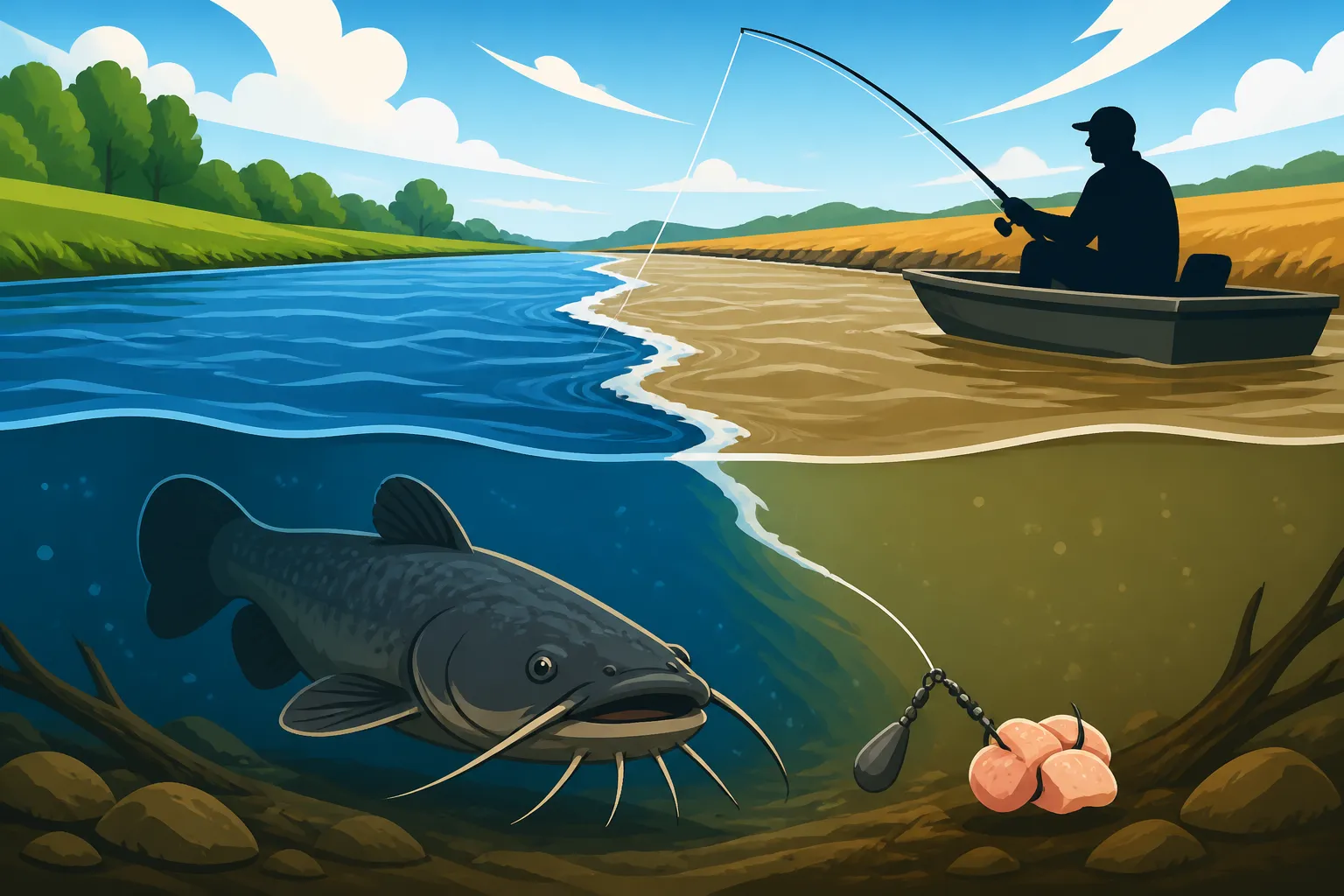
When we talk about fishing in a river, the first thing that often comes to mind is just "current." But not all current is created equal, and understanding the nuances of how water moves is absolutely key to unlocking consistent success, especially when you're targeting catfish. A "current seam" isn't some secret, hidden spot only known to a select few; it's a dynamic, visible, and highly productive area that forms naturally wherever fast-moving water meets slower water. Think of it as a watery highway median, where traffic is flowing in different lanes at different speeds.
The Dynamics of Flow: Where Fast Meets Slow
Imagine a river like the Kansas River after a good rain, pushing a strong flow. Now, picture that flow encountering an obstacle: maybe a big rock, a fallen tree limb, a bridge piling, or even just a natural bend in the riverbank. On one side of that obstruction, the water will be rushing past, creating a zone of high velocity. But directly behind or to the side of that obstruction, the water will slow down, often creating an eddy or a calmer pocket. The distinct line where that fast water brushes up against the slower water – that's your current seam.
These seams aren't always dramatic whirlwinds; sometimes they're subtle, just a slight difference in the ripple pattern on the surface, or a faint line of foam and debris collecting where the two current speeds diverge. But for a catfish, that subtle line is a five-star dining experience combined with a comfortable resting lounge. These transitional zones are absolutely critical to how catfish navigate, feed, and conserve energy in a river system. In many Kansas rivers, like the Republican River or the lower reaches of the Arkansas River in the state, these seams are constantly forming and shifting, making them dynamic targets that require a keen eye and a good understanding of river dynamics.
Why Catfish Love Current Seams
So, why are these current seams such magnets for catfish? It all boils down to survival, efficiency, and opportunity:
- Energy Conservation: Fighting a strong current all day is exhausting, even for a powerful fish like a blue cat. A current seam allows catfish to hold just out of the main flow in the slower water, expending minimal energy, while still being perfectly positioned to dart out into the faster water when an opportunity arises. It's like having a comfortable armchair right next to a buffet line.
- Ambush Points: These seams act as natural conveyor belts for food. As baitfish, insects, and other organic debris tumble downstream in the faster current, many of them get swept into the slower water of the seam. Catfish can sit patiently in the slack water and simply wait for their next meal to be delivered directly to them. It's an ideal ambush point, making it a prime location for those seeking to maximize their chances.
- Oxygenation: Generally, areas with good current flow tend to be well-oxygenated. While catfish are hardy and can tolerate lower oxygen levels than some other species, they still prefer healthy, oxygen-rich water, especially when they are actively feeding. Current seams typically provide this ideal environment.
- Cover and Structure: Current seams often form around natural or man-made structures – submerged logs, rock piles, brush, bridge pilings, or sharp drop-offs. These structures provide vital cover, offering protection from predators and a sense of security for the catfish. This combination of current break, food source, and cover makes current seams irresistible to these whiskered fish.
Becoming a River Detective: Identifying Current Seams in Kansas Waters
Knowing what a current seam is intellectually is one thing; actually finding one on a river is another. It requires a bit of patience, a keen eye, and sometimes a good feel for the water. In Kansas, where rivers can vary from wide, slow-moving stretches to faster, more dynamic flows, learning to "read the water" is an indispensable skill for any serious catfish angler.
Visual Cues: Reading the Water's Surface
The surface of the water often tells a story if you know how to interpret it. Here are some key visual cues to look for when trying to spot a current seam:
- Confluence of Currents: Look for where two distinct bodies of water meet, such as a smaller creek flowing into a larger river. The point where these two currents merge will almost always create a pronounced seam. Similarly, watch for major bends in a river where the main flow hugs the outside bank, leaving an eddy or slower water on the inside bend. These are classic spots for Kansas River Catfish Spots.
- Obstructions and Structure: Any object that disrupts the main flow of the current will create a seam. This could be obvious things like bridge pilings, wing dams, or submerged rock piles. But don't overlook less obvious structures like a single large boulder, a cluster of fallen trees (known as a "snag"), or even a natural point of land jutting out into the river. The water immediately downstream and to the side of these structures will often be considerably calmer, forming a seam.
- Foam Lines and Debris: One of the easiest ways to spot a seam is to look for lines of foam, leaves, small sticks, or other floating debris. These items tend to collect along the boundary where fast and slow water meet. If you see a distinct line of floating material that runs parallel to the bank or along an obstruction, you've likely found a current seam. These "trash lines" are literal food lines for catfish, concentrating bait and other edibles.
- Ripple Patterns and Water Color Changes: Sometimes, the difference in current speed will manifest as a subtle change in the ripple pattern on the water's surface. One area might have a choppier, more agitated surface, while right next to it, the water is smoother. Occasionally, especially after rain, you might even notice slight differences in water color or clarity where a dirtier, faster current meets a slightly clearer, slower one.
Subsurface Secrets: Using Electronics and Your Hands
While visual cues are great, especially for bank anglers or those in smaller boats, sometimes the most productive current seams are hidden beneath the surface. This is where modern technology and a good "feel" for your line come into play.
- Fish Finders and Sonar: If you're fishing from a boat on a larger Kansas reservoir or river, a good fish finder is invaluable. Use your sonar to identify underwater structures like humps, channels, drop-offs, and submerged timber. Current seams will frequently form along these topographical changes. For instance, a long, submerged point extending into the river will create a current break and seam along its edges. Look for depth changes and concentrated baitfish or larger fish arches hugging these subsurface breaks. Best Fish Finder for Kansas Reservoirs can help you scout these underwater features.
- Tactile Feel: Reading Your Line: Even without fancy electronics, you can "feel" current seams. When you cast your bait into the water, pay close attention to how your line feels. As your weight hits the bottom and drifts, you'll feel the drag of the current on your line. When your bait crosses into a slower current zone, you'll notice a distinct reduction in that drag or a change in how your weight "hops" along the bottom. Conversely, moving from slow to fast water will cause your line to tighten and your weight to move faster. This sensitivity is particularly useful when How to Catch Channel Catfish From the Bank where you don't have a fish finder.
- Probe Poles or Heavy Weights: For those fishing from a boat in shallower river sections, a long probe pole can be used to physically feel for changes in depth, submerged snags, or rock piles that might create current breaks. Alternatively, a heavy lead weight on a separate line can be slowly dragged along the bottom to map out the contours and identify where the current changes.
Equipping for Success: Gear and Bait for Current Seam Catfishing
Once you've identified those promising current seams, the next step is to make sure you have the right tools to present your bait effectively and land those powerful river cats. Fishing in current requires robust gear that can handle the extra strain and the potential for larger, harder-fighting fish.
Rods, Reels, and Line: Building Your Foundation
Your foundational gear needs to be up to the task of battling strong current and even stronger fish.
- Rods: Opt for heavy-action rods, typically 7 to 9 feet in length. The extra backbone is crucial for casting heavy weights, setting hooks into tough mouths, and muscling big catfish out of strong currents or snags. A medium-heavy action might suffice for smaller channel cats in less intense current, but for serious river catfishing, go beefy.
- Reels: Look for baitcasting reels or robust spinning reels with a high line capacity and a smooth, powerful drag system. Catfish can make incredibly strong runs, especially in current, and a subpar drag will quickly lead to broken lines or lost fish. Durability and cranking power are key. For excellent options, you can browse Amazon's selection of catfish-specific reels.
- Line: This is where many anglers make a mistake by going too light. For fishing current seams, you'll want strong, abrasion-resistant line.
- Monofilament: A heavy monofilament line, typically 20-40 pound test, offers good abrasion resistance and a bit of stretch, which can be forgiving.
- Braided Line: Many experienced catfishermen prefer braided line, in the 50-80 pound test range. It has virtually no stretch, providing excellent sensitivity to detect subtle bites in current, and incredible strength for pulling fish out of cover. Just be aware that braid can be more prone to snagging on sharp objects.
- Leader Material: Regardless of your main line, it's often wise to use a heavy monofilament or fluorocarbon leader (e.g., 50-80 lb test) tied to your main line. This provides an extra layer of abrasion resistance against rocks and logs, and if you get snagged, you might only lose your hook and weight, not your entire rig. Learn more about optimal choices in Best Line Weight for Kansas Catfish.
Terminal Tackle: The Essential Connections
The business end of your fishing setup needs to be just as robust as your rod and reel.
- Hooks: When it comes to catfish, circle hooks are your best friend. They are incredibly effective at hooking fish in the corner of the mouth, leading to fewer gut hooks and easier releases if you're practicing catch and release. For channel cats, sizes 2/0 to 5/0 are good. For larger blue cats and flatheads, step up to 6/0 to 10/0. Look for heavy-gauge wire hooks that won't straighten under pressure. Amazon has a great variety of circle hooks in bulk packs. You can get more specific insights in Best Hook Size for Channel Catfish.
- Weights (Sinkers): This is absolutely critical for fishing current. You need enough weight to hold your bait firmly on the bottom in the desired location within the current seam.
- Pyramid Sinkers: Excellent for digging into the bottom and holding in current.
- No-Roll or Flat Bank Sinkers: Also good for holding bottom and resisting rolling in the current.
- Sliding Sinkers: Often preferred for Carolina rigs, allowing the fish to pick up the bait without immediately feeling the weight.
- You'll typically need sinkers ranging from 1 ounce to 6 ounces or more, depending on the current strength. Always carry a variety! Read about different setups in Best Slip Sinker Rig for Catfish.
- Swivels and Beads: A quality barrel swivel or a heavy-duty three-way swivel is essential for preventing line twist and connecting different components of your rig. Beads are often used to protect knots from sliding sinkers.
Bait Choices: What Catfish Really Want
Catfish are opportunistic eaters, but certain baits consistently outperform others, especially in current.
- Fresh Cut Bait: This is often king for channel cats and blue cats. Shad, carp, skipjack herring, or even freshly caught sunfish cut into chunks or strips release enticing oils and scent into the current, drawing catfish from downstream. Make sure your bait is fresh; rotten bait is usually less effective than fresh, even for catfish. What Channel Catfish Eat Lakes gives you more insights.
- Stink Baits: Commercial stink baits, punch baits, and dip baits can be incredibly effective for channel catfish. These baits are designed to disperse a powerful scent trail in the water. For optimal performance in current, use a bait holder designed for these sticky baits.
- Live Bait: For trophy flatheads, live bait is often the preference. Small sunfish (bluegill, green sunfish), shad, or small suckers hooked through the back or lips are prime choices. Make sure to check Kansas Fishing Regulations Explained for rules on baitfish collection.
- Prepared Baits: While not always as effective in strong current, baits like chicken livers (secured with mesh) or hot dogs can still catch channel cats, particularly in slower moving seams.
- When choosing bait, always consider what's available locally and what the fish in that particular body of water are accustomed to eating. You can often find specialty bait holders or bait nets for catching your own fresh bait on Amazon. Don't forget to review Best Bait for Kansas Catfish for more detailed recommendations.
Mastering the Presentation: Techniques for Fishing Current Seams
You've found the seam, you've got your gear and bait ready. Now, how do you actually fish it? Presenting your bait effectively in a current seam is an art form that separates successful river anglers from those who struggle. It's all about precision, patience, and understanding how the current interacts with your rig.
Anchoring and Positioning: Setting Up for the Strike
Correct positioning is paramount, whether you're fishing from a boat or the bank. The goal is always to get your bait into the "strike zone" of the current seam and keep it there.
- From a Boat:
- Upstream Anchor: Often, the most effective method is to anchor your boat upstream from the current seam you intend to fish. This allows you to cast your bait downstream into the seam, letting the current carry your bait naturally into the fish's feeding lane. This simulates a piece of food drifting by.
- Downstream Anchor (for specific situations): Sometimes, anchoring directly downstream of a seam, particularly a strong eddy, can work. You'd cast upstream into the seam, and your bait would then settle and hold. This is less common but can be useful for very specific spots.
- Multiple Rods: If legal and manageable, consider setting out multiple rods at slightly different distances or angles into the seam to cover more water and identify the "sweet spot."
- From the Bank:
- Scouting is Key: For bank anglers, scouting along the river to find those visible seams (foam lines, eddy lines) is critical. Look for areas where the bank creates an obstruction or a natural bend, slowing the current.
- Casting Upstream: Just like from a boat, casting slightly upstream of the seam and letting your heavily weighted bait wash down into the calmer water is a solid strategy. This method for How to Catch Channel Catfish From the Bank ensures a natural presentation.
The Art of the Cast and Presentation
Once positioned, your casting and how you present your bait makes all the difference.
- Targeting the Seam: Aim your cast so your bait lands just upstream of where you believe the seam is. This gives your weight time to sink and settle into the slower water of the seam as it drifts. You want your bait to come to rest within the seam, not get swept away by the faster current.
- Heavy Weights Are Your Friend: Don't be shy with your sinkers. If your bait is constantly rolling or drifting out of the seam, you need more weight. The idea is to have your bait firmly anchored to the bottom, right where the catfish are waiting.
- Feeling the Bite in Current: Bites in current can feel different. Sometimes it's a sharp, unmistakable thump. Other times, it might just be a subtle twitch or an increased "heaviness" on your line as a fish picks up the bait and turns. With braided line, the enhanced sensitivity can really help. Pay close attention to any changes in the consistent pull of the current on your line.
- Carolina Rig or Three-Way Swivel Rig: These are two of the most popular and effective rigs for catfishing in current.
- Carolina Rig: A sliding sinker (like an egg sinker or no-roll sinker) on your main line, followed by a bead, then a swivel, and finally a leader to your hook. This allows the fish to take the bait without immediately feeling the weight of the sinker.
- Three-Way Swivel Rig: One eye of the swivel goes to your main line, another to a short leader with a weight, and the third to a longer leader with your hook. This keeps your bait slightly off the bottom and can be very effective in areas with snags, as the weight might break off without losing your whole rig. These techniques are often highlighted in Kansas Catfish Fishing Techniques.
Specialized Approaches: Trotlines and Jug Fishing
While not traditional rod-and-reel methods, trotlines and jug fishing are deeply rooted in Kansas catfishing culture and often leverage current seams, channels, and structure to catch fish efficiently. They are particularly effective when targeting Kansas Flathead Catfish Daily Limit or a good number of channel cats.
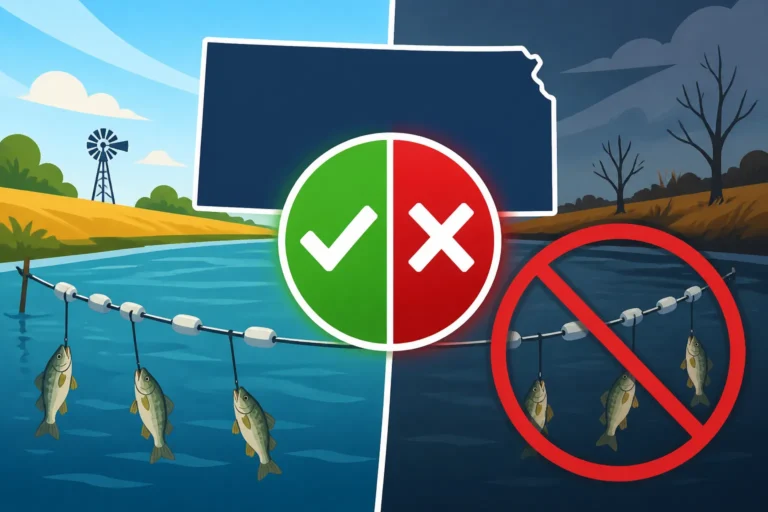
- Trotlines: A trotline consists of a main line stretched across a section of river or lake, with multiple baited hooks attached at intervals on shorter droppers. Anglers often set trotlines along the edges of channels, near submerged structure, or precisely where current seams form. The goal is to place hooks where cruising catfish are likely to encounter them as they move along these current breaks. Regulations are strict, so always refer to Kansas Trotline and Jug Fishing Rules before deploying one.
- Jug Fishing: This method involves individual lines with hooks attached to floating jugs or bottles. The jugs drift with the current, often along natural current seams, carrying the baited hooks through prime catfish territory. When a fish bites, the jug starts to bob and move, signaling a strike. This can be a very active and exciting way to fish for catfish, especially on larger rivers and reservoirs with expansive current seams. Again, check local regulations.
Remember, consistent success in fishing current seams for catfish comes with practice. The more time you spend on the water observing, casting, and feeling for those subtle changes, the better you'll become at identifying and effectively fishing these highly productive spots. And don't forget to always respect the river and its power.
Disclaimer
This article is for general informational purposes only and does not constitute professional advice. Laws, prices and regulations vary by location and change over time. Consult a qualified professional for guidance on your specific situation.