Best Fish Finder for Deep Reservoirs
For many Kansas anglers, the vast, deep expanses of our state's reservoirs can feel like a complete mystery. You know there are big fish out there—walleye, crappie, catfish, and even the mighty striped bass—but actually finding them in hundreds of feet of water, especially when they're suspended or tucked into deep structure, feels like trying to find a needle in a haystack. This guide is all about demystifying that challenge, helping you understand what makes a fish finder truly effective for our deep Kansas reservoirs, so you can spend less time guessing and more time reeling in your next trophy.
Why a Specialized Fish Finder is Essential for Deep Kansas Reservoirs
Fishing deep reservoirs in Kansas presents a unique set of challenges that can quickly frustrate even seasoned anglers. Unlike shallow ponds or rivers where you might visually identify structure or rely on subtle changes in depth, large impoundments like Milford Lake, Wilson Lake, or Cheney Reservoir hide their secrets well beneath the surface. Standard, entry-level fish finders often struggle to penetrate these depths with clarity, leaving you with a fuzzy, uninformative screen that doesn't help you locate fish or understand the bottom contour.
Think about it: when you're out on the water, battling the wind and current, the last thing you want is a screen showing you a vague blob when you're trying to pinpoint a school of Kansas Walleye Length Limits holding tight to a submerged ridge at 40 feet. A specialized deep-water fish finder isn't just a fancy gadget; it's a critical tool that provides the underwater vision you need to interpret the aquatic landscape and zero in on productive areas. It turns guesswork into informed decision-making, transforming your fishing experience from hopeful casting to strategic targeting.
Overcoming Depth and Clarity Challenges
The sheer volume of water in our larger reservoirs—like the expansive Milford Lake, often called the "Fishing Capital of Kansas"—means that light doesn't penetrate very far, making visual scouting impossible past a few feet. Furthermore, the water column can hold thermoclines, different layers of water temperature that fish often relate to, and these can be tricky for less powerful sonar units to interpret accurately.
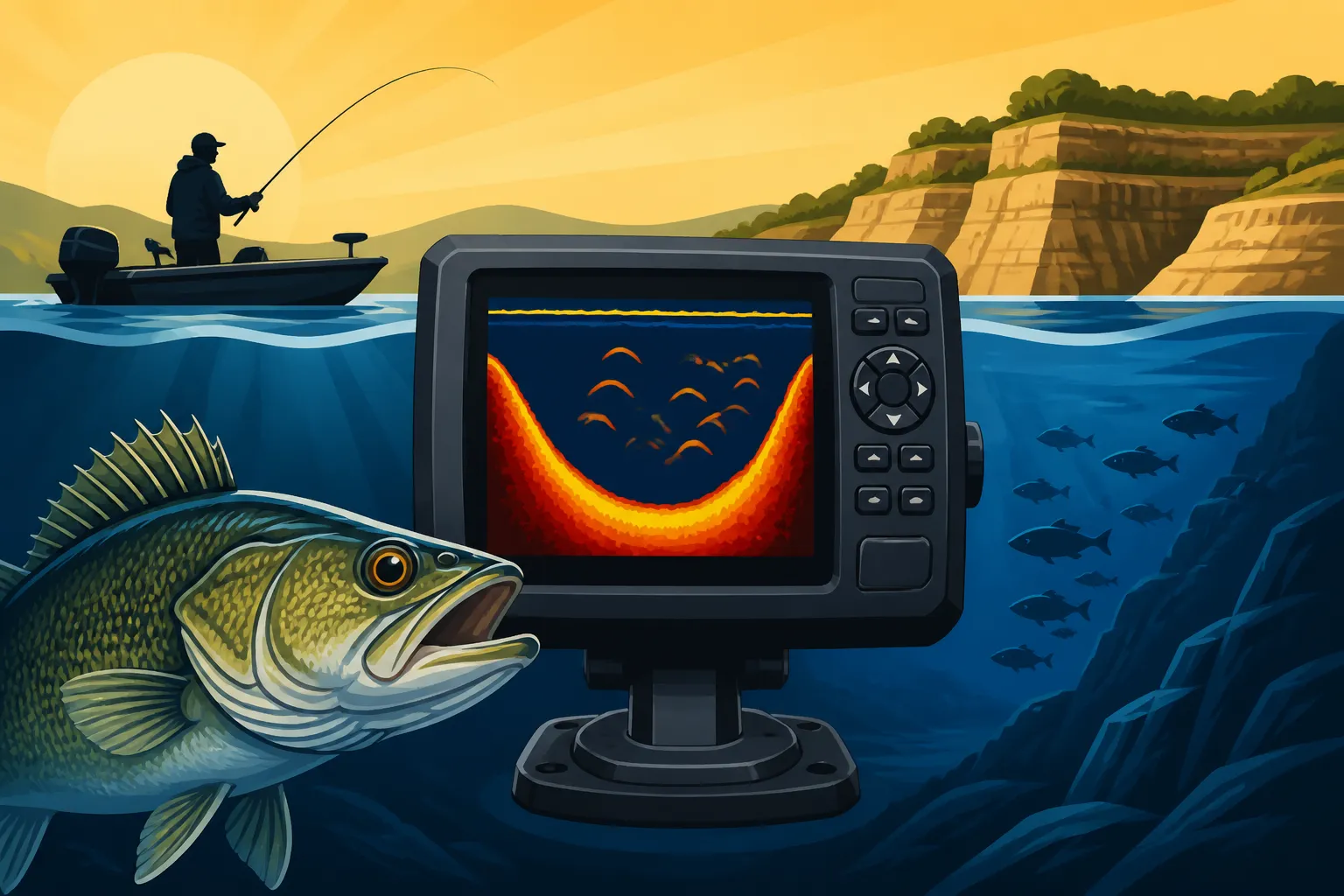
A robust fish finder with high-power transducers and advanced sonar technologies is designed to cut through these conditions. It uses stronger signals and more sensitive receivers to bounce sound waves off the bottom and return a clear, detailed picture, even when that bottom is 100 feet or more down. This clarity is paramount for identifying subtle changes in structure, seeing individual fish arcs, and even distinguishing baitfish from larger predators. Without this specialized equipment, you're essentially fishing blind, hoping for a chance encounter rather than actively pursuing your quarry.
Identifying Structure and Fish in the Deep
Fish in deep reservoirs don't just swim around randomly; they orient themselves to structure, currents, and baitfish. This could be a submerged creek channel, a steep drop-off, a rock pile, or even standing timber from when the reservoir was flooded. Knowing what lies beneath your boat is the key to consistent success. For example, understanding Kansas Walleye Fishing Techniques often involves finding specific structural elements where these fish ambush prey.
A good deep-water fish finder allows you to map these underwater features with incredible precision. You can see how a point extends into deeper water, where a hump rises from the bottom, or where a brush pile offers cover for crappie. More importantly, it helps you identify the fish themselves, showing their size, depth, and even their movement patterns. This insight means you're not just casting into open water; you're casting to a known target, greatly increasing your chances of a bite.
Essential Features for a Deep-Water Fish Finder
When you're looking to conquer the depths of Kansas reservoirs, you can't just pick any fish finder off the shelf. You need specific features that are engineered for performance in deeper water. This isn't about having every bell and whistle, but rather focusing on the core capabilities that will give you a real advantage.
Transducer Power and Frequency
The transducer is the heart of your fish finder, sending and receiving the sonar signals. For deep water, power is critical. Measured in RMS (Root Mean Square) wattage, higher power means the signal can penetrate deeper and return a stronger echo. Look for units with at least 500W RMS, with 1000W or more being ideal for consistently clear images in very deep conditions.
Frequency is another vital component. Lower frequencies (like 50 kHz) excel at deep-water penetration, offering a wider cone angle that covers more area beneath the boat, albeit with less detail. Higher frequencies (like 200 kHz) provide much finer detail and target separation but lose effectiveness in extreme depths. Many top-tier fish finders offer dual-frequency or CHIRP sonar, which cycles through a range of frequencies to give you the best of both worlds—excellent depth penetration with impressive detail and target separation. For example, when trying to find schools of Kansas Crappie Length and Bag Limits suspended in timber, that detail makes all the difference.
| Feature | Low Frequency (e.g., 50 kHz) | High Frequency (e.g., 200 kHz) | CHIRP Sonar |
|---|---|---|---|
| Depth Penetration | Excellent | Limited (best for shallower water) | Excellent (combines depth with detail) |
| Cone Angle | Wider | Narrower | Variable, optimized for detail and coverage |
| Detail/Resolution | Lower (good for general bottom contour) | Higher (good for target separation) | Very High (distinct fish arches, fine detail) |
| Target Separation | Moderate | High | Excellent (can distinguish individual fish) |
| Ideal Use | Deep water, wide area scanning | Shallow to medium water, precise targeting | All depths, high-resolution imaging |
High-Resolution Display and GPS Mapping
A powerful transducer is useless without a display that can translate the raw data into a clear, understandable image. For deep reservoirs, look for a screen with high pixel resolution. More pixels mean a sharper image, allowing you to discern subtle details like a faint thermocline, individual baitfish, or a fish hugging the bottom. Screen size is also a consideration; while portability is nice, a larger screen often enhances readability, especially when split-screening with other functions.
Integrated GPS mapping is almost non-negotiable for deep reservoir fishing. Our Kansas reservoirs are massive, and being able to mark waypoints, track your path, and navigate back to productive spots is invaluable. Look for units that come pre-loaded with detailed lake maps or allow you to upload high-definition bathymetric charts. This feature will help you understand the underwater topography, mark those submerged channels and humps you find, and revisit them easily. When you find a productive channel Kansas Channel Catfish Daily Limit are using, marking it with GPS means you can return to it again and again. You can compare options from various brands on a platform like Amazon or see them in person at a Bass Pro Shops.
Advanced Sonar Technologies
Beyond traditional 2D sonar, modern fish finders incorporate several advanced technologies that greatly enhance your view of the underwater world.
- CHIRP Sonar: As mentioned, CHIRP (Compressed High-Intensity Radiated Pulse) sends a range of frequencies instead of a single one. This results in much better target separation, clearer images, and superior deep-water performance compared to traditional fixed-frequency sonar. It's often considered the gold standard for all-around performance.
- Down Imaging/ClearVü/DownScan: These technologies (brand names vary, but the concept is similar) use a high-frequency, thin, fan-shaped beam to create photo-like images directly below your boat. This is fantastic for identifying specific structures like brush piles, submerged trees, or rock formations with incredible detail, helping you distinguish a submerged stump from a large fish.
- Side Imaging/SideVü/SideScan: Taking it a step further, side imaging beams scan out to the sides of your boat, giving you a picture of what's happening to your port and starboard. This is revolutionary for covering large areas quickly and finding structure or schools of fish that you might otherwise drive right over. Imagine scanning a long bank on Wilson Lake and spotting a brush pile 50 feet to your left holding a school of crappie – that's the power of side imaging. This technology helps you quickly scout potential areas before you even get close.
Getting the Most Out of Your Deep Reservoir Fish Finder
Simply having a top-tier fish finder isn't enough; you need to know how to set it up, interpret the information it provides, and integrate it into your fishing strategy to truly leverage its capabilities in our Kansas waters.
Proper Installation and Transducer Placement
The best fish finder in the world won't perform optimally if it's not installed correctly. Transducer placement is paramount, especially for deep-water performance. For transom-mount transducers, ensure it's mounted in clean, turbulence-free water, typically on the lowest part of the transom. A common mistake is mounting it too high or in an area where air bubbles from the hull interfere with the signal, causing a weak or fuzzy return.
For in-hull or through-hull transducers, which are popular for deeper water and higher speeds, proper adhesion and placement inside the boat's hull are crucial. Any air bubbles or imperfections in the epoxy can severely degrade performance. If you're unsure, it's often worth having a professional handle the installation, especially for more complex systems. Remember that if you're out on a boat, you'll also need to consider Kansas Boat Registration Guide rules.
Mastering Settings and Interpretation
Modern fish finders come with a dazzling array of settings. While it can be tempting to just leave them on "auto," tweaking these settings can significantly improve your view, particularly in challenging deep-water scenarios.
- Sensitivity/Gain: This controls how strong of an echo the unit will display. Too low, and you'll miss faint targets; too high, and you'll get screen clutter. Adjust it gradually until you see a clear bottom and distinct fish arches without too much noise.
- Color Palette: Experiment with different color palettes. Some offer better contrast for specific conditions or personal preference, making fish and structure pop more clearly on screen.
- Scroll Speed: Adjusting the scroll speed to match your boat speed can make fish arches appear more accurate. Faster speeds for faster boat movement, slower for drift fishing or stationary scanning.
- Range and Zoom: Don't just look at the full water column. Use the range setting to focus on a specific depth range (e.g., 20-60 feet) where you expect fish to be. Zooming in on this section can reveal details you'd otherwise miss. When targeting specific depths for Kansas Trout Permit Cost and Season, this feature is invaluable.
Learning to interpret what you see on the screen takes practice. Fish often appear as arches (or dots, depending on boat speed and fish movement), while structure appears as solid shapes. Look for "bait balls" (dense clusters of small fish) as they often attract larger predators. Understanding the bottom hardness (often indicated by the thickness or intensity of the bottom return) can tell you if it's soft mud or hard rock, which different species prefer.
Integrating with Fishing Techniques
Your fish finder isn't just for locating fish; it's an integral part of your entire fishing strategy, especially for Kansas Fishing Techniques for Beginners eager to explore deeper waters.
- Trolling: When trolling for walleye or wipers on large reservoirs, your fish finder helps you stay on top of specific depth contours or submerged structures. You can adjust your lure depth precisely to match where fish are showing on the screen.
- Vertical Jigging: For species like crappie or catfish holding tight to brush piles, a fish finder with precise down imaging is a game-changer. You can see your lure descend and even watch how fish react to it in real-time. This is often crucial for Kansas Winter Trout Fishing Tips where fish might be lethargic and holding close to the bottom.
- Drift Fishing: When drift fishing for catfish or suspended crappie, your fish finder helps you understand the current, identify drift lanes that keep you over productive structure, and know when you're passing over active fish.
Regularly check your unit for software updates, which can often improve performance and add new features. Keep your screen clean for optimal visibility. With practice and patience, your deep-water fish finder will become an indispensable companion on all your Kansas fishing adventures, helping you unlock the secrets of our incredible reservoirs. You can find accessories and maintenance items at stores like Bass Pro Shops or online at Amazon.
Disclaimer
This article is for general informational purposes only and does not constitute professional advice. Laws, prices and regulations vary by location and change over time. Consult a qualified professional for guidance on your specific situation.